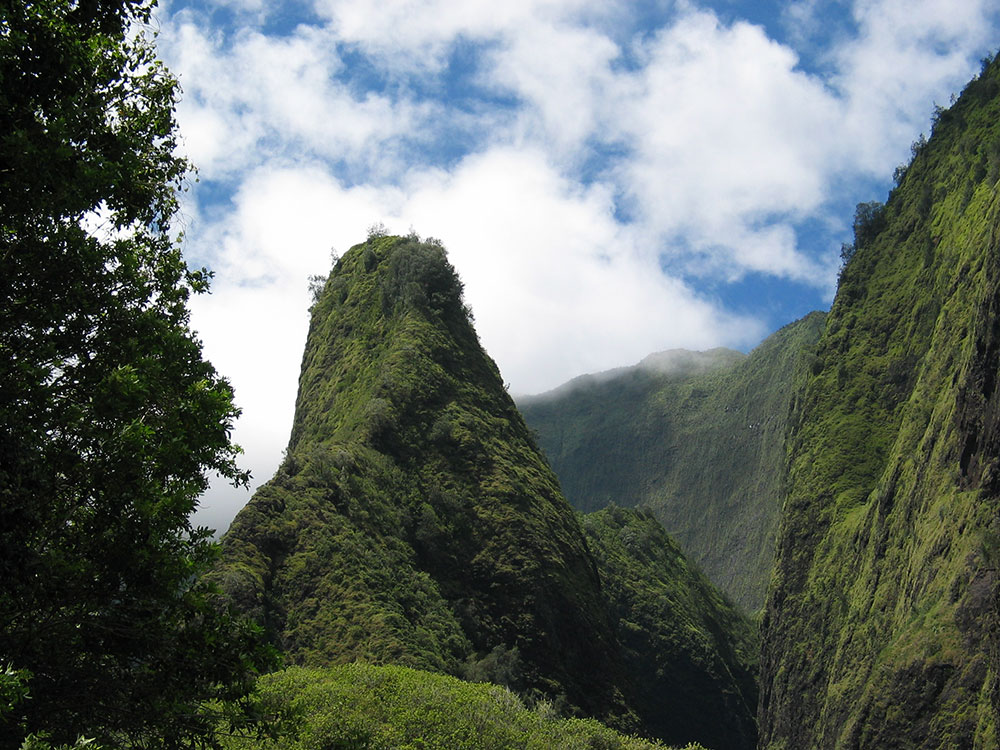
Lush rainforest park known for its towering needle-shaped peak, botanical gardens, and historical significance as a sacred Hawaiian site.
General Information
Last entry at 4:30pm
Non-Residents: $5 per person (children 3 and under free)
Parking: $10 per non-resident vehicle
Reservations required for non-residents
How to Get There
From Kahului, HI (5 mi): Drive west on Kaʻahumanu Avenue, continue onto Main Street into Wailuku, then follow ʻĪao Valley Road to the park entrance at the end of the road.
Overview
ʻĪao Valley (“cloud supreme”) is a lush, stream-cut valley in the West Maui Mountains, 3.1 miles west of Wailuku, designated a National Natural Landmark in 1972. Dense rainforest covers the valley, and the summit at its head, Puʻu Kukui, is the state’s second-wettest location, averaging 386 inches of rain a year.
ʻĪao Valley State Monument
The 6.2-acre state park sits at the end of ʻĪao Valley Road (Highway 32). Its landmark is the ʻĪao Needle (Kūkaemoku), a vegetation-covered lava remnant rising 1,200 feet from the valley floor. A short trail (Iao Needle Lookout Trail and Ethnobotanical Loop) leads to a windy overlook, and other trails follow ʻĪao Stream through the forest.
Kepaniwai Park and Heritage Gardens
Established in 1952, the gardens honor Maui’s multicultural history with tributes and structures from Hawaiian, American missionary, Chinese, Japanese, Portuguese, Korean and Filipino cultures. A nearby nature center has a small museum and children’s educational exhibits.
History
- In the late 15th century, Maui’s ruler Kakaʻe designated the valley an aliʻi burial ground.
- In 1790, the Battle of Kepaniwai took place here, when Kamehameha the Great defeated the Maui army under Kalanikūpule. The battle was said to be so bloody that bodies dammed ʻĪao Stream, giving the site its name, Kepaniwai (“the damming of the waters”).
- The ʻĪao Needle is associated with Kanaloa, god of the underworld, while the god Kāne, giver of life, is linked to fresh water, clouds and streams.
This article uses material from the Wikipedia article "Iao Valley", which is released under the Creative Commons Attribution-Share-Alike License 3.0