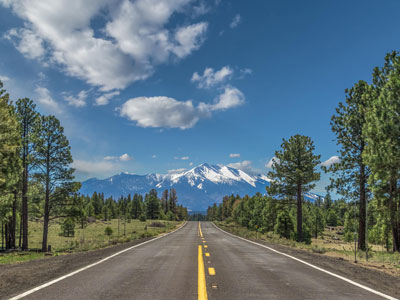

Arizona city with strong tourism sector, due to its proximity to Grand Canyon National Park, Oak Creek Canyon, the Arizona Snowbowl, Meteor Crater, and Historic Route 66
Overview
Flagstaff is a city in northern Arizona, lies near the southwestern edge of the Colorado Plateau and within the San Francisco volcanic field, along the western side of the largest contiguous ponderosa pine forest in the continental United States. The city sits at around 7,000 feet and is next to Mount Elden, just south of the San Francisco Peaks, the highest mountain range in the state of Arizona. Humphreys Peak, the highest point in Arizona at 12,633 feet, is about 10 miles north of Flagstaff in Kachina Peaks Wilderness. The geology of the Flagstaff area includes exposed rock from the Mesozoic and Paleozoic eras, with Moenkopi Formation red sandstone having once been quarried in the city; many of the historic downtown buildings were constructed with it. The Rio de Flag river runs through the city.
Originally settled by the pre-Columbian native Sinagua people, the area of Flagstaff has fertile land from volcanic ash after eruptions in the 11th century. It was first settled as the present-day city in 1876. Local businessmen lobbied for Route 66 to pass through the city, which it did, turning the local industry from lumber to tourism and developing downtown Flagstaff. In 1930, Pluto was discovered from Flagstaff. The city developed further through to the end of the 1960s, with various observatories also used to choose Moon landing sites for the Apollo missions. Through the 1970s and 1980s, downtown fell into disrepair, but was revitalized with a major cultural heritage project in the 1990s.
Flagstaff has a strong tourism sector, due to its proximity to Grand Canyon National Park, Oak Creek Canyon, the Arizona Snowbowl, Meteor Crater, and Historic Route 66.
The Sinagua people were a pre-Columbian culture that occupied a large area in Arizona between circa 500 and 1425 CE. The Northern Sinagua were living in the pine forests of northern Arizona before moving into the area that is now Flagstaff about 700 CE. The 1064 and 1066 eruptions of Sunset Crater covered the area in ash, which greatly enriched the soil for farming; this also caused a population growth in the area, with Ancestral Puebloans and Cohonina people also moving to the Wupatki site near the city.
The Sinagua peoples left the area by the early 15th century, likely moving north and later becoming the Hopi. The San Francisco Peaks, which overlook Flagstaff, are a sacred site in Hopi culture.
Until western expansion in the 1860s, the Yavapai occupied the land up to the San Francisco Peaks. The Yavapai land in the area saw overlap with the land of the Northern Tonto Apache that stretched across the San Francisco Peaks to the Little Colorado River.
The area of Flagstaff had a wagon road to California in the 1800s, constructed by Edward Fitzgerald Beale's men. The first white (non-Native) settlement in the area was established by Edward Whipple, who opened a saloon on the wagon road in 1871. The first permanent settlement came in 1876, when Thomas F. McMillan built a cabin just north of the present-day main town. McMillan was a key developer of northern Arizona.
During the 1880s, Flagstaff began to grow, and by 1886, Flagstaff was the largest city on the railroad line between Albuquerque and the west coast of the United States. In 1888, McMillan purchased an unfinished building that sits at the present-day intersection of Leroux Street and Route 66/Santa Fe Avenue, turning it into a bank and hotel known as the Bank Hotel. Coconino County was created in 1891, and Flagstaff was chosen as its county seat over nearby Williams.
In 1894, A. E. Douglass recommended Flagstaff to Percival Lowell as the site for the Lowell Observatory, where it was built on Mars Hill. Flagstaff also became incorporated as a town in 1894. The city grew rapidly, primarily due to its location along the east–west transcontinental railroad line in the United States.
On January 1, 1900, John Weatherford opened the Weatherford Hotel in Flagstaff. Weatherford opened the town's first movie theater in 1911; it collapsed under heavy snowfall a few years later, but he soon replaced it with the Orpheum Theater. The Weatherford Hotel and Orpheum Theater are still in use today.
The state of Arizona was admitted to the Union in 1912. Flagstaff saw its first tourism boom in the early years of the 1900s, becoming known as the City of Seven Wonders, as the "Seven Wonders" of the wider Flagstaff area – listed as the Coconino National Forest, Grand Canyon, Oak Creek Canyon, San Francisco Peaks, Sunset Crater, Walnut Canyon, and Wupatki National Monument – were more widely known.
In 1926, Route 66 was completed and ran through Flagstaff. Flagstaff became a popular tourist stop along Route 66, particularly due to its proximity to the natural wonders. In the last years of the 1920s, tourism took over from traditional industries.
During the Great Depression, Route 66 brought unemployed workers heading to California, known as "auto nomads" in Flagstaff. Flagstaff had also been highlighted on the map by Clyde Tombaugh's 1930 discovery of Pluto from the Lowell Observatory.
During the Apollo program in the 1960s, the Lowell Observatory Clark Telescope was used by the United States Geological Survey (USGS) to map the Moon for the lunar expeditions, enabling the mission planners to choose a safe landing site for the lunar modules.
As the baby boomer generation began to start their own families in the 1970s and 1980s, many moved to Flagstaff based on its small-town feel, and the population began to grow again; there were not enough jobs to support the many educated individuals moving to the city. The city did not expand its infrastructure downtown despite the growing population, causing problems. Several historic buildings from the 1800s were also destroyed for construction of new ones, or leveled completely. Downtown Flagstaff became an uninviting place, and many businesses started to move out of the area, causing an economic and social decline.
During the 1990s, the city redeveloped. Store owners in downtown supported the Main Street programs of preservation-based revitalization, and in 1992, the city hired a new manager to improve the area: a different mix of shops and restaurants opened up to take advantage of the area's historical appeal. Heritage Square was built as the center of the revitalized downtown.
Flagstaff is about 130 miles north of the State capital, Phoenix. The cityscape of Flagstaff is its historic downtown area centered on Heritage Square, with the historic nature of its restored buildings and local theme iconic to the city and representative of its culture. Flagstaff is one of the United States' sunniest and snowiest cities, with a variable "semi-arid" climate and a monsoon season in summer.
The San Francisco Peaks are a main aspect of Flagstaff's local geography and can be seen from everywhere in the city. Humphreys Peak is the highest point in Arizona at 12,637 feet; from trails up this mountain, the entire State can be seen on a clear day. Several trails around the peaks provide views of the Grand Canyon. While the most popular access point is Arizona Snowbowl (southwest face), the peaks can also be approached from the north and east. The peaks are about 10 miles northwest of downtown Flagstaff, with the Snowbowl resort just southwest of Humphreys Peak. The wildlife of the peaks include mule deer, elk, turkey vultures, and black bears, all visible from public trails.
Moenkopi Formation red sandstone is a distinctive feature of Flagstaff, as it was used as a building material from the 1880s because of its fire retardant properties. The source used for quarrying most of this rock was a deposit 1 mile east of the town, which fell under the control of Charles Begg in 1887, who then began selling the stone across the southwest – after he made a successful sale in California that expanded the business, he was replaced in 1888 by a master quarryman. While it was used as building material across the West, some of Flagstaff's most prominent buildings are famous for the stone, including the Bank Hotel, Weatherford Hotel, Babbitt Brothers Building, Coconino County Courthouse, and various NAU buildings, including Old Main.
Flagstaff is home to seven National Register of Historic Places historic districts: Southside, Townsite, Fort Tuthill, North End, Northern Arizona Normal School, the Railroad Addition, and USFS Fort Valley Experimental Forest Station, as well as a variety of many other structures and areas. The Lowell Observatory is a National Historic Landmark.
Tourism is a large contributor to the economy, as the city receives over 5 million visitors per year.
Flagstaff has a thriving tourism industry, and has since the early 1900s, primarily stemming from its proximity to the Grand Canyon National Park and other natural wonders, giving it the nickname 'City of Seven Wonders'. Other natural wonders and native ruins, Route 66, and its astronomical history also bring tourism from out of state, while people from further south in Arizona visit Flagstaff because of its cooler climate in the summer and its ski resort in the winter. The city has several hotels and restaurants, including its historic hotels. The first hotel of the Ramada Inn chain opened in 1954 at the intersection of Routes 66, 89, and 89A, adjacent to what was then Arizona State College (now NAU). The original building is still intact, operating as a Super 8 motel. Flagstaff is said to attract a lot of the tourism for the entire county as it is the only large population center that can cater to tourists, as well as being the location of information points for the National Park Service (NPS).
The Grand Canyon, a Wonder of the World, is about 80 miles northwest of Flagstaff. The first stagecoach tours to the Grand Canyon from the city began running from the Bank Hotel in 1892. Lowell Observatory celebrated its 125th anniversary in 2019 and continues to be a leading astronomical research center, as well as a popular destination for visitors. More than 100,000 people visited in both 2018 and 2019; in 2019 the observatory opened its new Giovale Open Deck Observatory, an observation plaza with a suite of six advanced telescopes.
Local museums include the Museum of Northern Arizona, which features displays of the biology, archeology, photography, anthropology, and native art of the Colorado Plateau, and the Arboretum at Flagstaff, a 200-acre (81 ha) arboretum containing 2,500 species of drought-tolerant native plants representative of the high desert region.
A lot of the local culture is also focused on Route 66, which originally ran between Chicago and Los Angeles, greatly increased the accessibility to the area, and enhanced the culture and tourism in Flagstaff. Route 66 remains a historic route, passing through the city between Barstow, California, and Albuquerque, New Mexico. In early September, the city hosts an annual event, Route 66 Days, to highlight its connection to the famous highway.
Flagstaff has acquired a reputation as a magnet for outdoor enthusiasts, and the region's varied terrain, high elevation, and amenable weather attract campers, backpackers, climbers, recreation and elite runners, and mountain bikers from throughout the southwestern United States. There are 679.2 acres of city parks in Flagstaff, the largest of which are Thorpe Park and Buffalo Park. Wheeler Park, next to city hall, is the location of summer concerts and other events. The city maintains an extensive network of trails, the Flagstaff Urban Trails System, or "FUTS" includes more than 50 miles of paved and unpaved trails for hiking, running, and cycling. The trail network extends throughout the city and is widely used for both recreation and transportation. There are over 56 miles of urban trails in Flagstaff.
Flagstaff's proximity to Grand Canyon National Park, about 75 miles north of the city, has made it a popular tourist destination since the mid-19th century. Other nearby outdoor attractions include Walnut Canyon National Monument, Sunset Crater Volcano National Monument, Wupatki National Monument, and Barringer Crater. Glen Canyon National Recreation Area and Lake Powell are both about 135 mi north along U.S. Route 89.
This article uses material from the Wikipedia article "Flagstaff, Arizona", which is released under the Creative Commons Attribution-Share-Alike License 3.0.
Featured Locations

Humphreys Peak
Highest natural point in the state of Arizona, with an elevation of 12,637 feet (3,852 m)
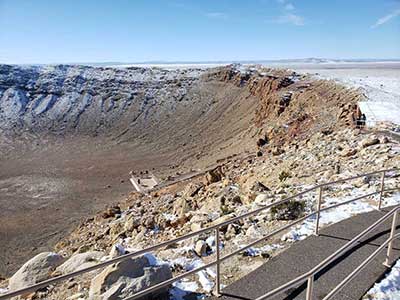
Meteor Crater Natural Landmark
Meteorite impact crater 3,900 ft in diameter, some 560 ft deep, and is surrounded by a rim that rises 148 ft above the surrounding plains
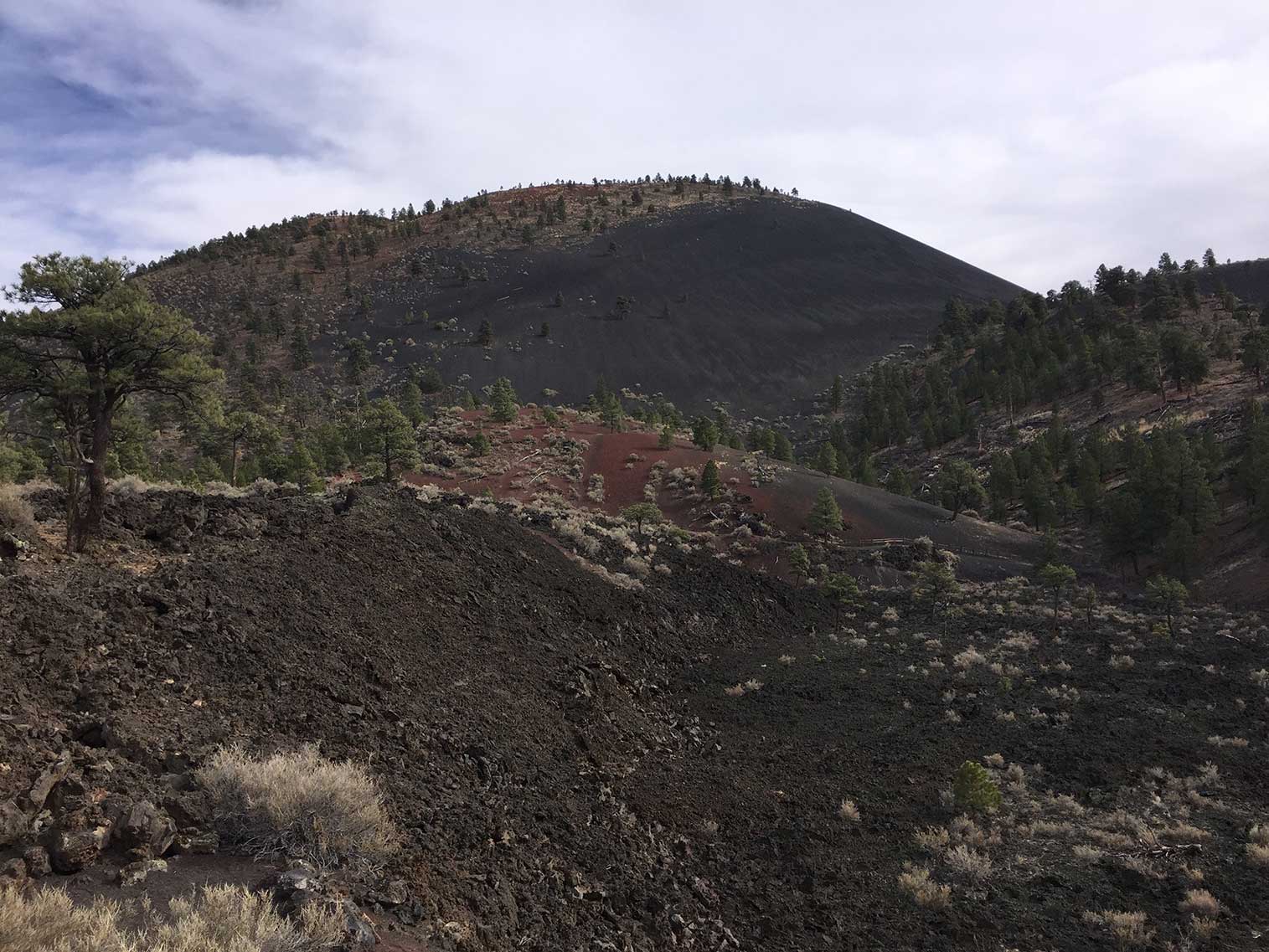
Sunset Crater National Monument
Cinder cone located north of Flagstaff in Arizona
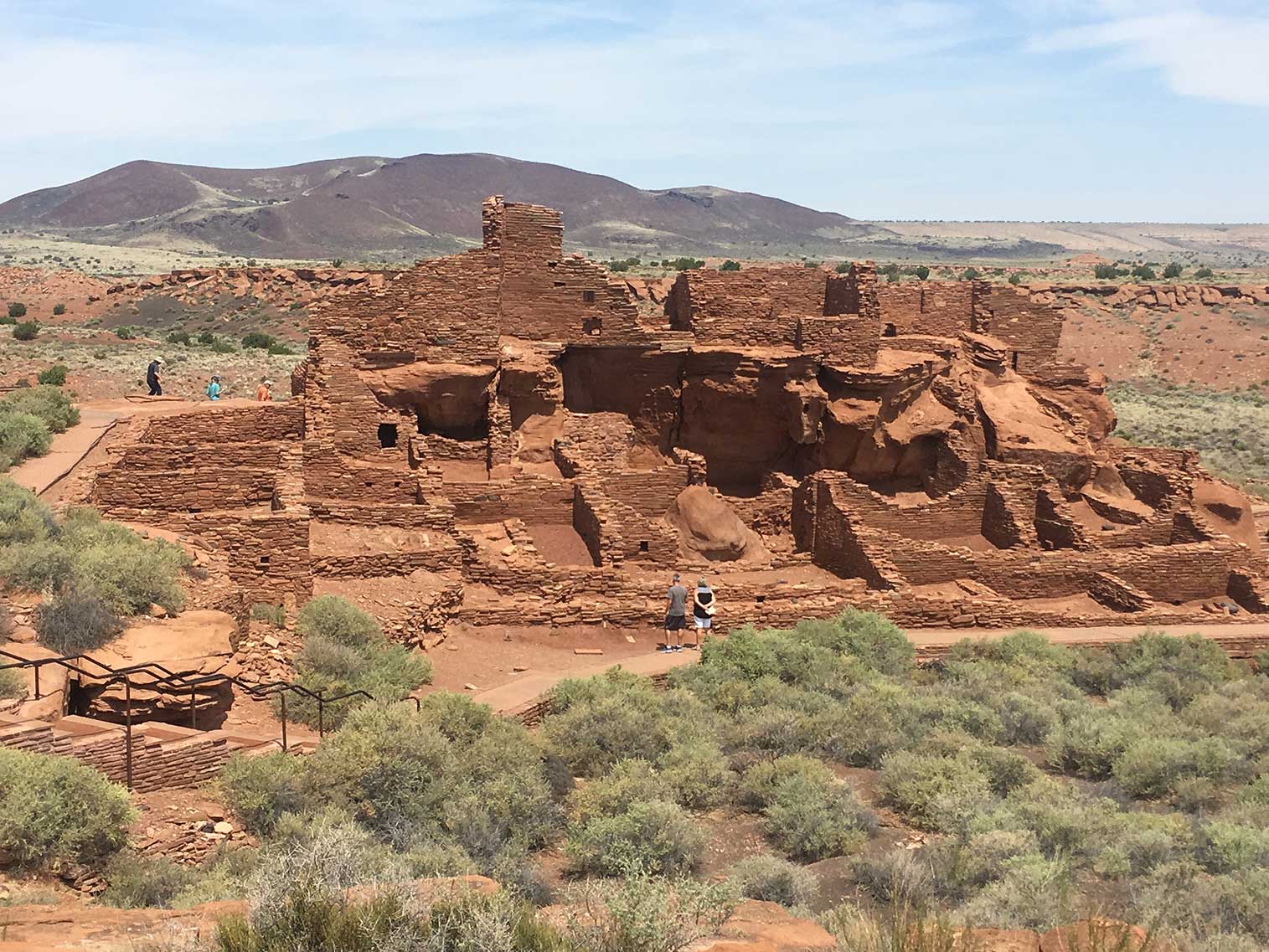
Wupatki National Monument
Monument rich in Native American archaeological sites, includes three contributing buildings and 29 contributing structures on 35,422 acres