Grand Beaux-Arts complex of city and federal offices and seat of municipal government of the city of Dallas
General Information
Dallas City Hall is the seat of municipal government of the city of Dallas, Texas. The current building, the city's fifth city hall, was completed in 1978 and replaced the Dallas Municipal Building.
The City of Dallas' idea for a centralized municipal center began in 1944. The idea was to relocate from the current Dallas Municipal Building to a grand Beaux-Arts complex of city and federal offices, a convention center and cultural facilities.
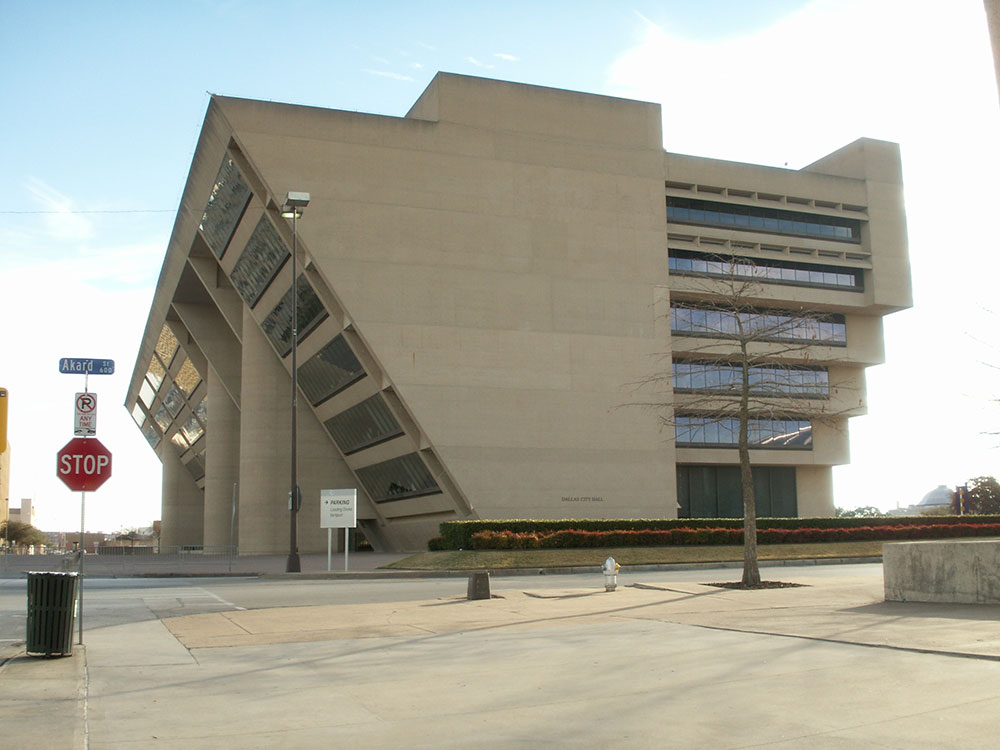
I.M. Pei's modernist inverted pyramid design is a result of space requirements from city government. Public areas and citizen services required much less space than offices that ran the government and overhanging the upper floors allowed them to be larger than the public spaces below. The building slopes at a 34° angle, with each of the 7 above-grade floors being 9½ feet wider than the one below. This inclined façade interacts with the buildings it faces downtown and provides protection from the weather and Texas sun.
Pei also persuaded the city to acquire an additional 6 acres in front of the building as a plaza and buffer zone for his grand public structure.
A buff-colored concrete was chosen for the main building material; its color resembled local earth tones.
City Hall contained 1,400 workstations when it opened in 1978. It had few floor-to-ceiling walls, using instead five-, six-, and seven-foot-high partitions to create separate offices. The absence of walls allowed employees and visitors to have window views from all areas.
The second floor of Dallas City Hall is referred to as the Great Court because of its 250-foot (76 m) length and the uninterrupted height to the vaulted ceiling approximately 100 feet (30 m) above.
The Park Plaza is two blocks long and one block wide and is bounded by Young, Ervay, Marilla and Akard streets. The Plaza includes a 180-foot (55 m)-diameter reflecting pool, a variable-height fountain, park benches and three distinctive 84-foot (26 m)-high flagpoles. The Plaza is landscaped with trees native to Texas: live oaks and red oaks. The reflective pool contains large floating sculptures designed by artist Marta Pan.
A 16-foot (4.9 m)-high by 24-foot (7.3 m)-wide, three-piece sculpture titled "The Dallas Piece" was designed by Henry Moore for the plaza and resembles vertebrae.
A state-of-the-art Conference Center that includes a 156-seat auditorium and three conference rooms was recently added to Dallas City Hall.
This article uses material from the Wikipedia article "Dallas City Hall", which is released under the Creative Commons Attribution-Share-Alike License 3.0