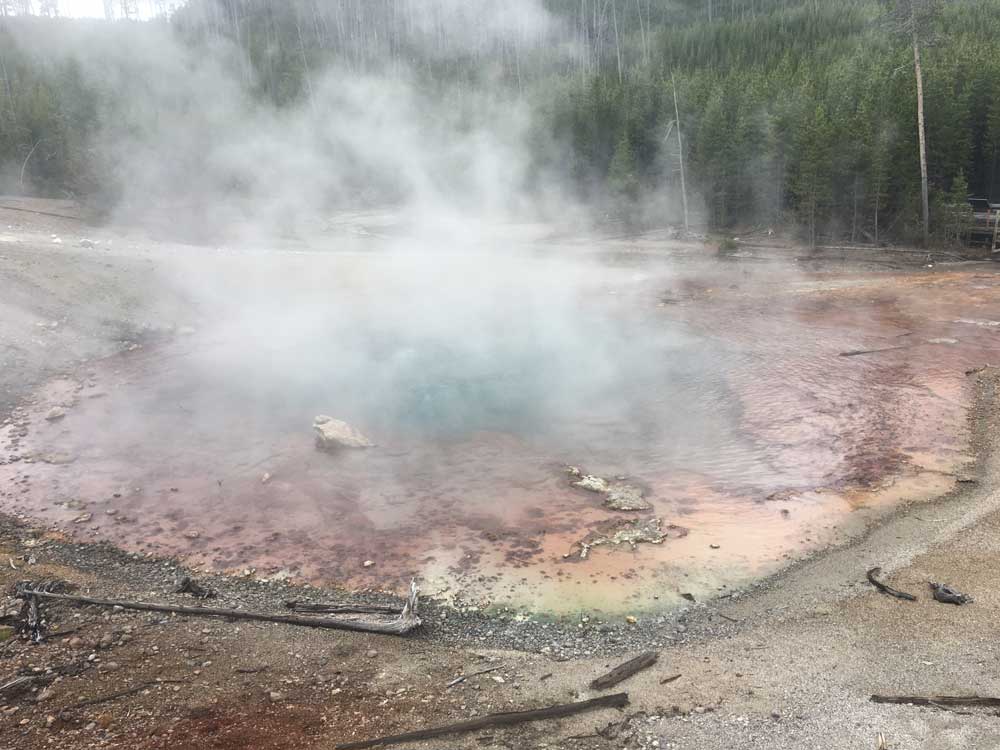
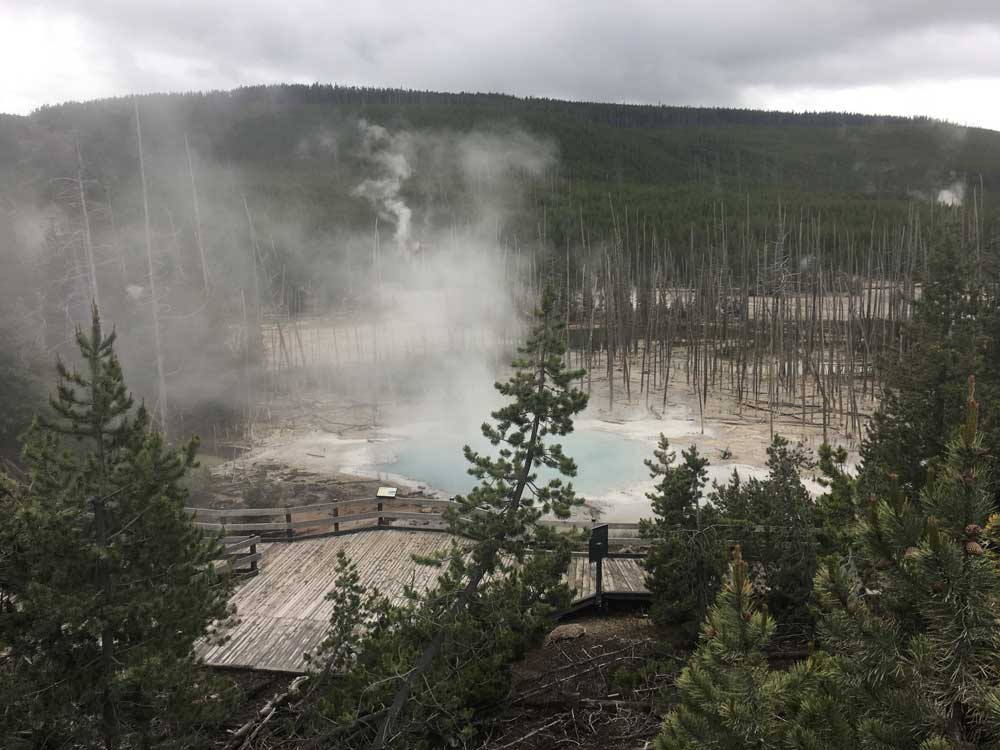
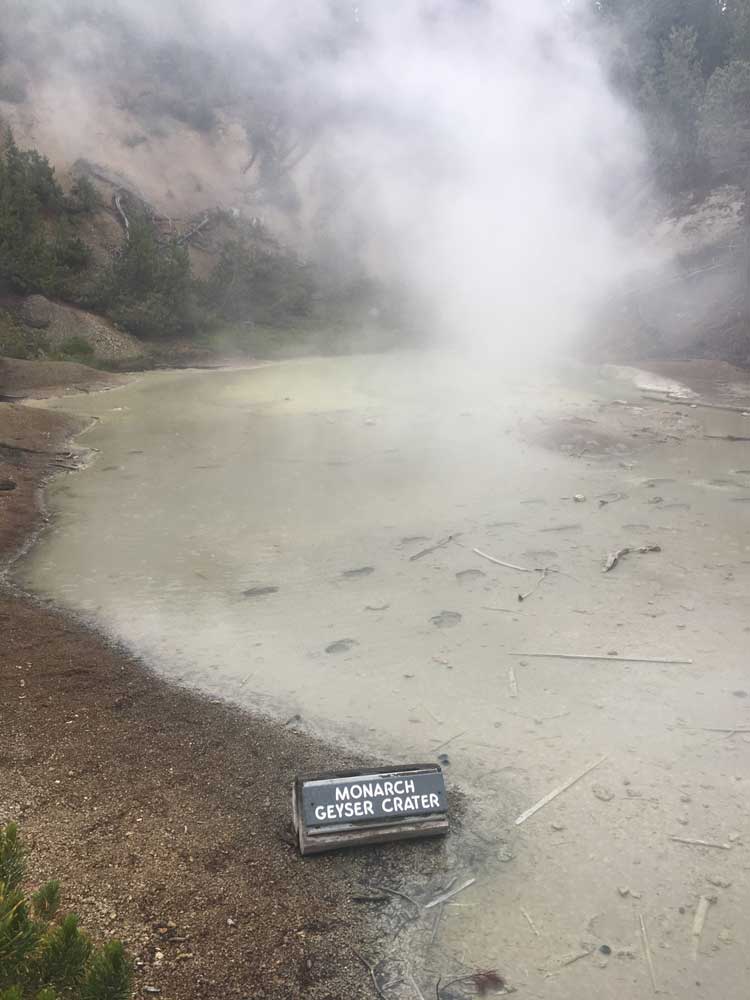
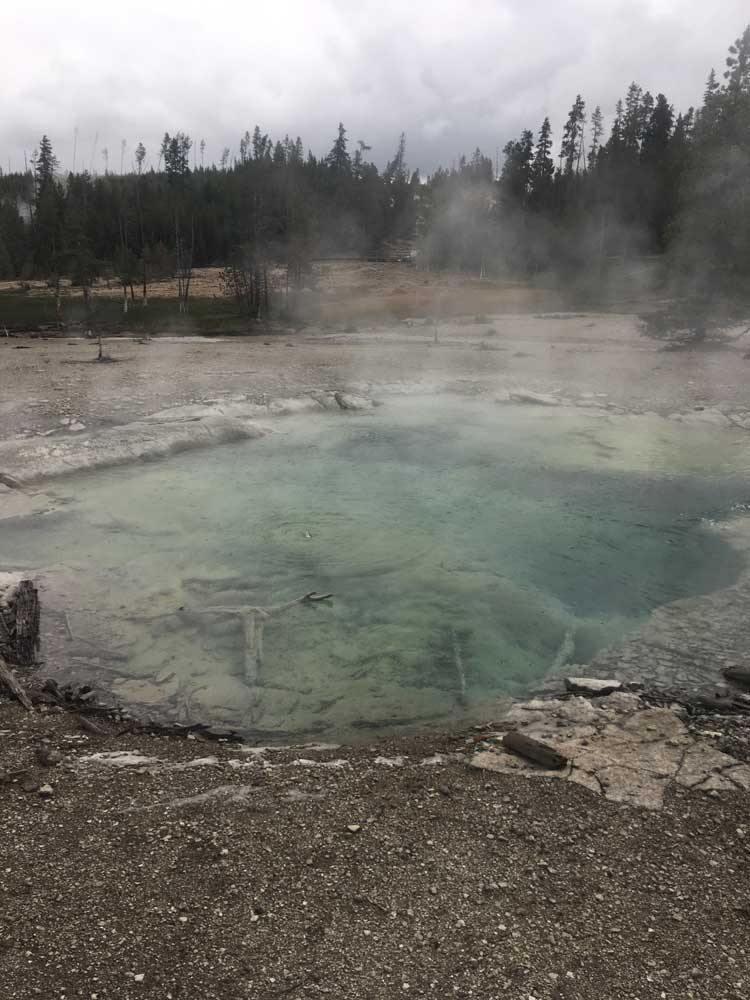
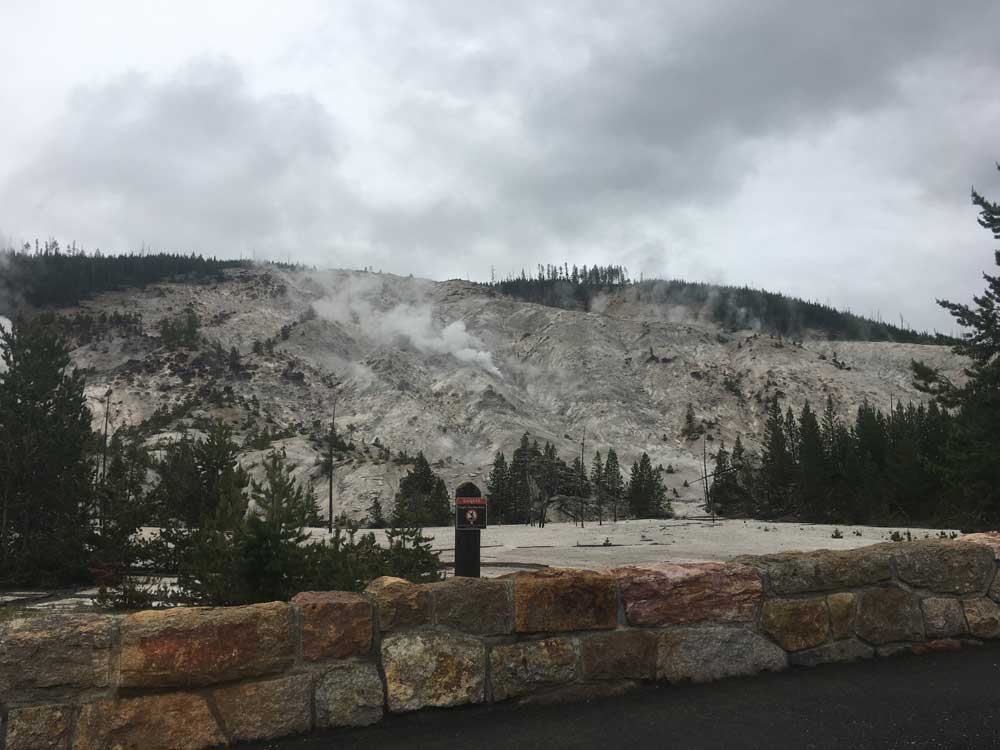
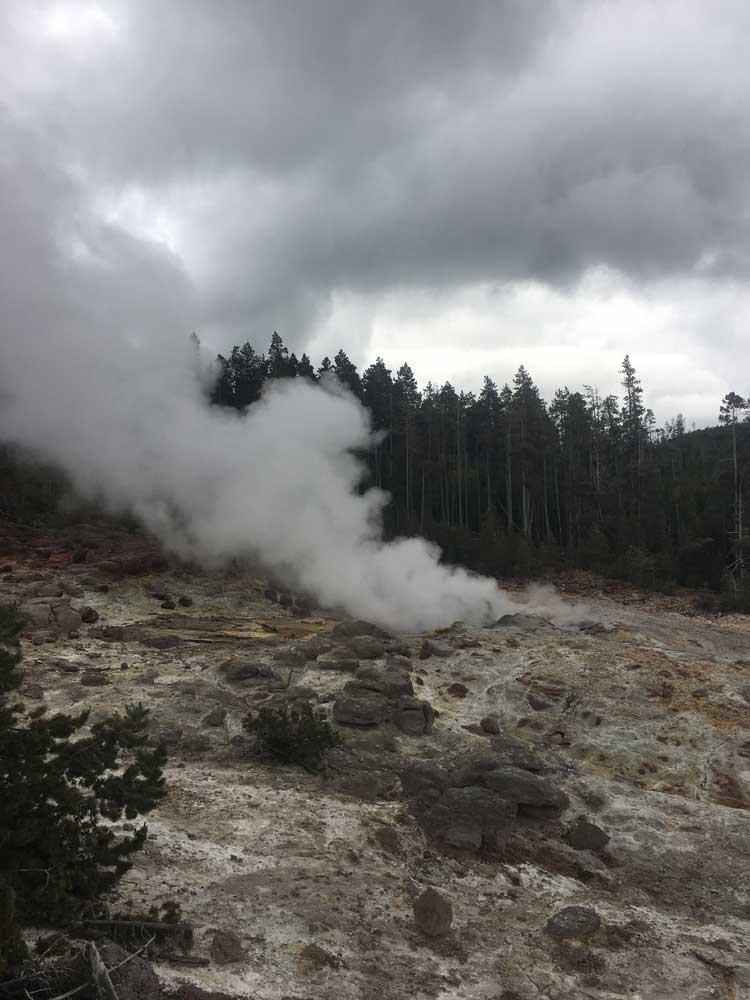
Hottest geyser basin in the park and is located near the northwest edge of Yellowstone Caldera near Norris Junction and on the intersection of three major faults.
General Information
The Norris Geyser Basin is the hottest geyser basin in the park and is located near the northwest edge of Yellowstone Caldera near Norris Junction and on the intersection of three major faults. The Norris-Mammoth Corridor is a fault that runs from Norris north through Mammoth to the Gardiner, Montana, area. The Hebgen Lake fault runs from northwest of West Yellowstone, Montana, to Norris. This fault experienced an earthquake in 1959 that measured 7.4 on the Richter scale (sources vary on exact magnitude between 7.1 and 7.8; see 1959 Hebgen Lake earthquake). Norris Geyser Basin is so hot and dynamic because these two faults intersect with the ring fracture zone that resulted from the creation of the Yellowstone Caldera of 640,000 years ago.
The tallest active geyser in the world, Steamboat Geyser, is located in Norris Basin. Unlike the slightly smaller but much more famous Old Faithful Geyser located in Upper Geyser Basin, Steamboat has an erratic and lengthy timetable between major eruptions. During major eruptions, which may be separated by intervals of more than a year (the longest recorded span between major eruptions was 50 years), Steamboat erupts over 300 feet (90 m) into the air. Steamboat does not lie dormant between eruptions, instead displaying minor eruptions of approximately 40 feet (12 m).
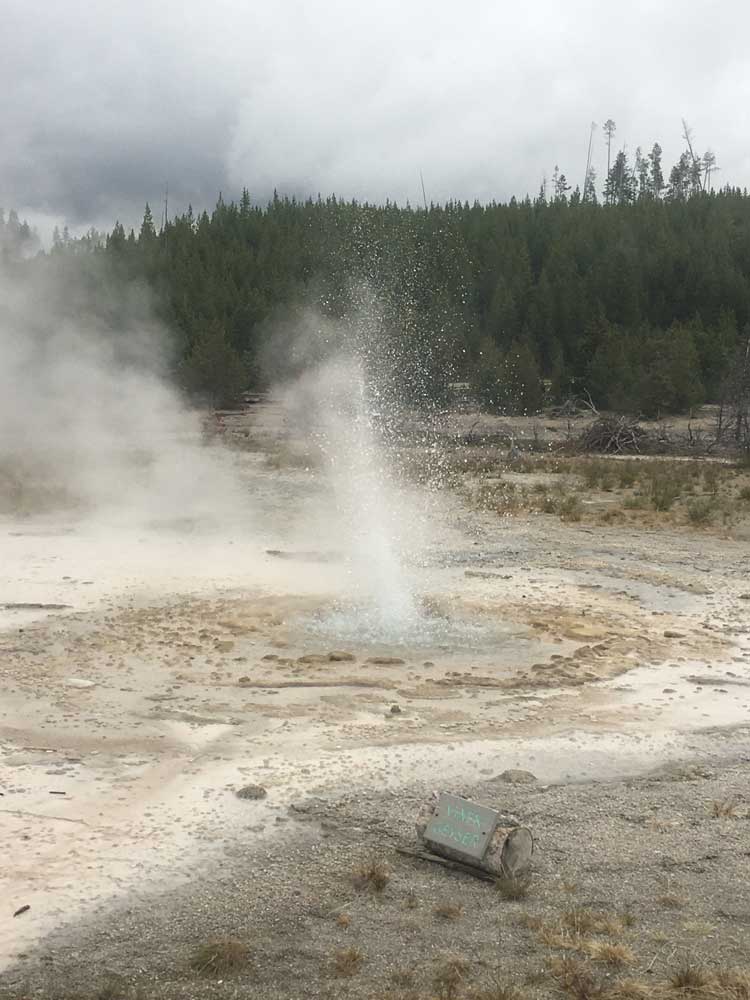
Echinus Geyser is a geyser in the Norris Geyser Basin of Yellowstone National Park.
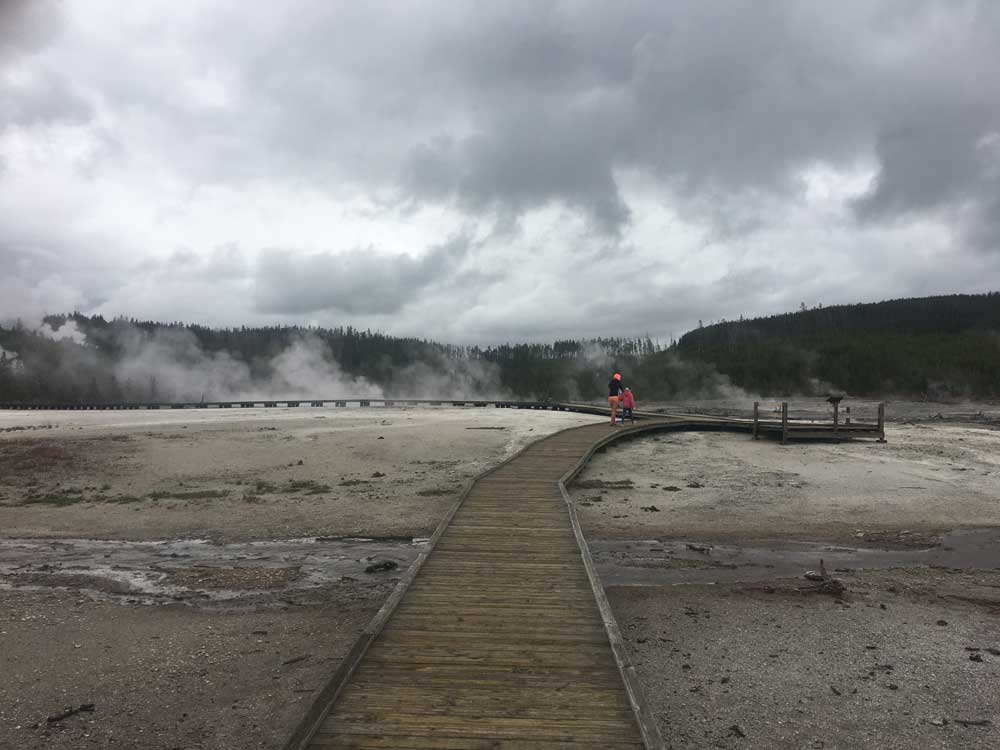
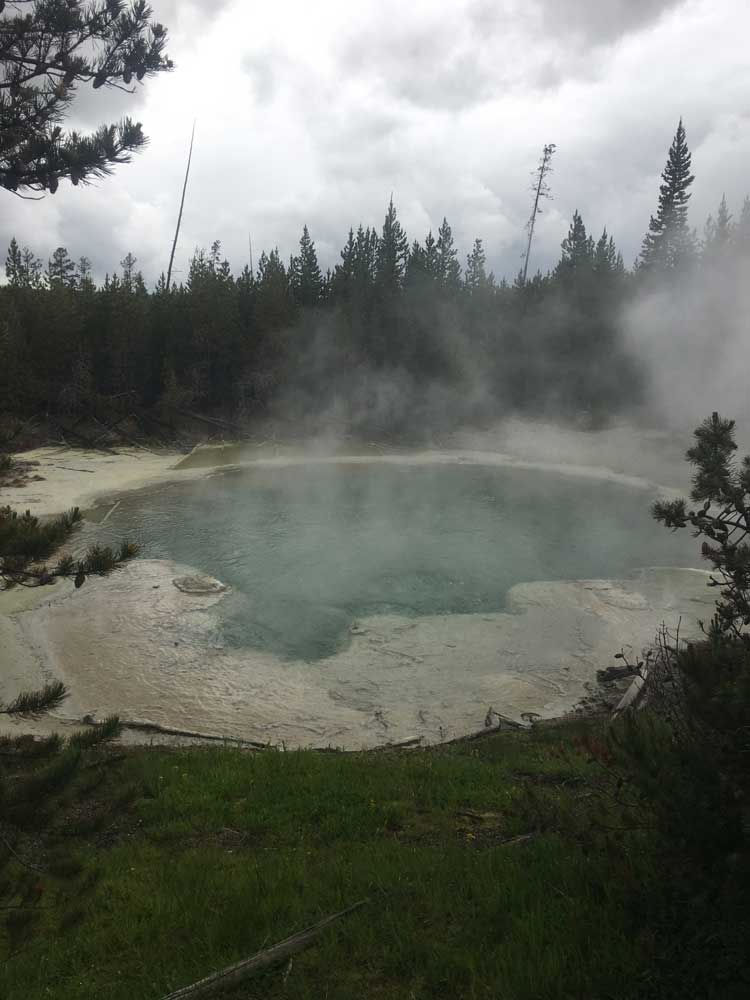
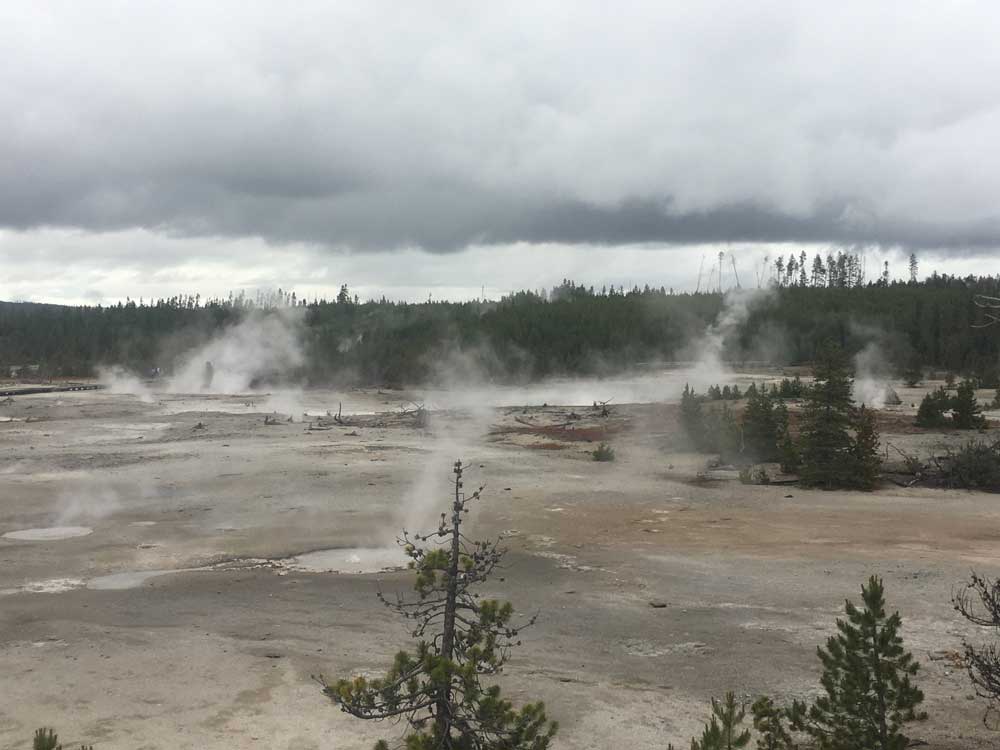
Norris Geyser Basin is the hottest and most changeable region in all of Yellowstone National Park, and presents the most alien and intimidating of spectacles. For half a mile the landscape is without any vegetation, just a seething expanse of pools, steam, geysers and white calcium deposits, in places stained bright colors by algae. The air is often filled with strong smells of sulphur and hydrogen sulphide. But much of the basin is viewable in comfort by a network of boardwalks and paths.
Echinus was named during one of the U.S. Geological Surveys of the park in the late 1870s or early 1880s. The name Echinus comes from the spiny appearance of the cone that resembles a Sea urchin or class Echinoidea.
Echinus' eruptions are unpredictable. Its fountain reaches a height of as much as 40 to 60 feet (12 to 18 m), with a duration of about 4 minutes. Prior to 1998, this geyser was very regular, every 35 to 75 minutes. There were also major eruptions that lasted as much as 118 minutes. It is speculated that there was a secondary underground water source that used to power the major eruptions and that the connection to the source was severed leading to Echinus' current state.
In October 2017, Echinus Geyser began to show signs of growing activity, with possible eruptions every 2-3 hours. In January 2018, Echinus' last eruption was recorded of this active phase. One recorded eruption occurred in January 2019.
Echinus is the largest acid-water geyser in the world. Its waters have a pH of 3.3 to 3.6, nearly as acidic as vinegar. The water temperature is 80.3 °C (176.5 °F).
This article uses material from the Wikipedia articles "Geothermal areas of Yellowstone", "Echinus Geyser", which are released under the Creative Commons Attribution-Share-Alike License 3.0
Featured Regions
,_Gibbon_Falls_--_2022_--_2649-400.jpg)
Gibbon Falls
Historic waterfall where the Gibbon River plunges over a volcanic cliff, creating one of the park's most accessible and photographed cascades.
Roaring Mountain
Steaming mountainside thermal area containing hundreds of fumaroles that continuously vent hot gases and steam from Yellowstone's volcanic system.
Steamboat Geyser
World's tallest active geyser, capable of erupting to heights over 300 feet during infrequent major eruptions that can last several hours.