
Nonprofit public aquarium known for its regional focus on the marine habitats of Monterey Bay, receives two million visitors each year
General Information
Saturday: 10am to 7pm
Sunday: 10am to 6pm
Youth (5–17): $50
Seniors (70+): $50
Children under 5: Free
Monterey County residents: Free (Sept 2–14)
SNAP EBT cardholders: Free for up to 4 people with ID
Pacific Grove (1.5 mi)
How to Get There
From Monterey, CA (1.6 mi): Head north on Pacific Street, turn left onto Foam Street, and continue to Cannery Row to reach the Monterey Bay Aquarium.
Overview
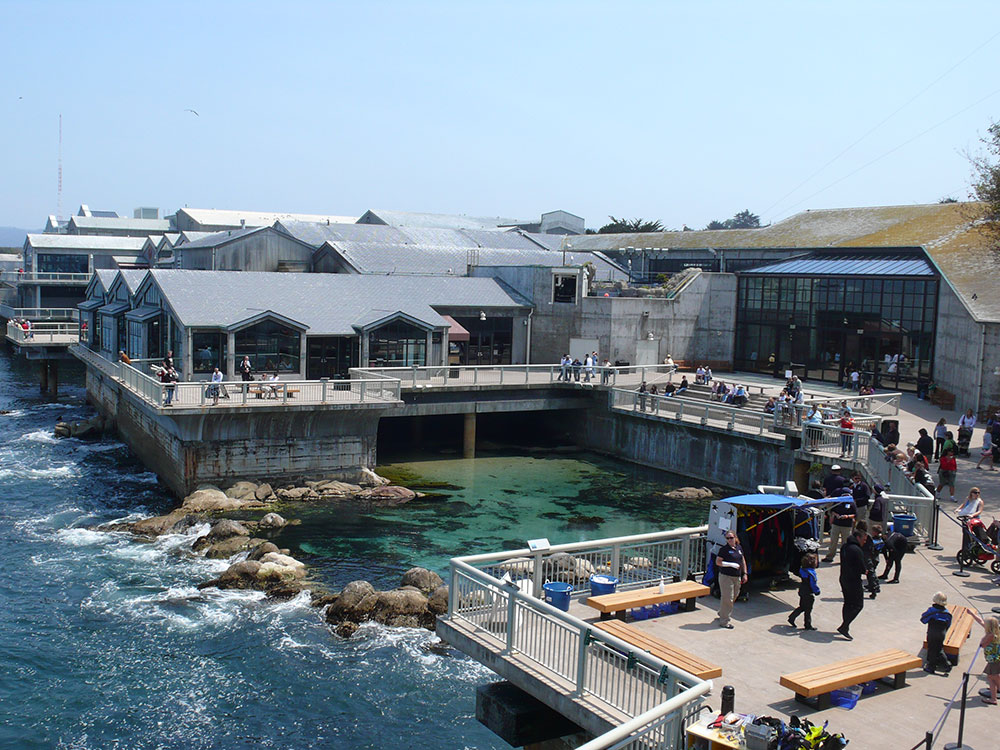
Monterey Bay Aquarium is a nonprofit public aquarium in Monterey, California. Known for its regional focus on the marine habitats of Monterey Bay, it was the first to exhibit a living kelp forest when it opened in October 1984. Its biologists have pioneered the animal husbandry of jellyfish and it was the first to successfully care for and display a great white shark. The organization's research and conservation efforts also focus on sea otters, various birds, and tunas. Seafood Watch, a sustainable seafood advisory list published by the aquarium beginning in 1999, has influenced the discussion surrounding sustainable seafood.
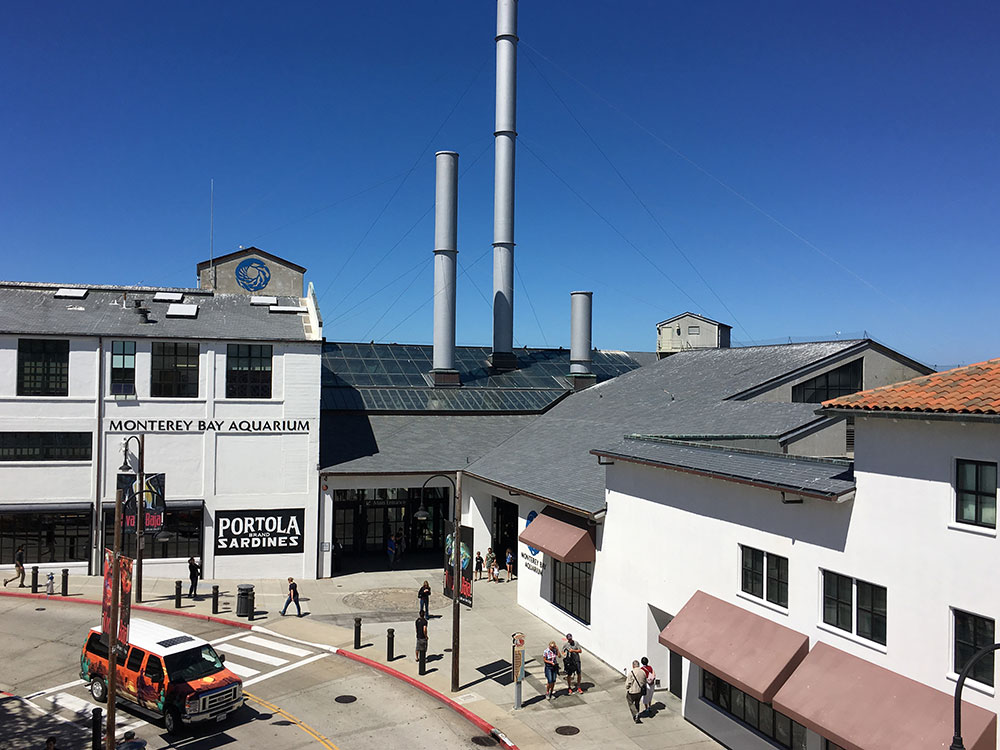
Early proposals to build a public aquarium in Monterey County were not successful until a group of four marine biologists affiliated with Stanford University revisited the concept in the late-1970s. Monterey Bay Aquarium was built at the site of a defunct sardine cannery and has been recognized for its architectural achievements by the American Institute of Architects. Along with its architecture, the aquarium has won numerous awards for its exhibition of marine life, ocean conservation efforts, and educational programs.
Monterey Bay Aquarium receives around two million visitors each year. It led to the revitalization of Cannery Row, and produces hundreds of millions of dollars for the economy of Monterey County. In addition to being featured in two PBS Nature documentaries, the aquarium has appeared in film and television productions.
Kelp Forest exhibit
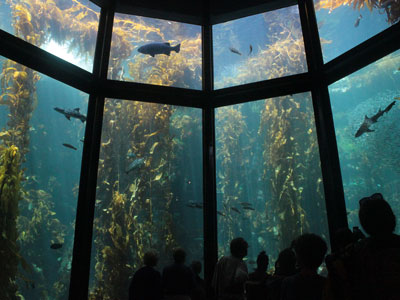
At 28 feet (8.5 m) tall and 65 feet (20 m) long, the Kelp Forest exhibit is the focal point of Monterey Bay Aquarium's Ocean's Edge wing. Nearly three stories high, the exhibit is regarded as the first successful attempt to maintain a living kelp forest in an artificial setting. During the facility's planning and construction, professionals doubted that kelp could be grown in an aquarium at this scale. And, even if it could be grown, critics of the project did not think the public would be interested in seeing this representation of Monterey Bay. During the design phase, kelp scientists Wheeler North at the California Institute of Technology and Mike Neushal at the University of California, Santa Barbara informed the aquarium of the kelp's needs. The exhibit's success at sustaining giant kelp and its realistic appearance are attributed to the availability of direct sunlight, the use of natural seawater from Monterey Bay, and a surge machine (a large plunger) that replicates California's pulsing water currents. The 5-foot (1.5 m) surge machine, which plunges every 6 seconds, allows the kelp in the exhibit to grow an average of 4 inches (10 cm) per day and was designed and constructed by David Packard. Kelp forests are important ecosystems along California's coast—compared to tropical rainforests in their biodiversity—and, alongside giant kelp, the exhibit contains species of fish indigenous to Monterey Bay, including rockfishes and leopard sharks.
Open Sea wing
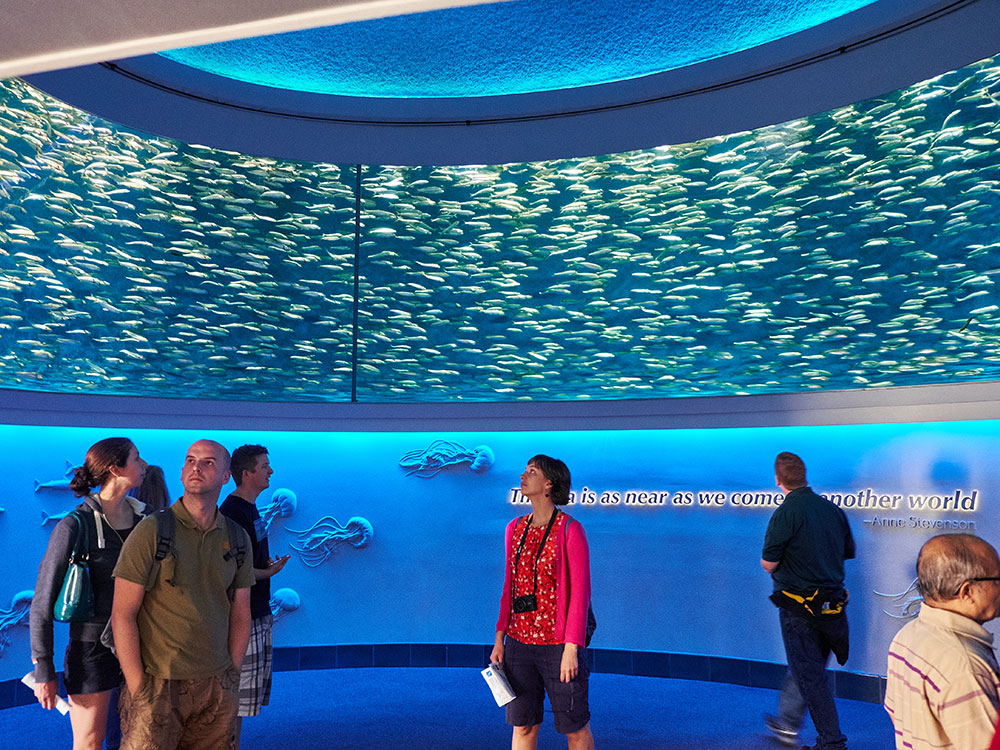
In 1996, Monterey Bay Aquarium opened a second wing of aquatic exhibits, focusing on the pelagic habitats found 60 miles (97 km) offshore in Monterey Bay. Costing US$57 million and taking seven years to develop, the wing almost doubled the aquarium's public exhibit space. It consists of three separate galleries: various jellyfish and other plankton found in the bay; a pelagic, large community exhibit; and "ocean travelers", which features tufted puffins and sea turtles When the exhibition opened, the San Francisco Chronicle reported the aquarium had the most jellyfish on exhibit in the world. In 1997, the Association of Zoos and Aquariums awarded the wing its Exhibit Award.
This article uses material from the Wikipedia article "Monterey Bay Aquarium", which is released under the Creative Commons Attribution-Share-Alike License 3.0