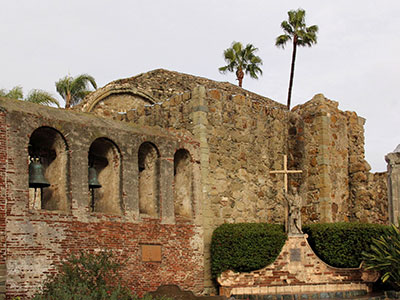
Californioa mission modeled after the Byzantine cathedrals scattered throughout Europe and Western Asia
San Juan Capistrano, California, 92675
November 1, 1776 (2nd)
it was the 4th mission.
Tuesday: CLOSED
Wednesday: 9am to 4pm
Thursday: 9am to 4pm
Friday: 9am to 4pm
Saturday: 9am to 4pm
Sunday: 9am to 4pm
Closed Thanksgiving, Christmas Eve and Christmas Day.
Closed at noon on Good Friday and Romance of the Mission.
Mission Store Hours:
Monday: CLOSED
Tuesday: 10am to 5pm
Wednesday: 10am to 5pm
Thursday: 10am to 5pm
Friday: 10am to 5pm
Saturday: 10am to 5pm
Sunday: 10am to 5pm
Closed the day before Thanksgiving, Thanksgiving, Christmas Eve and Christmas Day.
Closed at noon on Good Friday and Romance of the Mission.
Seniors (60+): $12
Youth/Student (5+, or with valid student ID): $9
Children (4 and younger): Free
Household of 4: $45
From Los Angeles (54 miles): Get on US-101 S from N Main St. Follow I-5 S to Ortega Hwy in San Juan Capistrano. Take exit 82 from I-5 S. Drive to Ortega Hwy.
Overview
MMission San Juan Capistrano is a Spanish mission in San Juan Capistrano, Orange County, California. Founded November 1, 1776 in colonial Las Californias by Spanish Catholic missionaries of the Franciscan Order, it was named for Saint John of Capistrano. The Spanish Colonial Baroque style church was located in the Alta California province of the Viceroyalty of New Spain. The Mission was secularized by the Mexican government in 1833, and returned to the Roman Catholic Church by the American government in 1865. The mission was damaged over the years by a number of natural disasters, but restoration and renovation efforts date from around 1910.
The mission was founded in 1776, by Spanish Catholics of the Franciscan Order. Named for Saint John of Capistrano, a 14th-century theologian and "warrior priest" who resided in the Abruzzo region of Italy, San Juan Capistrano has the distinction of being home to the oldest building in California still in use, a chapel built in 1782.
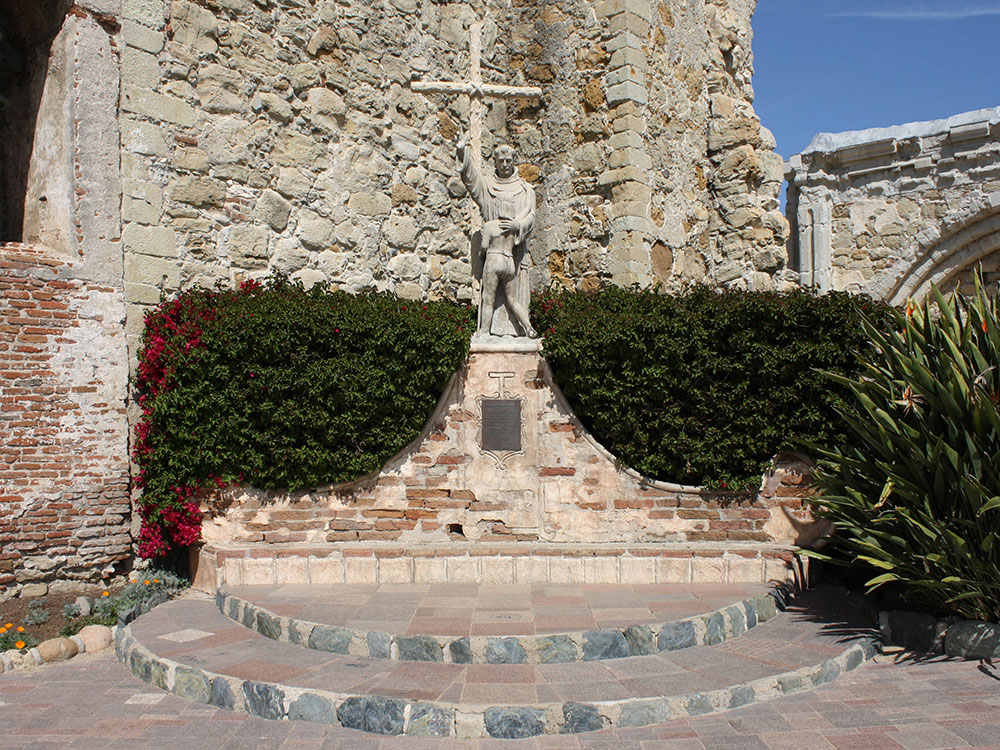
More than 69 former inhabitants, mostly Juaneño Indians, have marked graves in the Mission's cemetery (campo santo). The remains of (later Monsignor) St. John O'Sullivan, who recognized the property's historic value and working tirelessly to conserve and rebuild its structures, are buried at the entrance to the cemetery on west side of the property, and a statue raised in his honor stands at the head of the crypt. The surviving chapel also serves as the final resting place of three priests who passed on while serving at the Mission: José Barona, Vicente Fustér, and Vicente Pascual Oliva are all entombed beneath the sanctuary floor.
The Mission entered a long period of gradual decline after Mexican government secularization in 1833. After 1850 U.S. statehood, numerous efforts were made over the latter 19th century to restore the Mission to its former state, but none achieved much success until the arrival of O'Sullivan in 1910. Restoration efforts continue, and the chapel called "Father Serra Church" is still used for religious services.
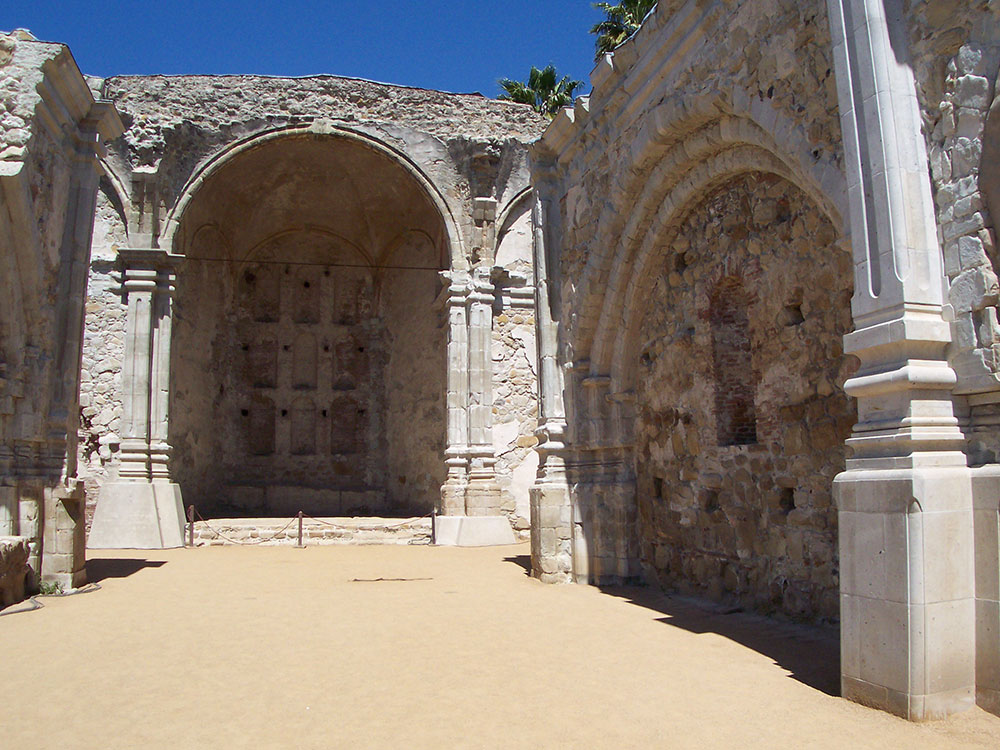
Over 500,000 visitors, including 80,000 school children, come to the Mission each year. And while the ruins of "The Great Stone Church" (which was all but leveled by an 1812 earthquake) are a renowned architectural wonder, the Mission is perhaps best known for the annual "Return of the Swallows" which is traditionally observed every March 19 (Saint Joseph's Day). Mission San Juan Capistrano has served as a favorite subject for many notable artists, and has been immortalized in literature and on film numerous times, perhaps more than any other mission.
In 1984, a modern church complex was constructed just north and west of the Mission compound and is now known as Mission Basilica San Juan Capistrano. Today, the mission compound serves as a museum, with the Serra Chapel within the compound serving as a chapel for the mission parish.
Dubbed by architects the "American Acropolis" in reference to its classical Greco-Roman style. "The most important and pretentious building of the whole Mission period ..." was modeled after the Byzantine cathedrals scattered throughout Europe and Western Asia. The Mission has earned a reputation as the "Loveliest of the Franciscan Ruins."
Visitors
On March 22, 1969, President Richard M. Nixon and First Lady Pat Nixon visited the Mission and rang the Bell of San Rafael. A bronze plaque commemorating the event is set in the bell wall. In celebration of the new Mission church being elevated to minor basilica status in 2000, exact duplicates of the damaged bells were cast by Royal Bellfoundry Petit & Fritsen b.v. of Aarle-Rixtel, the Netherlands utilizing molds made from the originals. The replacement bells were placed in the bell wall and the old ones put on display within the footprint of the destroyed Mission campanile ("bell tower").
California pepper tree
The largest California pepper tree (Schinus molle) in the United States resided at Mission San Juan Capistrano until 2005, when it was felled due to disease. The 57-foot (17 m) tall specimen, planted in the 1870s, was typical of the early California landscape; it was also listed in the National Register of Big Trees. The oldest pepper tree in California resides in the courtyard of Mission San Luis Rey de Francia.
This article uses material from the Wikipedia article "Mission San Juan Capistrano", which is released under the Creative Commons Attribution-Share-Alike License 3.0.
-1000.jpg)
.jpg)
 Wikimedia Commons; Image Size Adjusted


 <
<


