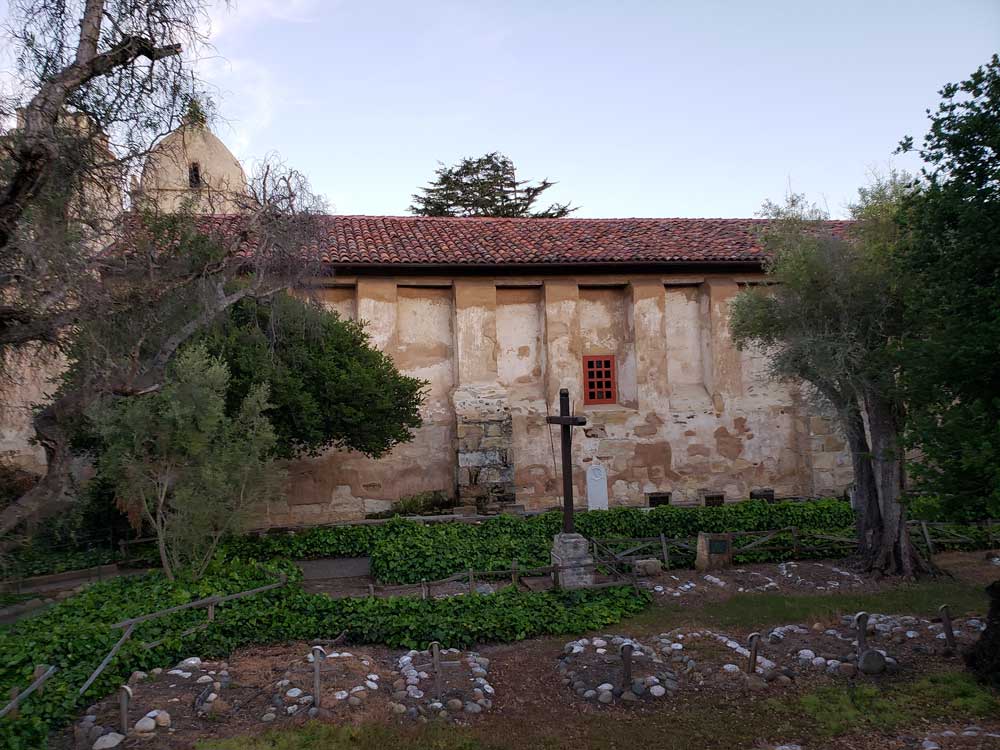
Carmel mission church is one of the most authentically restored of all the mission churches in California
Wednesday and Thursday: 10am to 4pm
Friday and Saturday: 10am to 5pm
Sunday: 12:30pm to 5pm
Mission Grounds close 15 minutes prior to store close
The Museum and Mission Store are closed on New Year’s Day, Good Friday, Easter, Thanksgiving, Christmas Eve, Christmas Day, Day after Christmas
From San Francisco (123 miles): Get on US-101 S/Central Fwy. Follow US-101 S and CA-1 S to Rio Rd in Monterey County. Follow Rio Rd to Lasuen Dr in Carmel-by-the-Sea.
Overview
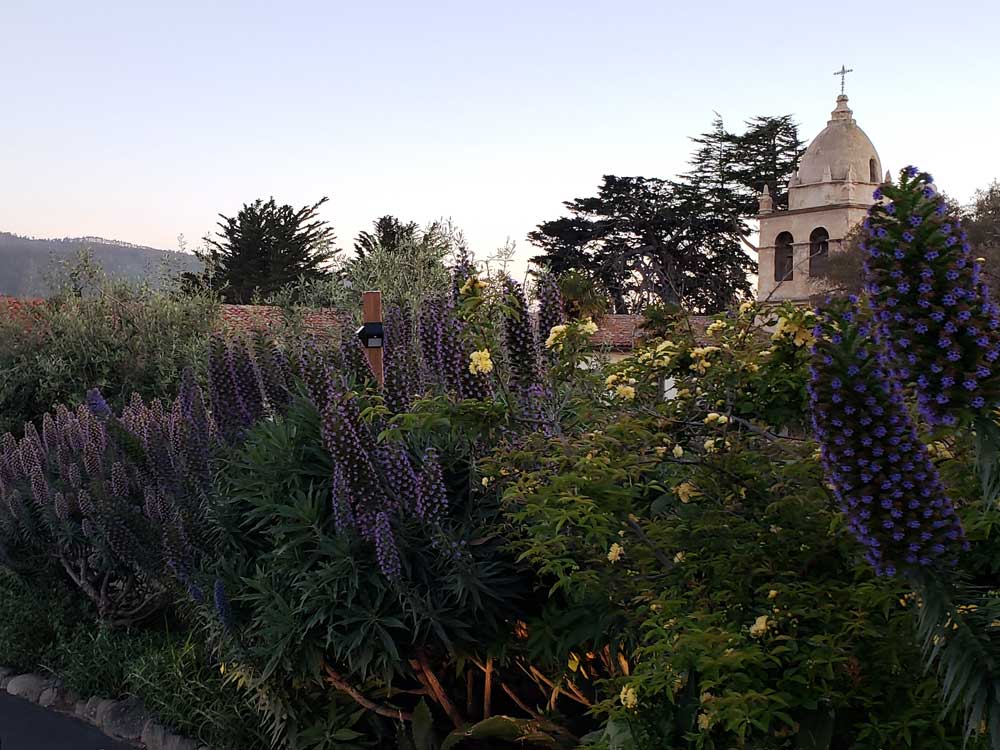
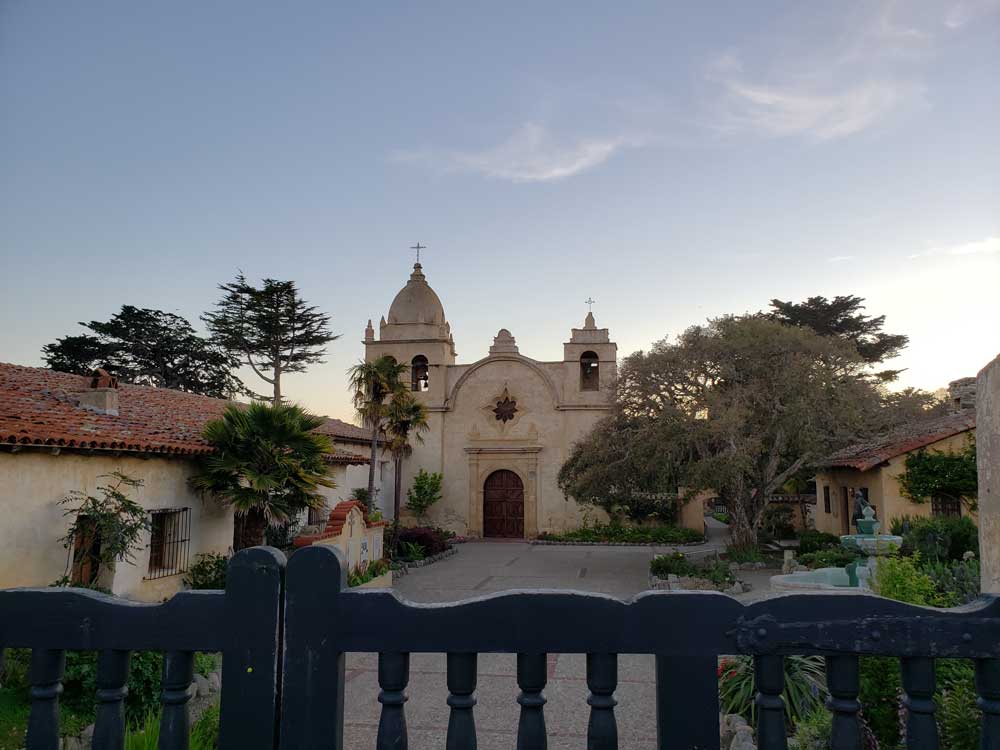
Mission San Carlos Borromeo del Río Carmelo, or Misión de San Carlos Borromeo de Carmelo, first built in 1797, is one of the most authentically restored Roman Catholic mission churches in California. It is located at the mouth of Carmel Valley, California.
From 1797 until 1833, Carmel Mission was the headquarters of all Alta California missions. It was headed by Saint Junípero Serra from 1770 until his death in 1784. It was also the seat of the second missions presidente, Father Fermín Francisco de Lasuén, who was in charge of completing nine more mission churches. By the mid-19th century, the Carmel Mission structures had fallen into disrepair. The chapel was saved from total destruction when the roof was rebuilt in 1884. In 1886, ownership of the mission was transferred from a group of Franciscans to the Diocese of Monterey. Ever since, Carmel Mission has been a parish within that Diocese. Beginning in 1931, Harry Downie began restoring the mission and worked continuously on the project for the next 50 years. It is the only Spanish mission in California that has its original bell and bell tower.
History
Mission Carmel (a.k.a. The Carmel Mission), was the second mission built by Franciscan missionaries in Upper California. It was first established as Mission San Carlos Borromeo in Monterey, California near the native village of Tamo on June 3, 1770 by Father Junípero Serra. It was named for Carlo Borromeo, Archbishop of Milan, Italy, and was the site of the first Christian confirmation in Alta California.
Relocation to Carmel Valley
Serra found that the land near the mouth of the Carmel River (named Río del Carmelo by Vizcaíno in 1603) was better suited for farming. In May 1771, Spain's viceroy approved Serra's petition to relocate the mission. The mission was established in the new location on August 1, 1771; the first mass was celebrated on August 24, and Serra officially took up residence in the newly constructed buildings on December 24. The name of the relocated mission was extended to Mission San Carlos Borromeo del Río Carmelo.
Serra's headquarters
"Mission Carmel", as it came to be known, was Serra's favorite and, because it was close to Monterey, the capital of Alta California, he chose it as his headquarters. When he died on August 28, 1784, he was interred beneath the chapel floor. After Serra's death, Father Fermín Lasuén replaced the adobe structure with one made of stone quarried from the nearby Santa Lucia Mountains. By 1850, the mission was nearly a ruin. The stone chapel building was deteriorating while most of the adobe buildings were eroding away. The roof collapsed in 1852.
Restoration
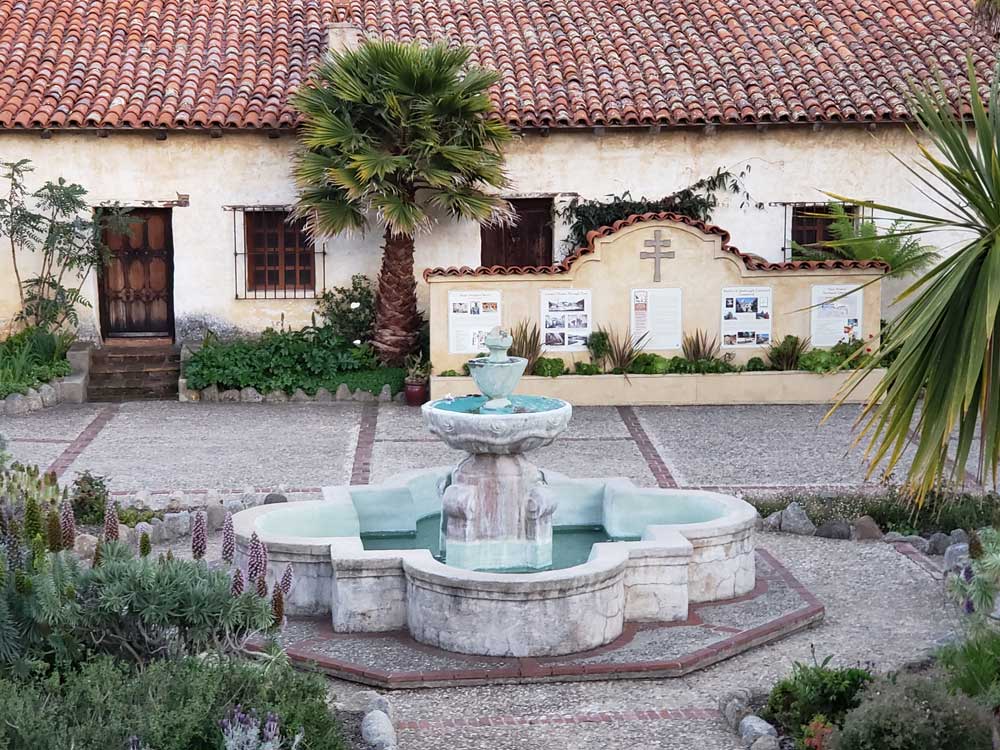
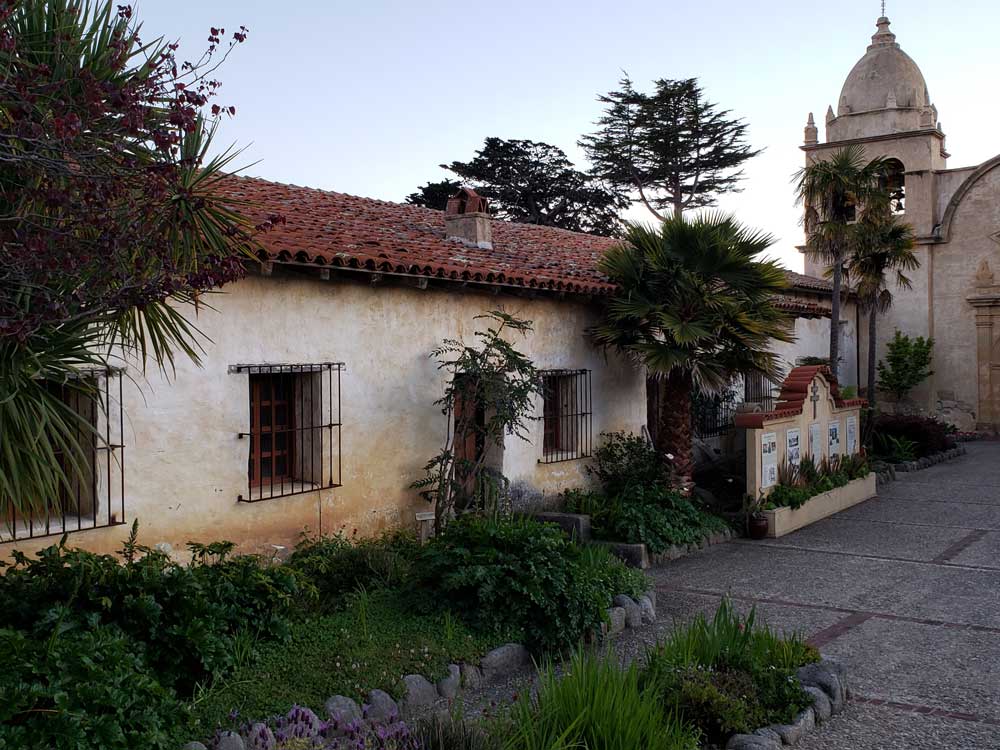
When the Roman Catholic Church gained full control of the buildings on October 19, 1859, the mission was in ruins. In 1884 Father Angel Casanova was able to gather enough private funds to replace the roof on the chapel sufficient to preserve it until the 1930s. In 1931 Monsignor Philip Scher hired master cabinet maker Henry John ("Harry") Downie who had an excellent reputation for restoring Spanish antiques. Scher initially asked Downie to restore some statues at the Carmel Mission but his job quickly expanded and he was put in charge of restoring the entire mission. Two years later, the church transferred the mission from the Franciscans to the local diocese and it became a regular parish church. Downie lived nearby in Carmel and worked almost daily for nearly 50 years to restore the mission, ancillary buildings, walls, and grounds. He painstakingly researched the church's architecture and site, often relying on original Spanish sources, and gathered genuine artifacts from across California.
He first restored the padres' quarters, then the roof of the chapel in 1936, and over the next five years the interior of the basilica. In 1941, he oversaw restoration of the former soldiers' quarters on the east side of the quadrangle. In 1943 he began restoration of a building that had been on the south side of the quadrangle, although nothing was left but the eroded adobe foundation and a few ruined walls.
The building was reconstructed and made into classrooms for Junipero Serra Elementary School. In 1946, the ruin on the east side of the quadrangle that had been the original padre's kitchen and a blacksmith shop was rebuilt. It is used today as a chapel. Downie also consulted on the restoration of the missions that are considered the most authentic, including San Luis Obispo, San Juan Bautista, and San Buenaventura. He also helped the Native Daughters of the Golden West to reconstruct Mission Soledad. He was knighted by Pope Pius and by King Juan Carlos of Spain.
In 1960, the mission was designated as a minor basilica by Pope John XXIII. In 1987, Pope John Paul II visited the mission as part of his U.S. tour.
The original bell nicknamed Ave Maria was made in Mexico City in 1807. It was placed at the Mission in 1820. When the mission was secularized in 1834, the bell was removed and held onto by local Native Americans for safekeeping. It was finally lost, but relocated once again, during restoration. It was re-installed in the mission bell tower in 1925.
Modern use
As a result of Downie's dedicated efforts to restore the buildings, the Carmel mission church is one of the most authentically restored of all the mission churches in California. It is an active parish church of the Roman Catholic Diocese of Monterey. In addition to its activity as a place of worship, Mission Carmel also hosts concerts, art exhibits, lectures, and numerous other community events. In 1986, then-pastor Monsignor Eamon MacMahon acquired a Casavant Frères organ with horizontal trumpets. Its hand-painted casework is decorated with elaborate carvings and statuary reflecting the Spanish decorative style seen on the main altar.
The mission also serves as a museum, preserving its own history and the history of the area. There are four specific museum galleries: the Harry Downie Museum, describing restoration efforts; the Munras Family Heritage Museum, describing the history of one of the most important area families; the Jo Mora Chapel Gallery, hosting rotating art exhibits as well as the monumental bronze and travertine cenotaph (1924) sculpted by Jo Mora; and the Convento Museum, which holds the cell Serra lived and died in, as well as interpretive exhibits. At one end of the museum is a special chapel room containing some of the vestments used by Serra.
Modern restoration
Between 2000 - 2007 private funding paid for the painting conservation of the major original Spanish Colonial oil paintings in the nave by Fine Art Conservation Laboratories, a professional art conservation facility extensively experienced in the preservation and restoration of Spanish Colonial Art. The most important artwork conserved at this time was the "Deposition," a painting commissioned by Father Serra prior to his death which now hangs in the vicinity of his tomb in the apse of the Carmel Mission.
This article uses material from the Wikipedia article "Mission San Carlos Borromeo de Carmelo", which is released under the Creative Commons Attribution-Share-Alike License 3.0.