Highest ridge of the Allegheny Mountains, which covers parts of four states, with its summit, Spruce Knob (4863 ft; 1482 m), the highest point in the state of West Virginia
General Information
How to Get There
From Washington, DC (181 mi) Follow M St NW and 23rd St NW. Take I-66 W and US-48 W to WV-28 S/N Main St in Petersburg. Continue on WV-28 S. Drive to Forest Rd 104 in Riverton.
Overview
Spruce Mountain, in eastern West Virginia, is the highest ridge of the Allegheny Mountains. The "whale-backed" ridge extends for only about 16 miles (26 km), from northeast to southwest, but several of its peaks exceed 4,500 feet (1,400 m) in elevation. The summit, Spruce Knob (4863 ft; 1482 m), is celebrated as the highest point in the state as well as the range, which covers parts of four states.
Things to Do
Stand at the Highest Point in West Virginia
Spruce Knob, rising to 4,863 feet above sea level, is the highest point in West Virginia. Located within the Monongahela National Forest, this spectacular mountain offers sweeping views of the Allegheny Mountains, unique high-elevation ecosystems, and some of the state's best hiking and outdoor recreation opportunities.
Enjoy Panoramic Mountain Views
The summit observation area provides breathtaking 360-degree views of the surrounding mountains, valleys, and wilderness areas. On clear days, visitors can see for miles across eastern West Virginia and neighboring states. The summit is especially popular during sunrise, sunset, and fall foliage season.
Explore High-Elevation Ecosystems
Spruce Knob's cool climate supports red spruce forests, mountain meadows, and rare plant communities more commonly found in northern regions. Visitors can experience unique habitats that are distinct from much of the surrounding Appalachian landscape.
Enjoy Stargazing and Night Sky Viewing
Due to its elevation and low levels of light pollution, Spruce Knob is one of the premier stargazing destinations in the eastern United States. Visitors frequently gather at the summit to observe the Milky Way, meteor showers, and other celestial events.
Experience Hiking and Wilderness Recreation
The area serves as a gateway to extensive hiking opportunities within Monongahela National Forest. Visitors can enjoy backpacking, wildlife viewing, photography, camping, and exploring nearby wilderness areas including Seneca Creek Backcountry and Dolly Sods Wilderness.
Top Trails
Whispering Spruce Trail
Length: Approximately 0.5 miles loop
Elevation Gain: Minimal
Difficulty: Easy
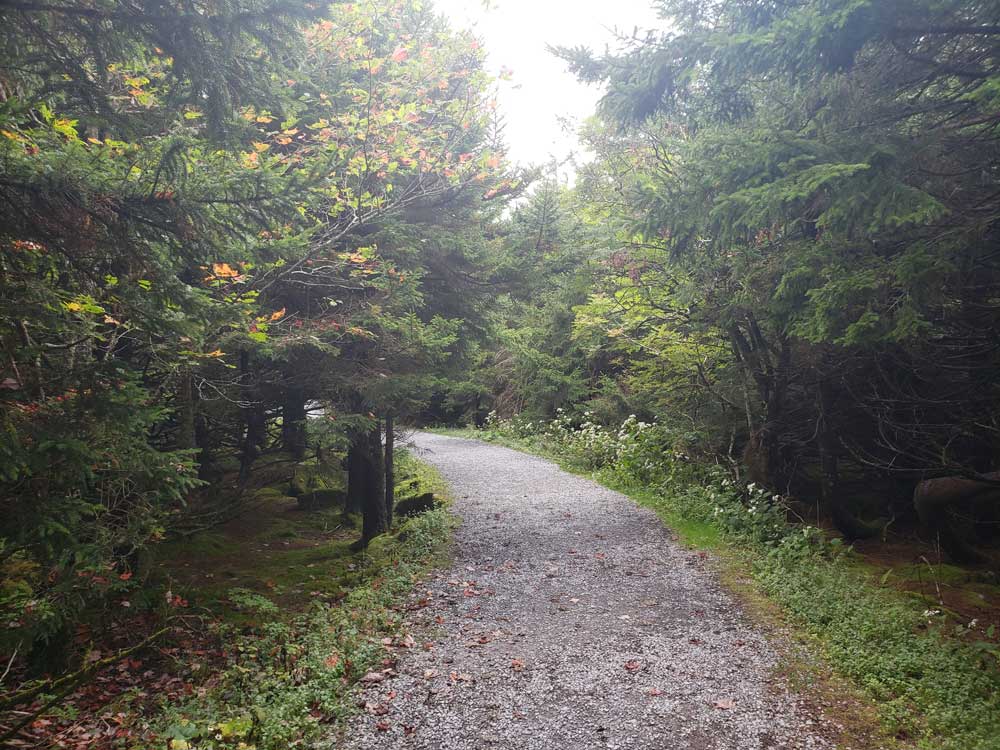
This interpretive loop trail begins near the summit and introduces visitors to the unique high-elevation spruce forest ecosystem. Informational signs explain the area's geology, wildlife, and natural history while offering scenic summit views.
Huckleberry Trail
Length: Approximately 6 miles one way
Elevation Gain: Moderate
Difficulty: Moderate
One of the area's most popular hiking routes, the Huckleberry Trail descends from the summit through forests and mountain terrain while connecting Spruce Knob with Seneca Rocks. The trail offers excellent backcountry scenery and wildlife viewing opportunities.
Spruce Knob Summit Trail
Length: Approximately 0.5 miles round trip
Elevation Gain: Minimal
Difficulty: Easy
This short walk provides access to observation platforms and overlooks near the summit. It is suitable for most visitors and offers outstanding views with minimal hiking effort.
Seneca Creek Trail
Length: Variable distances available
Elevation Gain: Moderate to Strenuous
Difficulty: Moderate to Strenuous
This scenic trail explores the beautiful Seneca Creek Backcountry, featuring waterfalls, mountain streams, forests, and remote wilderness settings. It is a favorite among backpackers and hikers seeking a more immersive mountain experience.
Sources: Monongahela National Forest and U.S. Forest Service information regarding Spruce Knob, summit overlooks, hiking trails, high-elevation ecosystems, wilderness recreation, and visitor facilities. https://www.fs.usda.gov/recarea/mnf/recarea/?recid=12366
Additional information verified through Monongahela National Forest visitor resources covering Whispering Spruce Trail, Huckleberry Trail, Seneca Creek Trail, stargazing opportunities, and scenic overlooks at West Virginia's highest point. https://www.fs.usda.gov/mnf
Geography
Spruce Mountain lies mostly within the Spruce Knob-Seneca Rocks National Recreation Area, a U.S. National Recreation Area (NRA) located within the Monongahela National Forest (MNF) in Pendleton County. It extends from the vicinity of Onego in the north to near Cherry Grove in the south. Brushy Run separates Timber Ridge — a spur of the main mountain — to the east. The ridgelines of Spruce Mountain and Timber Ridge continue to the north of US Route 33 as Hoffman Ridge and Smith Mountain, respectively. To the south (south of West Virginia 28) the line continues as Big Mountain.
Prominent peaks of Spruce Mountain, north to south, are Horse Rock (4536 ft; 1383 m), Spruce Mountain Peak (4586 ft; 1398 m), Picea Benchmark (4613 ft; 1406 m), and Spruce Knob itself. Spruce Knob is the highest point in the eastern United States between the Adirondacks of New York and Mount Rogers (part of the Blue Ridge Mountains) in southern Virginia.
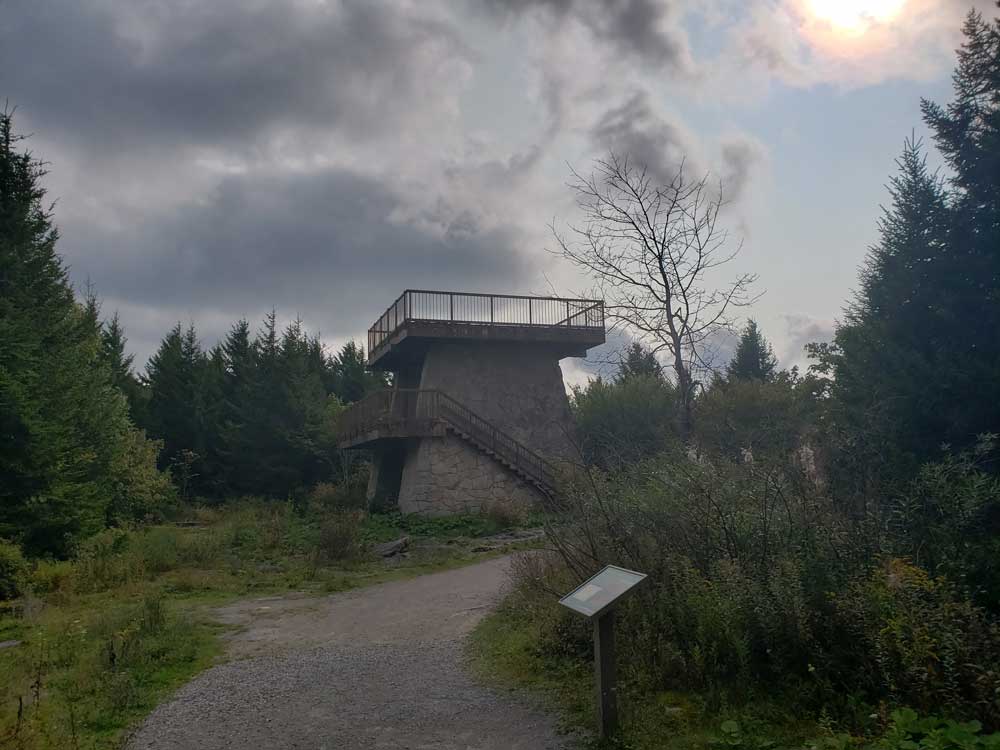
The summit of Spruce Knob has a definite alpine feel, much more so than most other mountains of the southern Appalachians. The upper few hundred feet are covered in a dense spruce forest, a relic boreal forest environment similar to those found in northern New England and Canada. The summit is accessible both via trails and a paved Forest Service road, and is crowned with a stone lookout tower amid a mixture of boulder fields, meadows and trees. A handicap-accessible nature trail half a mile (0.8 km) long circles the topmost part of the mountain. High west winds near the summit have gnarled the spruce there like Krummholz, flagged with limbs only on their leeward (eastward) side.
As is typical in the southern Appalachians, the highest point on a ridge is frequently referred to as a knob or dome. Spruce Knob is the highest point along a ridge known as the Allegheny Front. Dropping steeply to the east, it offers views of the Germany Valley and North Fork Mountain; to the west is the Allegheny Plateau. It also is the highest point in the Chesapeake Bay Watershed.
The summit was named for the spruce trees which grow there. Red spruce (Picea rubens) is the most common tree species on the summit. The lower altitudes are populated by oak, hickory, birch, beech and maple
There are over 75 miles (121 km) of hiking trails around the mountain and a small 25-acre (10 ha) lake well stocked with trout on the west side of the mountain. Two campgrounds are also on the mountain.
Hiking trails — Huckleberry Trail, Lumberjack Trail, Spruce Mountain Trail — extend the length of the ridge. There are over 75 miles (121 km) of trails around the Mountain and a small 25 acre (10 ha) lake well stocked with trout on the west side. There are also two campgrounds on the Mountain; the larger (43 sites) is nearest the lake.
Paved access is from U.S. Route 33/West Virginia Route 28 about 2 miles (3.2 km) south of Riverton. Briery Gap Road (County Route 33/4), Forest Road 112 and Forest Road 104 have been reconstructed and paved to provide a hard-surfaced road to the summit.
Forest Roads 104 and 112 are not maintained in the winter. Impassable conditions can be expected any time from mid-October to mid-April.
This article uses material from the Wikipedia article "Spruce Mountain (West Virginia)", which is released under the Creative Commons Attribution-Share-Alike License 3.0