General Information
Open daily
April through October: 9am to 5pm
November through March: 9am to 4pm
- Adults (12+): $28.00
- Youth (6-11): $15.00
- Children (0-5): Free
- Save $2 on admission tickets when you purchase 3 days in advance.
How to Get There
From Washington, DC (17 mi): Take 14th St NW to I-395 S. Take the I-395 S exit from 14th St NW. Follow I-395 S and Exit 10B to George Washington Mem Pkwy in Arlington. Exit from I-395 S. Drive to George Washington Mem Pkwy in Mount Vernon.
Overview
Mount Vernon is a landmark and former plantation of George Washington, the first president of the United States, and his wife, Martha. The estate is on the banks of the Potomac River in Fairfax County, Virginia. It is located south of Washington, D.C. and Alexandria, Virginia and is across the river from Prince George's County, Maryland.

The Washington family acquired land in the area in 1674. Around 1734, the family embarked on an expansion of its estate that continued under George Washington, who began leasing the estate in 1754 before becoming its sole owner in 1761.
The mansion was built of wood in a loose Palladian style; the original house was built by George Washington's father Augustine, around 1734. George Washington expanded the house twice, once in the late 1750s and again in the 1770s. It remained Washington's home for the rest of his life. Following his death in 1799, under the ownership of several successive generations of the family, the estate progressively declined as revenues were insufficient to maintain it adequately.
In 1858, the house's historical importance was recognized and it was saved from ruin by the Mount Vernon Ladies' Association. The philanthropic organization acquired it together with part of the Washington property estate. Escaping the damage suffered by many plantation houses during the American Civil War, Mount Vernon was restored.
Mount Vernon was designated a National Historic Landmark in 1960 and is listed on the National Register of Historic Places. It is still owned and maintained in trust by the Mount Vernon Ladies' Association and is open every day of the year.
When George Washington's ancestors acquired the estate, it was known as Little Hunting Creek Plantation, after the nearby Little Hunting Creek. However, when Washington's older half-brother, Lawrence Washington, inherited it, he renamed it after Vice Admiral Edward Vernon, who had been his commanding officer during the War of Jenkins' Ear and was famed for having captured Portobello from the Spanish. When George Washington inherited the property, he retained the name.
The current property consists of 500 acres (200 ha); the Mansion and over 30 outbuildings are situated near the riverfront. The property contained 8,000 acres (3,200 ha) when Washington lived there.
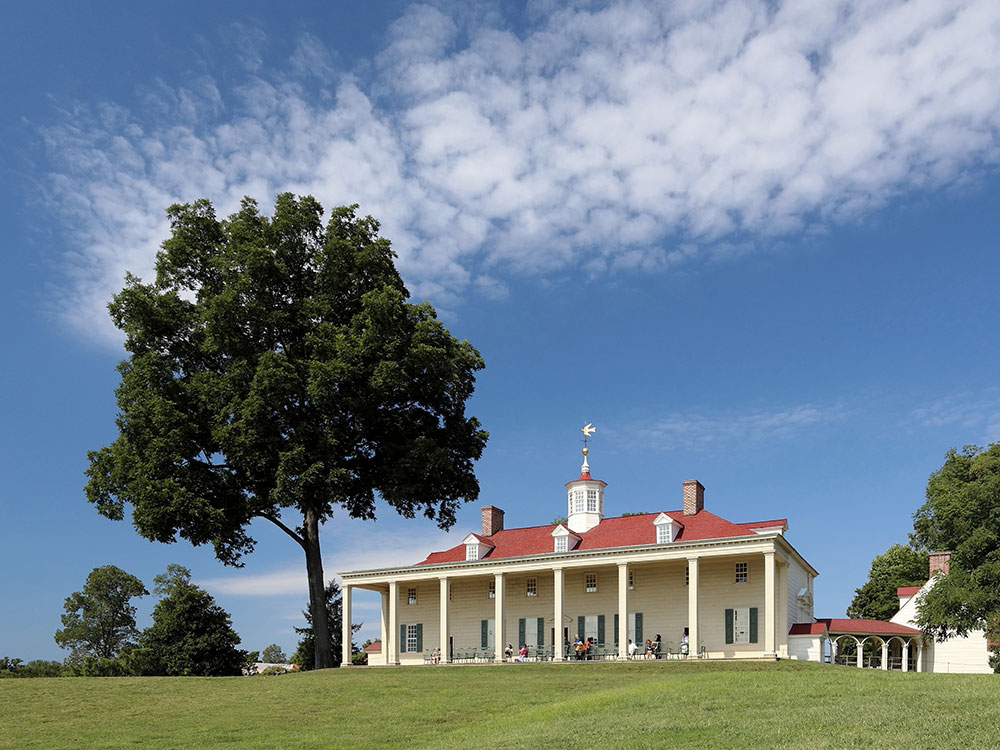
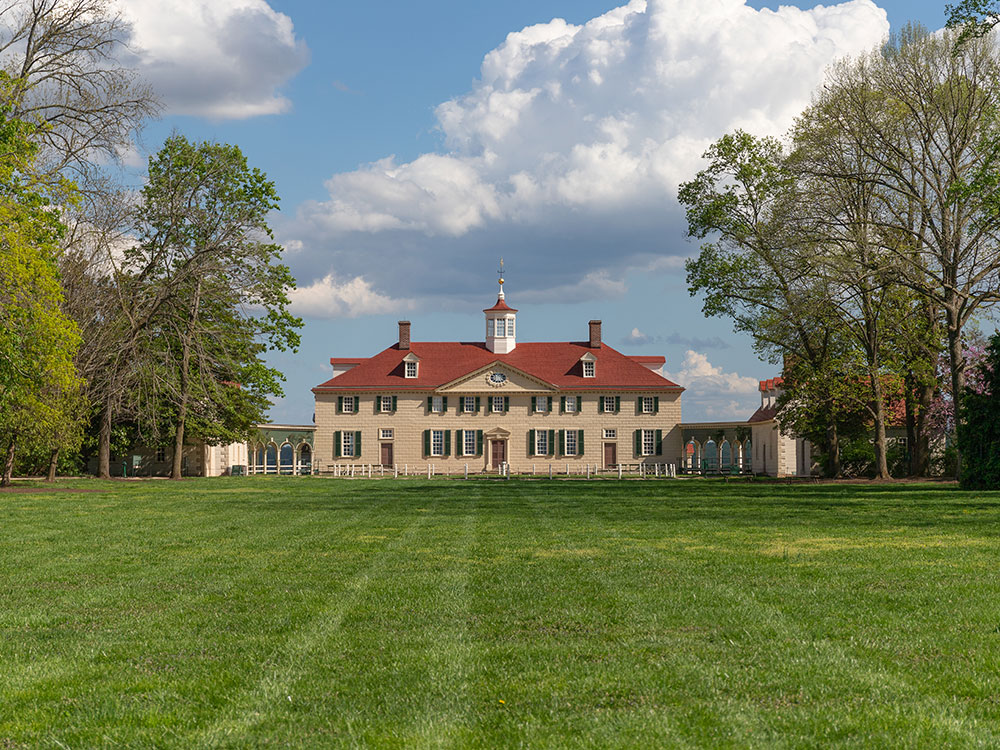
The present mansion was built in phases from approximately 1734, by an unknown architect, under the supervision of Augustine Washington. This staggered and unplanned evolution is indicated by the off-center main door. As completed and seen today, the house is in a loose Palladian style. The principal block, dating from about 1734, was a one-story house with a garret. In the 1750s, the roof was raised to a full second story and a third floor garret. There were also one-story extensions added to the north and south ends of the house; these were torn down during the next building phase. The present day mansion is 11,028 sq ft (1,025 m2).
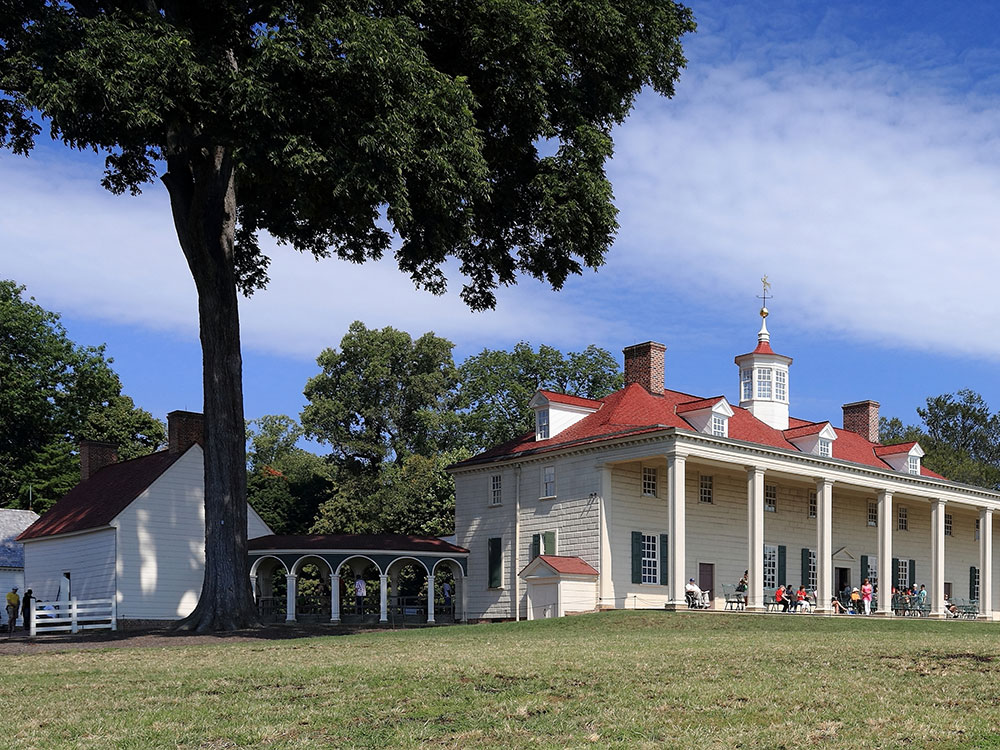
In 1774, the second expansion began. A two-story wing was added to the south side. Two years later a large two-story room was added to the north side. Two single-story secondary wings were built in 1775. These secondary wings, which house the servants hall on the northern side and the kitchen on the southern side, are connected to the corps de logis by symmetrical, quadrant colonnades, built in 1778. The completion of the colonnades cemented the classical Palladian arrangement of the complex and formed a distinct cour d'honneur, known at Mount Vernon as Mansion Circle, giving the house its imposing perspective.
The corps de logis has a hipped roof with dormers and the secondary wings have gable roofs with dormers. In addition to its second story, the importance of the corps de logis is further emphasized by two large chimneys piercing the roof and by a cupola surmounting the center of the house; this octagonal focal point has a short spire topped by a gilded dove of peace. This placement of the cupola is more in the earlier Carolean style than Palladian and was probably incorporated to improve ventilation of the enlarged attic and enhance the overall symmetry of the structure and the two wings; a similar cupola crowns the Governor's House at Williamsburg, of which Washington would have been aware.
The rooms at Mount Vernon have mostly been restored to their appearance at the time of George and Martha Washington's occupancy. Rooms include Washington's study, two dining rooms (the larger known as the New Room), the West Parlour, the Front Parlour, the kitchen and some bedrooms.
The interior design follows the classical concept of the exterior, but owing to the mansion's piecemeal evolution, the internal architectural features – the doorcases, mouldings and plasterwork – are not consistently faithful to one specific period of the 18th-century revival of classical architecture. Instead they range from Palladianism to a finer and later neoclassicism in the style of Robert Adam. This varying of the classical style is best exemplified in the doorcases and surrounds of the principal rooms. In the West Parlour and Small Dining rooms there are doorcases complete with ionic columns and full pediments, whereas in the hall and passageways the doors are given broken pediments supported by an architrave. Many of the rooms are lined with painted panelling and have ceilings ornamented by plasterwork in a Neoclassical style; much of this plasterwork can be attributed to an English craftsman, John Rawlins, who arrived from London in 1771 bringing with him the interior design motifs then fashionable in the British capital.
Visitors to Mount Vernon now see Washington's study, a room to which in the 18th century only a privileged few were granted entry. This simply furnished room has a combined bathroom, dressing room and office; the room was so private that few contemporary descriptions exist. Its walls are lined with naturally grained paneling and matching bookcases. In contrast to the privacy of the study, since Washington's time, the grandest, most public and principal reception room has been the so-called New Room or Large Dining Room – a two-storied salon notable for its large Palladian window, occupying the whole of the mansion's northern elevation, and its fine Neoclassical marble chimneypiece. The history of this chimneypiece to some degree explains the overall restrained style of the house. When it was donated to Washington by English merchant Samuel Vaughan, Washington was initially reluctant to accept the gift, stating that it was "too elegant & costly I fear for my own room, & republican stile of living."
Efforts have been made to restore the rooms and maintain the atmosphere of the 18th century; this has been achieved by using original color schemes and by displaying furniture, carpets and decorative objects which are contemporary to the house. The rooms contain portraits and former possessions of George Washington and his family.
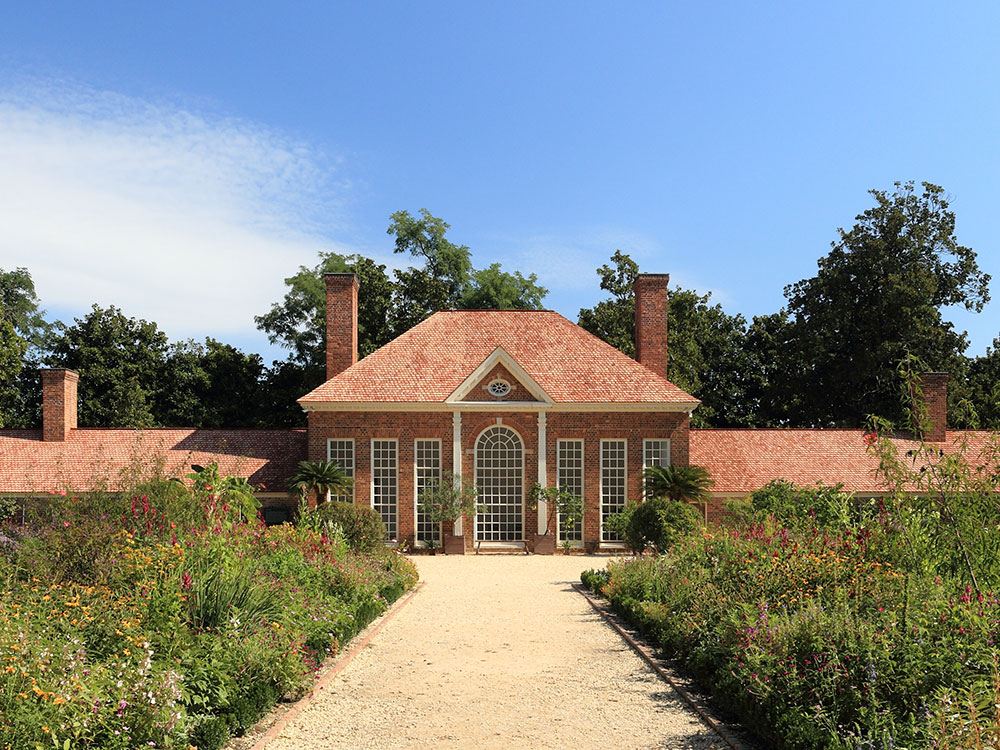
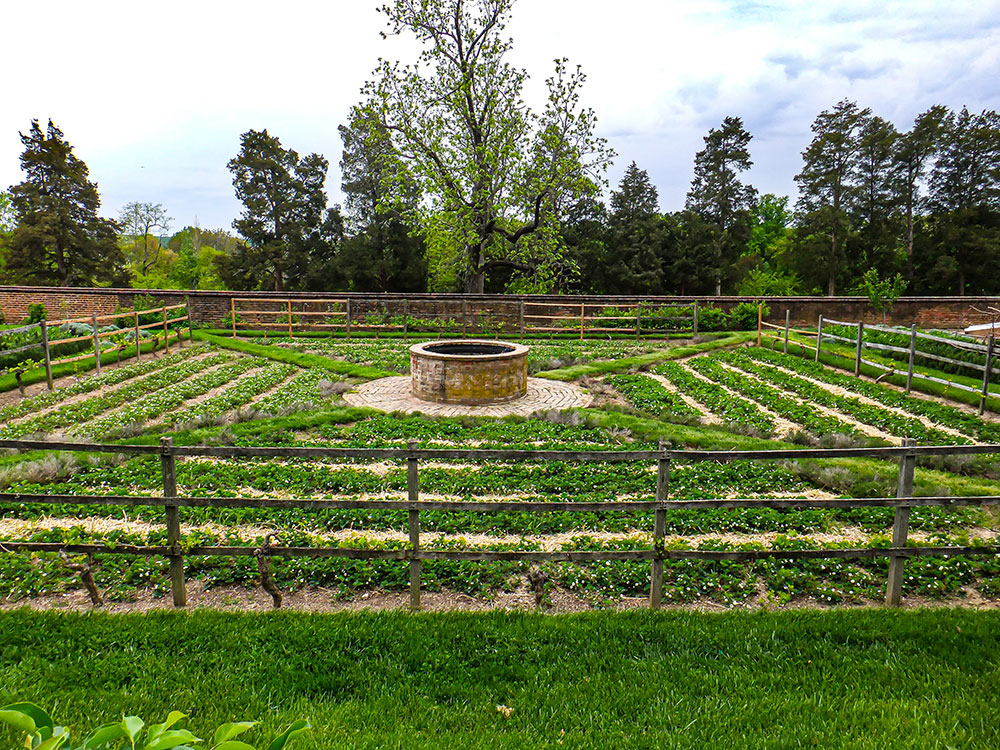
The gardens and grounds contain English boxwoods, taken from cuttings sent by Major General Henry Lee III ("Light Horse Harry" Lee, a Governor of Virginia and the father of Robert E. Lee), which were planted in 1786 by George Washington and now crowd the entry path. A carriage road skirts a grassy bowling green to approach the mansion entrance. To each side of the green is a garden contained by red brick walls. These Colonial Revival gardens grew the household's vegetables, fruit and other perishable items for consumption. The upper garden, located to the north, is bordered by the greenhouse. Ha-ha walls are used to separate the working farm from the pleasure grounds that Washington created for his family and guests. The overseer's quarter, spinning room, salt house, and gardener's house are between the upper garden and the mansion.
The lower garden, or southern garden, is bordered on the east by the storehouse and clerk's quarters, smokehouse, wash house, laundry yard, and coach house. A paddock and stable are on the southern border of the garden; east of them, a little down the hillside, is the icehouse. The original tomb is located along the river. The newer tomb in which the bodies of George and Martha Washington have rested since 1831 is south of the fruit garden; the slave burial ground is nearby, a little farther down the hillside. A "Forest Trail" runs through woods down to a recreated pioneer farm site on low ground near the river; the 4-acre (16,000 m2) working farm includes a re-creation of Washington's 16-sided treading barn.
A museum and education center are on the grounds and exhibit examples of Washington's survey equipment, weapons, and clothing, as well as dentures worn by the President. The Fred W. Smith National Library for the Study of George Washington opened in 2013. The library fosters new scholarship about George Washington and safeguards original Washington books and manuscripts. The site is open for scholarship by appointment only.
This article uses material from the Wikipedia article "Mount Vernon", which is released under the Creative Commons Attribution-Share-Alike License 3.0