General Information
Sunday 1pm to 5pm
How to Get There
Overview
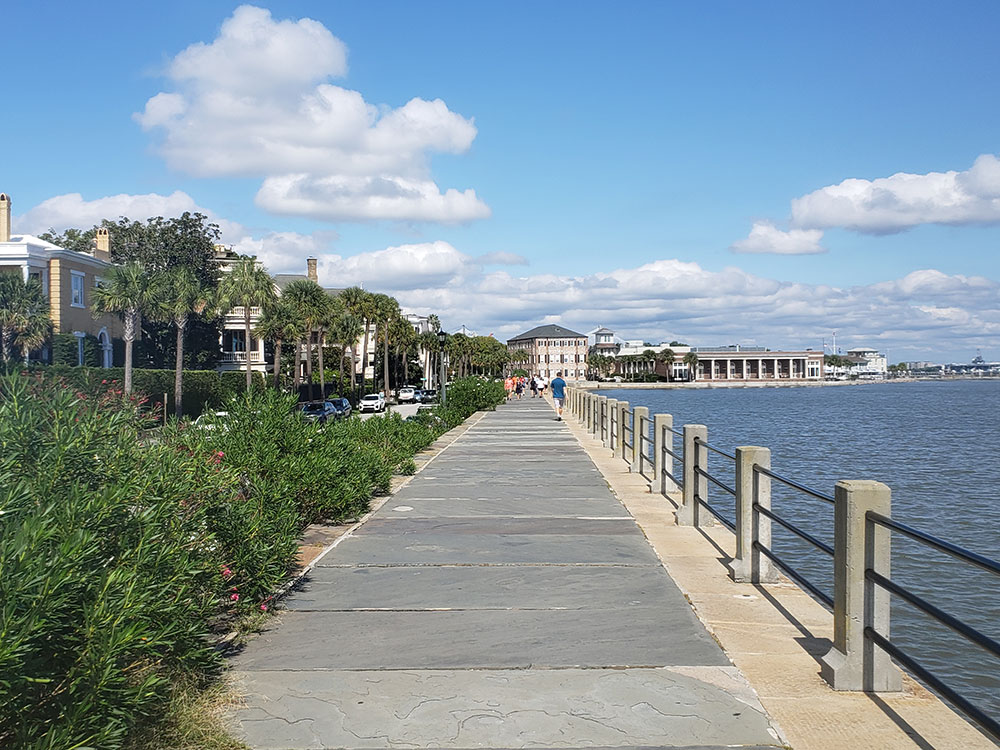
White Point Garden is a 5.7 acre public park located in peninsular Charleston, South Carolina, at the tip of the peninsula. It is the southern terminus for the Battery, a defensive seawall and promenade. It is bounded by East Battery (to the east), Murray Blvd. (to the south), King St. (to the west), and South Battery (to the north).
Placed at irregular intervals around three sides of the perimeter of White Point Garden are several military relics. Along East Battery are the 11-inch Dahlgren gun from the USS Keokuk that fired shells at Fort Sumter in 1863 and two Confederate columbiads (large cannons) that were used in the defense of Fort Sumter. On Murray Blvd. there are several more artillery pieces: a rare 7-inch Brooke rifle (a large cannon) that was found at Fort Johnson and four 13-inch Union mortars (weighing 17,000 pounds each). On the King St. side are a 1918 World War I howitzer; a French cannon of Revolutionary War vintage that was found in Camden, South Carolina; and a rapid-fire gun from a Spanish ship captured during the Spanish-American War.
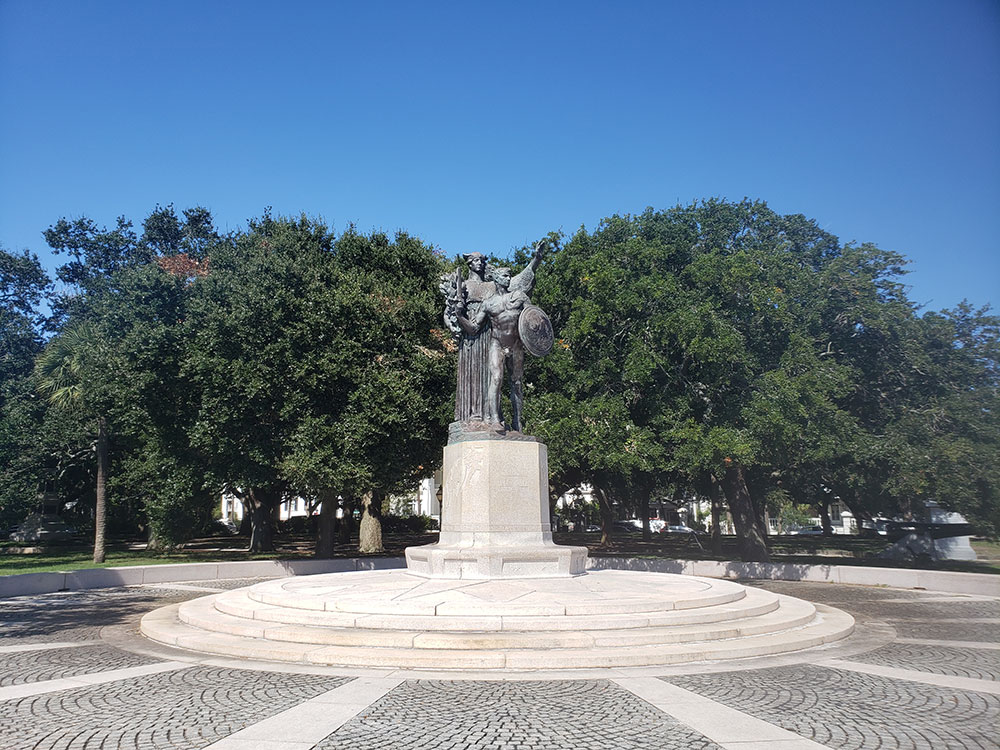
Along the center walkway in line with Church St. is The Defenders of Fort Moultrie, honoring South Carolinian soldiers during the Battle of Sullivan's Island. It is often called the Jasper Monument since it shows a statue of Sergeant William Jasper, a hero of the Revolutionary War battle won by the colonists at Fort Moultrie on Sullivan's Island on June 28, 1776. The memorial was added in 1877.
At the northeast corner is a marker, erected in 1943, to the Gentleman Pirate Stede Bonnet. The monument commemorates the hanging near that site of pirate captain Stede Bonnet and his crew in 1718, as well as the 1719 hanging of Richard Worley's pirates.
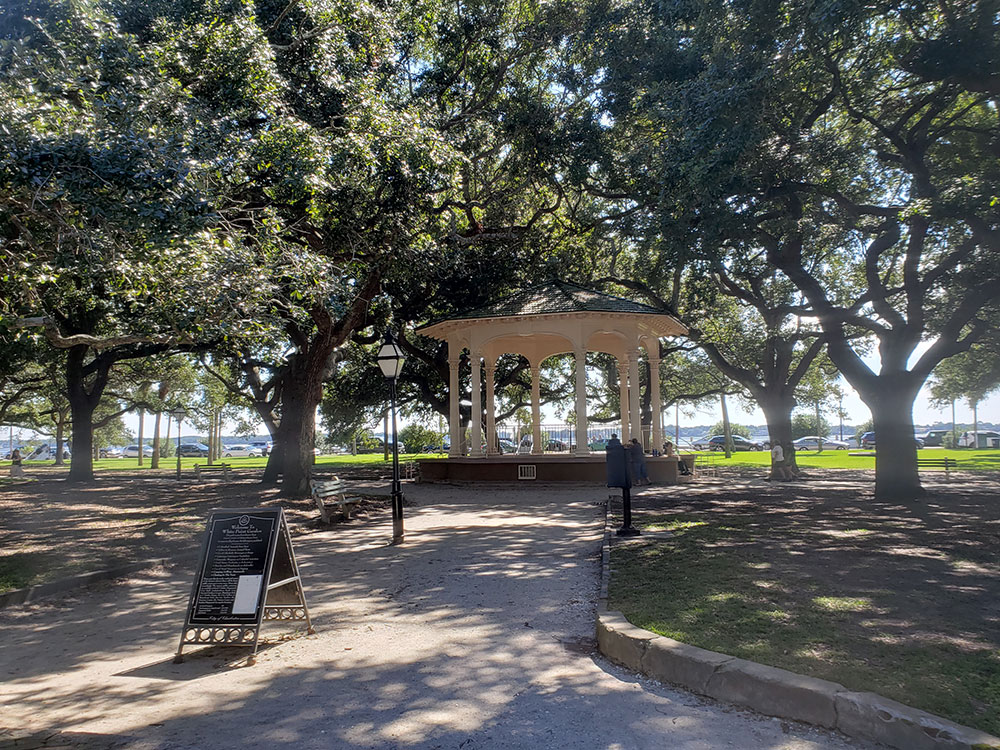
Located across from Meeting Street in the center of the park, a bandstand, begun in 1906 and completed in 1907, is a memorial to Mrs. George W. Williams by her daughter, Mrs. Martha W. Carrington. The bandstand, designed by William Martin Aiken and built by Robert McArtney, cost more than $5,000 when it was built and hosted regular concerts.
In 1962, Charleston sculptor Willard Hirsch was commissioned by Miss Sally Carrington to create a bronze statue of a dancing girl. The statue was a gift to the City and was installed as a water fountain in White Point Garden on an especially low granite base so that children could make easy use of it.
Near the southwest corner of the park is a memorial to the crew of the USS Amberjack, a submarine that was sunk during World War II, and 51 other American subs lost during the conflict.
Also located near the southwest corner of the park is the 20-foot tall, granite Hobson Monument. On April 26, 1952, the U.S. destroyer Hobson was cut in half and sunk after being in a collision with the American aircraft carrier Wasp. The stones used in the platform come from the 38 home states of the 176 sailors who died. The Hobson was built at the Charleston Navy Yard.
At the meeting of Meeting St. and South Battery is a memorial to the crew of the H.L. Hunley. Added in 1899, the granite monument recognizes the first successful submarine, the Hunley, which eventually sank in Charleston Harbor following a successful attack on the USS Housatonic.
Along the center walkway in the park, halfway between Church and Meeting, is a bronze bust, atop a granite column, of William Gilmore Simms (1806-1870), a poet, novelist, and historian, whose history of South Carolina served as the definitive textbook on state history for much of the 20th century. Sculpted by John Quincy Adams Ward, the monument was added in 1879. The base for the bust was designed by Edward Brickell White.
This article uses material from the Wikipedia article "White Point Garden", which is released under the Creative Commons Attribution-Share-Alike License 3.0