
General Information
Sunday 1pm to 5pm
How to Get There
Head east on Broad St toward Church St. Turn left onto Church St.
Overview
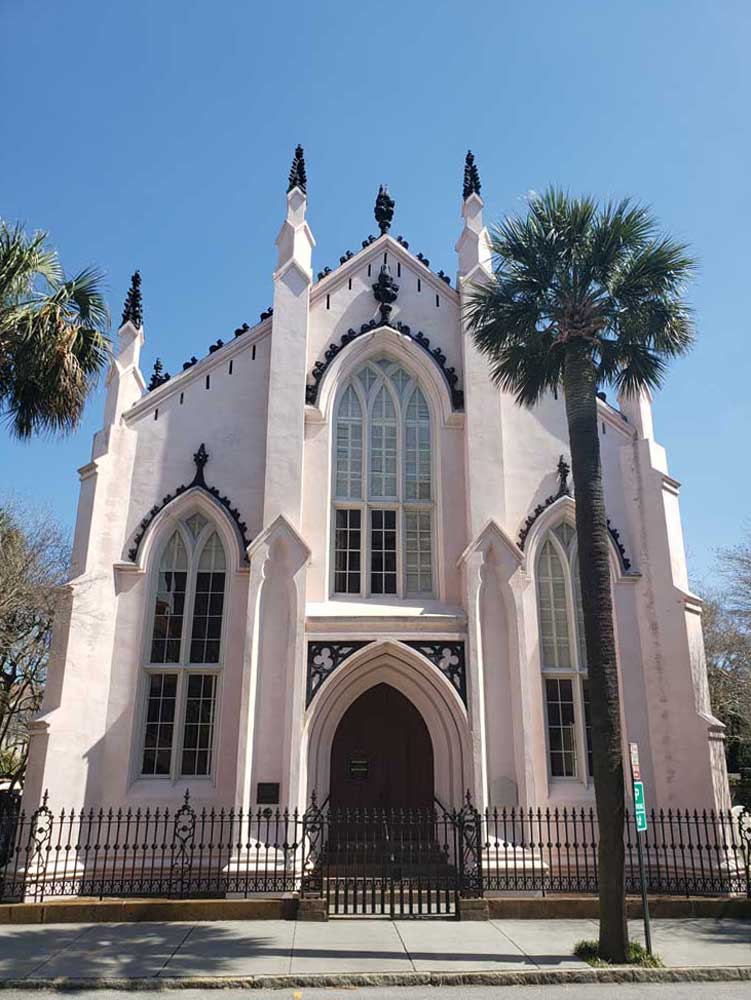
The Huguenot Church, also called the French Huguenot Church or the French Protestant Church, is a Gothic Revival church in Charleston, South Carolina. Built in 1844 and designed by architect Edward Brickell White, it is the oldest Gothic Revival church in South Carolina, and has been designated a National Historic Landmark and listed on the National Register of Historic Places. The congregation it serves traces its origins to the 1680s, and is the only independent Huguenot church in the United States.
As Protestants in predominantly-Catholic France, Huguenots faced persecution throughout the 16th and 17th centuries. Following the Revocation of the Edict of Nantes in 1685, many Huguenots fled France for various parts of the world, including Charleston. The early congregation of Charleston's Huguenot Church included many of these refugees, and their descendants continued to play a role in the church's affairs for many decades. The church was originally affiliated with the Calvinist Reformed Church of France, and its doctrine still retains elements of Calvinist doctrine. The church's services still follow 18th century French liturgy, but are conducted in English.
The present church was designed by Edward Brickell White, a local architect who had also designed a number of Greek and Roman buildings in the area, most notably Market Hall, the steeple of St. Philip's Episcopal Church, and the St. Matthew's German Evangelical Lutheran Church. The church was built by local contractor Ephraim Curtis.
The church is a stuccoed brick structure, three bays wide and six bays long, with each bay divided by narrow buttresses topped by elaborate pinnacles. The three front windows are topped with cast-iron crockets, and a battlement parapet surrounds the top of the church. The interior consists of walls with plaster ribbed grained vaulting, with marble tablets etched with names of Huguenot families.
This article uses material from the Wikipedia article "Huguenot Church", which is released under the Creative Commons Attribution-Share-Alike License 3.0
-1000.jpg)
.jpg)