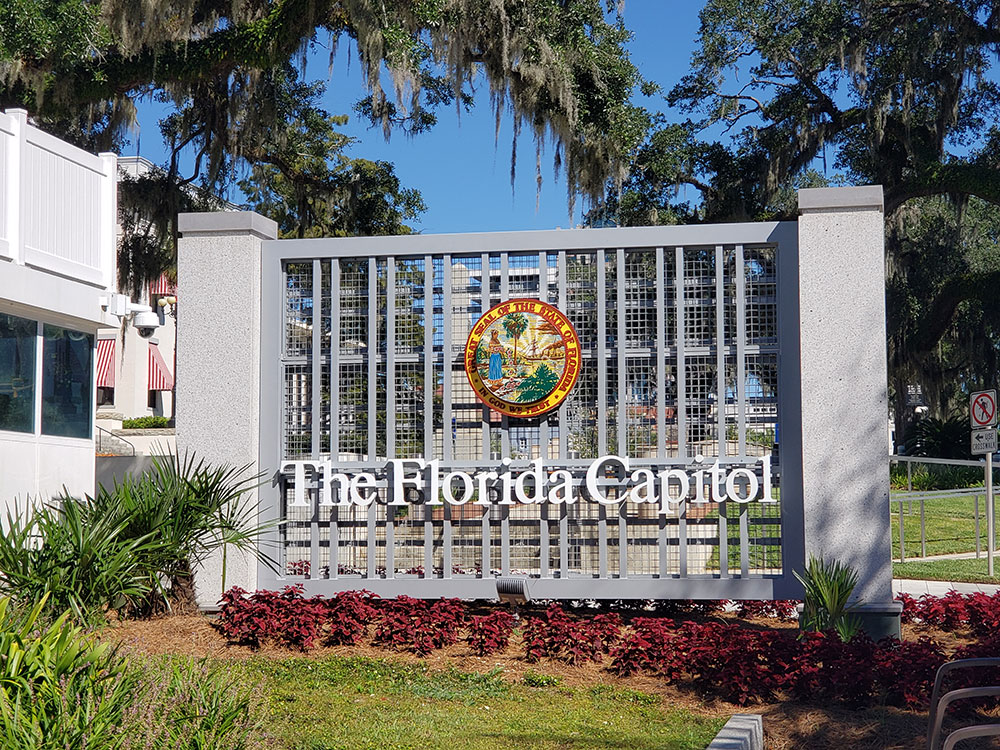
State Capitol in Tallahassee, Florida, is an architecturally and historically significant building listed on the National Register of Historic Places
General Information
Open 6am to 9pm daily
How to Get There
The Florida State Capitol in Tallahassee, Florida, is an architecturally and historically significant building listed on the National Register of Historic Places.
Sometimes called "The Old Capitol," the Historic Capitol, built in 1845, was threatened with demolition in the late 1970s when the new capitol building was built. Having been restored to its 1902-version in 1982, the Historic Capitol is directly behind the new Capitol building. Its restored space includes the Governor's Suite, Supreme Court, House of Representatives and Senate chambers, rotunda, and halls. Its adapted space contains a museum exhibiting the state's political history, the Florida Historic Capitol Museum, which is managed by the Florida Legislature.
The New Tower houses executive and legislative offices and the chambers of the Florida Legislature (consisting of the Florida Senate and Florida House of Representatives).
The architects who designed the New Capitol were given the starting assumption the Old Capitol — which had to remain in use until the New Capitol was completed — would be removed. Therefore, the design of the New Capitol in no way reflected the style of the old one. The site design, also, was prepared under the assumption the space occupied by the Old Capitol would be vacant. Since the preservation movement did not begin until after the New Capitol had been completed, and the demolition was being prepared for, it was too late to make any changes to either the New Capitol or the site.
The Historic Capitol was saved through citizens' action led by Secretary of State Bruce Smathers and then wife Nancy McDowell. The efforts were successful and the building was restored to its 1902 appearance, the final House and Senate chambers having been demolished (though there are no surviving drawings or photographs to inform restoration of the interior). Architectural highlights include the elaborate art glass dome, red and white striped awnings, and a representation of the Florida State Seal over the entry columns.
In 2011, the Florida Department of Management Services, in conjunction with MLD Architects, began restoration of the Historic Capitol's cupola, which included new copper roofing, and Tallahassee's most photographed landmark unveiled its new dome in April 2012.
The Capitol Complex design was a joint venture of the architectural firms of Edward Durell Stone of New York City and Reynolds, Smith & Hills of Jacksonville. It was built according to Stone's signature style of "Neoclassicism," with an ornate grill surrounding a white-columned box. The design symbolized the growth and development of Florida.
The Legislative Chambers are on the fourth floor with their respective public viewing galleries on the fifth floor. The floors between the observation deck and the first five floors are executive and legislative offices. There is a cafeteria on the lower level, a snack bar on the tenth floor, and the Florida Welcome Center just inside the west Plaza Level entrance. Florida Welcome Center staff conducts guided tours for groups of 15 or more and self-guided tours are available during business hours. The Senate office building and the House office building are each four stories high and on either end of the Capitol Complex. The bridges on the second and third floors allow people to walk between the Capitol and office buildings. These buildings contain primarily committee meeting rooms and legislative offices. The Knott Building was attached to the Capitol by a skywalk in 1999. The west front is known formally as Waller Park, for Curtis L. Waller, Judge of the United States Circuit Court of Appeals. In 2003, the dolphin statue "Stormsong" by Tallahassee artist Hugh Nicholson was added within Waller Park's Florida Heritage Fountain.
On the northeast corner of the Capitol Complex is the Florida Sri Chinmoy Peace State Marker. East of the House Office Building is a replica of the Liberty Bell. The replica was a gift to the citizens of Florida as a symbol of the 1950 United States Savings Bonds Independence Drive. Within the Capitol Courtyard is a memorial in remembrance of Dr. Martin Luther King Jr., dedicated in 1984. South of the King Memorial is The Florida Fraternal Order of Police Law Enforcement Memorial (dedicated in 2000). The memorial has the names of law enforcement officers killed in the line of duty. Outside of the Senate Office Building is a monument dedicated to Floridians who have received the Purple Heart medal.
On the lawn of the Old Capitol sit two marble obelisks. The northern one is the Leon County Civil War Memorial; The memorial demonstrates the efforts of courageous Floridians during the war between the states.
The Capitol Complex grounds are maintained by the Florida Department of Management Services.
The Plaza Level holds several items of note besides the offices of the Governor and the Cabinet. In the Rotunda, a copy of the State Seal cast in bronze is mounted on terra verde marble sits. This is not the current seal, but one in use when building was completed. It is surrounded by five smaller seals representing the nations and kingdoms that exerted sovereignty over all or parts of Florida (France, Spain, Great Britain, the Confederate States of America, and the United States).[when?] North of the Rotunda is the Florida Women's Hall of Fame and the Fallen Firefighters Wall of Honor. To the south are the Florida Artists Hall of Fame and a memorial for Florida's Medal of Honor recipients. Southwest of the Rotunda is the Heritage Chapel, an area designed to serve as a meditative space. Opposite to the Chapel is a plaque that states: "This plaque is dedicated to Senator Lee Weissenborn whose valiant effort to move the Capitol to Orlando was the prime motivation for the construction of this building." The west Plaza Level is the Florida Welcome Center and the "Images of the Sunshine State" murals by Florida artist James Rosenquist. The Florida Welcome Center offers maps, brochures, including a self-guided tour pamphlet, and related information.
The public viewing galleries for the Florida House of Representatives and the Florida Senate are on the fifth floor. A series of murals of Florida's history by Christopher Still encircle the House chamber floor. Outside of the Senate galleries is the Five Flags Mural by Renee Faure depicting people from Florida history.
The Observation Deck is the top or twenty-second floor of the Capitol building. The deck is 307 feet (94 m) above the Plaza Level and 512 feet (156 m) above sea level. In the east wing is an art gallery featuring a rotating display of artwork by Florida resident artists and a series of bronze plaques on the inductees of the Florida Artists Hall of Fame. The southern side is the Freedom Shrine.
The capitol is home to the Florida Legislative Research Center & Museum, which features exhibits about Florida's legislative history. The archives include art, historic photographs, documents and oral histories. The Gallery at the Historic Capitol features changing exhibits of photographs from the museum.
This article uses material from the Wikipedia article "Florida State Capitol" which is released under the Creative Commons Attribution-Share-Alike License 3.0