Cape Canaveral Space Force Station

Gzzz, CC BY-SA 4.0, via Wikimedia Commons; Image Size Adjusted

One of the NASA's ten field centers including the Kennedy Space Center Visitor Complex offering public tours of the center and Cape Canaveral Space Force Station

General Information

Hours:
Open daily 9am to 5pm
Unavailable Attractions:
For guests health and safety, the following attractions are unavailable:
The full Kennedy Space Center Bus Tour
Astronaut Appearances
Fees:
Daily Admission
Adult (age 12+): $57.00
Child (age 3-11): $47.00 Multiday Admission
Adult (age 12+): $82.00
Child (age 3-11): $67.00
Pet Policy:
Pets NOT allowed
Closest cities with hotels:
Titusville, New Smyrna Beach
Seasons:
All year
Address:
Space Commerce Way
Merritt Island, FL 32953
Rating:
5.0
Cape Canaveral, FL Weather Forecast

From Orlando (52 miles): Get on FL-408 E. Continue on FL-408 E. Take FL-417 Toll S and FL-528 E to FL-407 N/Challenger Memorial Pkwy in Brevard County. Take exit 37 from FL-528 E. Continue on FL-407 N/Challenger Memorial Pkwy to destination.

The John F. Kennedy Space Center (KSC, originally known as the NASA Launch Operations Center), located on Merritt Island, Florida, is one of the National Aeronautics and Space Administration's (NASA) ten field centers. Since December 1968, KSC has been NASA's primary launch center of human spaceflight. Launch operations for the Apollo, Skylab and Space Shuttle programs were carried out from Kennedy Space Center Launch Complex 39 and managed by KSC. Located on the east coast of Florida, KSC is adjacent to Cape Canaveral Space Force Station (CCSFS). The management of the two entities work very closely together, share resources and operate facilities on each other's property.

ft-lauderdale-stand
Gzzz, CC BY-SA 4.0, via Wikimedia Commons

Though the first Apollo flights and all Project Mercury and Project Gemini flights took off from the then-Cape Canaveral Air Force Station, the launches were managed by KSC and its previous organization, the Launch Operations Directorate. Starting with the fourth Gemini mission, the NASA launch control center in Florida (Mercury Control Center, later the Launch Control Center) began handing off control of the vehicle to the Mission Control Center in Houston, shortly after liftoff; in prior missions it held control throughout the entire mission.

Additionally, the center manages launch of robotic and commercial crew missions and researches food production and In-Situ Resource Utilization for off-Earth exploration. Since 2010, the center has worked to become a multi-user spaceport through industry partnerships, even adding a new launch pad (LC-39C) in 2015.

There are about 700 facilities and buildings grouped across the center's 144,000 acres (580 km2). Among the unique facilities at KSC are the 525-foot (160 m) tall Vehicle Assembly Building for stacking NASA's largest rockets, the Launch Control Center, which conducts space launches at KSC, the Operations and Checkout Building, which houses the astronauts dormitories and suit-up area, a Space Station factory, and a 3-mile (4.8 km) long Shuttle Landing Facility. There is also a Visitor Complex open to the public on site.

KSC is a major central Florida tourist destination and is approximately one hour's drive from the Orlando area. The Kennedy Space Center Visitor Complex offers public tours of the center and Cape Canaveral Space Force Station.

Because much of the installation is a restricted area and only nine percent of the land is developed, the site also serves as an important wildlife sanctuary; Mosquito Lagoon, Indian River, Merritt Island National Wildlife Refuge and Canaveral National Seashore are other features of the area.

The Kennedy Space Center Visitor Complex is the visitor center at NASA's Kennedy Space Center on Merritt Island, Florida. It features exhibits and displays, historic spacecraft and memorabilia, shows, two IMAX theaters, and a range of bus tours of the spaceport. The "Space Shuttle Atlantis" exhibit contains the Atlantis orbiter and the Shuttle Launch Experience, a simulated ride into space. The center also provides astronaut training experiences, including a multi-axial chair and Mars Base simulator. The visitor complex also has daily presentations from a veteran NASA astronaut. A bus tour, included with admission, encompasses the separate Apollo/Saturn V Center. There were 1.7 million visitors to the visitor complex in 2016.

The complex had its beginning in 1963 when NASA Administrator James Webb 1960s established self-guided tours the public could drive along a predetermined route through the Cape Canaveral Air Force Station and a small trailer containing simple displays on card tables.

As the American space program's popularity grew with the Mercury Program and Alan Shepard's historic launch, large numbers of press and public flocked to the Cape Canaveral area to get a close up view. Webb was urged by U.S. Rep. Olin Teague of Texas to create a visitors' program. By 1964, more than 250,000 self-guided car tours, permitted between 1 and 4 pm. ET on Sundays, were seen at Kennedy Space Center (KSC).

In 1965, KSC Director Kurt H. Debus was authorized to spend $2 million on a full-scale visitor center, covering 42 acres. Spaceport USA, as it was soon titled, hosted 500,000 visitors in 1967, its first year, and one million by 1969. Ten-thousand visitors toured the center on December 24, 1968, following the Apollo 8 orbit of the Moon.

Beginning July 22, 1966, public tours were offered on 40-passenger busses. Operated by TWA, a 1.5-hour tour that included the Vehicle Assemble Building and a 3-hour tour including launch facilities were available. Tickets ranged from $0.50 for children 12 and under to $2.50 for adults for the longer tour. More than 1,500 people toured that first day and additional busses were quickly added to the fleet of former Greyhound busses. TWA continued operating tours through at least the bicentennial celebrations in 1976.

Included in the base admission is tour-bus transportation to Launch Complex 39 and the surrounding KSC property, and the Apollo/Saturn V Center. Previously, it used to include admission to the Astronaut Hall of Fame, 6 miles (9.7 km) to the west. That building is now closed and the U.S. Astronaut Hall of Fame resides in a new exhibit at the visitor complex, Heroes & Legends.

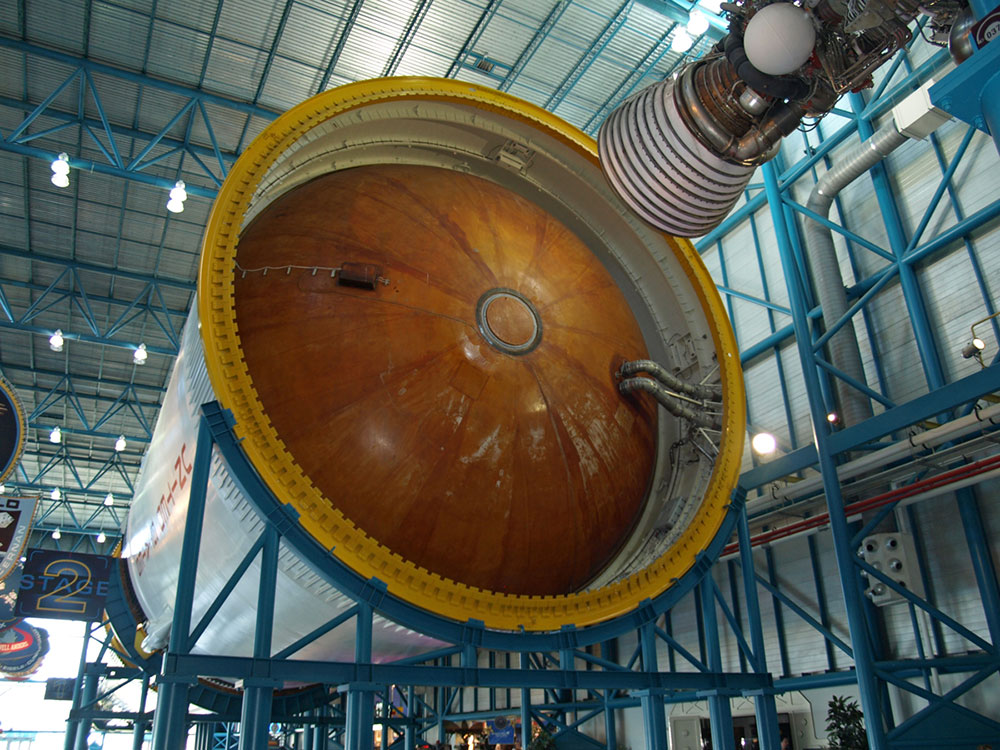
The Apollo/Saturn V Center, located 6 miles (9.7 km) north inside NASA's gates, is a large museum built around its centerpiece exhibit, a restored Saturn V launch vehicle, and features other space related exhibits, including an Apollo capsule. Two theaters allow the visitor to relive parts of the Apollo program. One simulates the environment inside an Apollo firing room during an Apollo launch, and another simulates the Apollo 11 Moon landing. The tour formerly included the Space Station Processing Facility (SSPF) where modules for the International Space Station were tested.

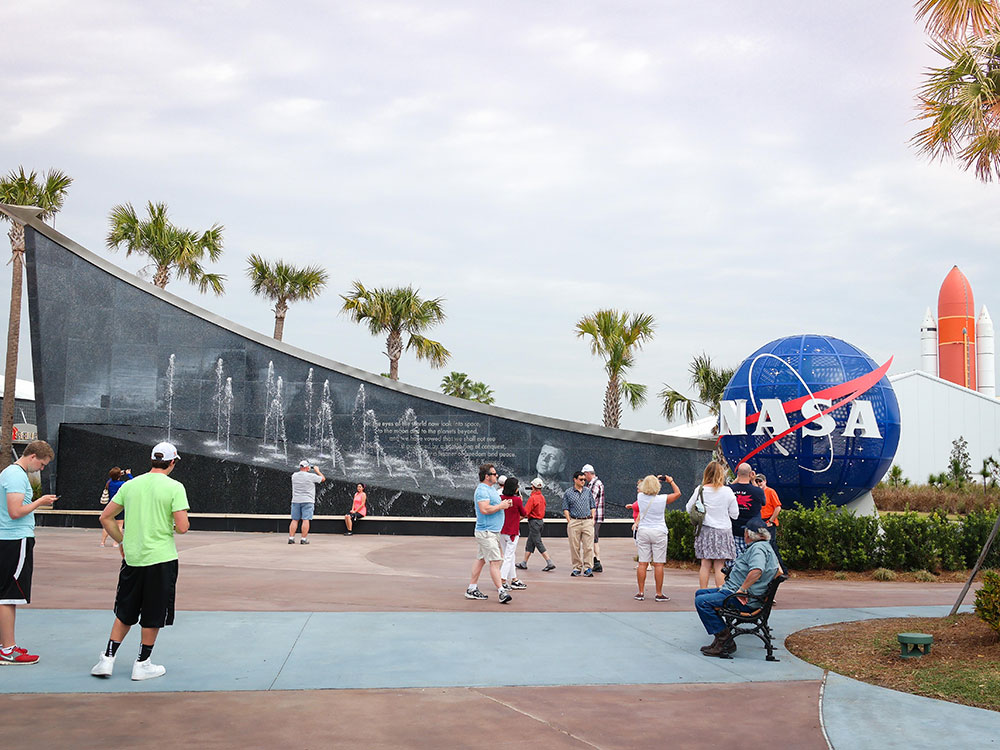
The Visitor Complex includes two facilities run by the Astronauts Memorial Foundation. The most visible of these is the Space Mirror Memorial, also known as the Astronaut Memorial, a huge black granite mirror through-engraved with the names of all astronauts who died in the line of duty. Elsewhere on the Visitor Complex grounds is the foundation's Center for Space Education, which includes a resource center for teachers, among other facilities; and the Kurt Debus Conference Center.

Heroes & Legends, which replaced the previous Early Space Exploration exhibit, houses the U.S. Astronaut Hall of Fame and several displays of artifacts. Among them is the Gemini 9A spacecraft, as well as a recreation of the Mercury Control Center using consoles and furniture relocated from the original building at Cape Canaveral Space Force Station.

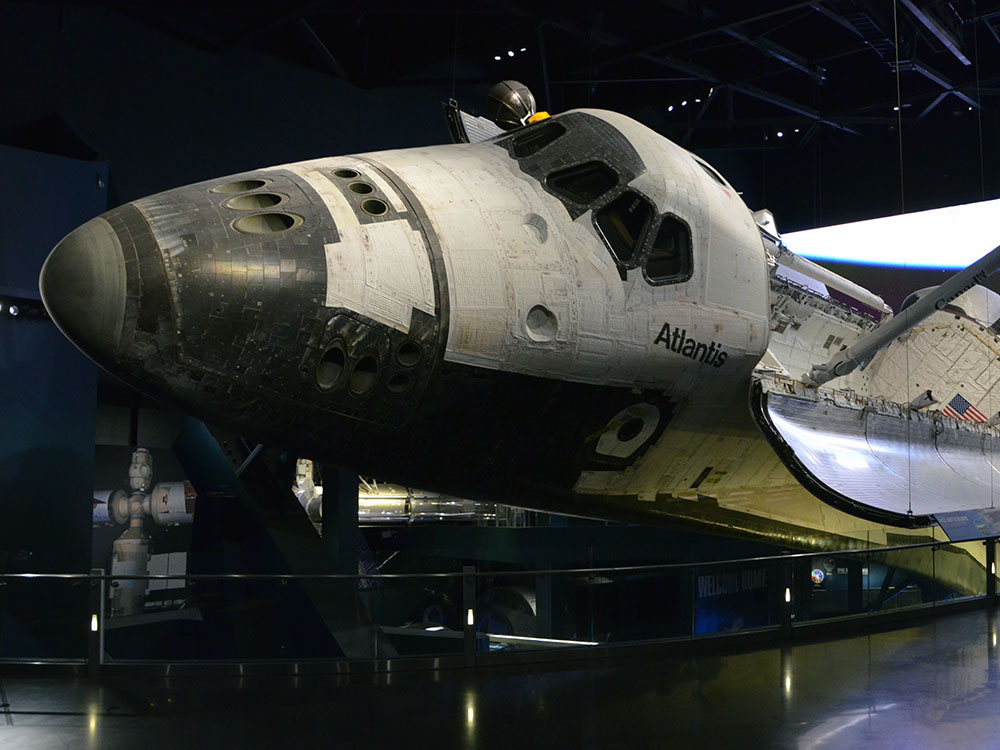
In 2010, the center announced a $100 million plan to house a retired Space Shuttle orbiter in a 10-story 64,000 square feet (5,900 m2) facility. On April 12, 2011, the 30th anniversary of the launch of STS-1, NASA announced that Space Shuttle Atlantis would be provided to the visitors center for display after its last flight on STS-135 and subsequent decommissioning. The exhibit officially opened on June 29, 2013, offering a nearly 360-degree view of the shuttle. Atlantis is positioned at a 43.21 degrees angle with the payload bay doors open; a view only previously seen in space.

The exhibit also includes a life sized replica of the Hubble Space Telescope, the Shuttle program's astrovan, Dr. Maxime Faget's Shuttle prototype from 1969, a large-scale slide mimicking the 22 degree slope of a Space Shuttle when landing, numerous astronaut training and Shuttle simulators, and other displays about life in space. On the ground level is the "Forever Remembered" exhibit, commemorating the 14 astronauts lost in both Space Shuttle Challenger and Space Shuttle Columbia disasters. Forever Remembered includes personal artifacts from the astronauts, two recovered pieces of the Shuttles, footage of the physical and emotional recovery, and the return to flight.

This exhibit replaced the Space Shuttle Explorer which was a full-scale, high-fidelity replica of the Space Shuttle which visitors were able to board. Explorer was removed from the KSC Visitor Center on December 11, 2011, and relocated to the Vehicle Assembly Building's turn basin dock adjacent to the Launch Complex 39 Press Site. The vehicle remained at the turn basin until 2012, when it was moved to the Space Center Houston.

The Shuttle Launch Experience, designed by Bob Rogers and the design team BRC Imagination Arts, opened May 25, 2007. The attraction puts guests through a simulated Shuttle launch. Delaware North Companies invested six years and $60 million into the attraction. Astronauts, NASA experts and attraction-industry leaders were consulted during development. The attraction is housed in a 44,000-square-foot (4,100 m2) building that holds four simulators, each accommodating 44 people. Former Shuttle commander and then NASA Administrator Charles F. Bolden narrates the simulation and hosts the prerecorded pre-show. In the attraction's early years, guests would enter from the outside and exit into a gift shop before heading back out to the Visitor Complex. In 2013, however, the attraction was later made part of the exhibit for the Space Shuttle Atlantis, with the former gift shop space being used for several simulators that allowed guests to try their hand at landing and docking the Space Shuttle.

The United States Astronaut Hall of Fame is now located in Heroes & Legends, which replaced the previous Early Space Exploration exhibit inside the visitor complex's main entrance. The $20 million exhibit, which opened in 2016, focuses on America's first astronauts and nine characteristics of a hero. Each characteristic features astronaut artifacts and multimedia relevant to that characteristic. Key artifacts include the 1966 Gemini 9A capsule flown by Thomas P. Stafford and Eugene Cernan, the original NASA emblem from the Mercury Control Center (1959), the control center from Project Mercury (remaining from Early Space Exploration), Mercury Redstone Rocket MR-6 (likely intended for Deke Slayton), and Wally Schirra's 1962 Sigma 7 capsule. There are also artifacts from specific astronauts, such as Gus Grissom's suborbital flight suit from July 21, 1961.

Heroes & Legends also holds the U.S. Astronaut Hall of Fame, displaying the inducted men and women. In the center of the hall is an interactive kiosk with an inductee database, a mission index, and a virtual photo opportunity with the Mercury 7 astronauts.

The United States Astronaut Hall of Fame, located inside the Heroes & Legends building, is included with visitor complex daily admission. The Hall of Fame was previously owned and operated by the U.S. Space Camp Foundation, but was purchased at auction by Delaware North Park Services in September 2002 on behalf of NASA. The building was renamed the ATX Center and houses educational programs including Camp Kennedy Space Center and the Astronaut Training Experience.

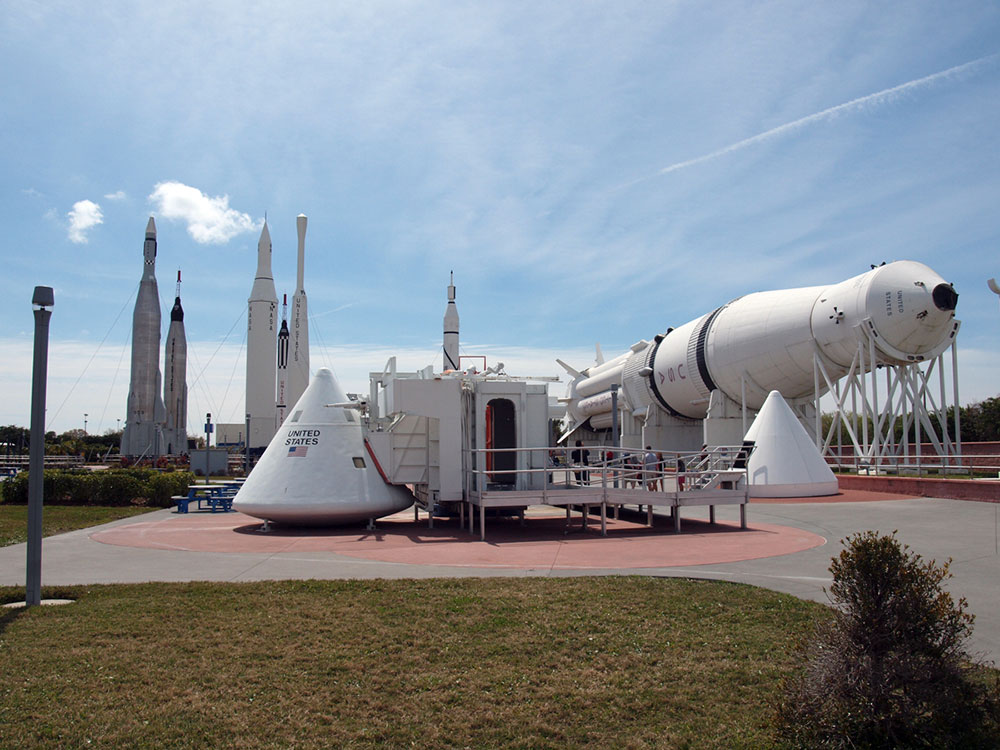
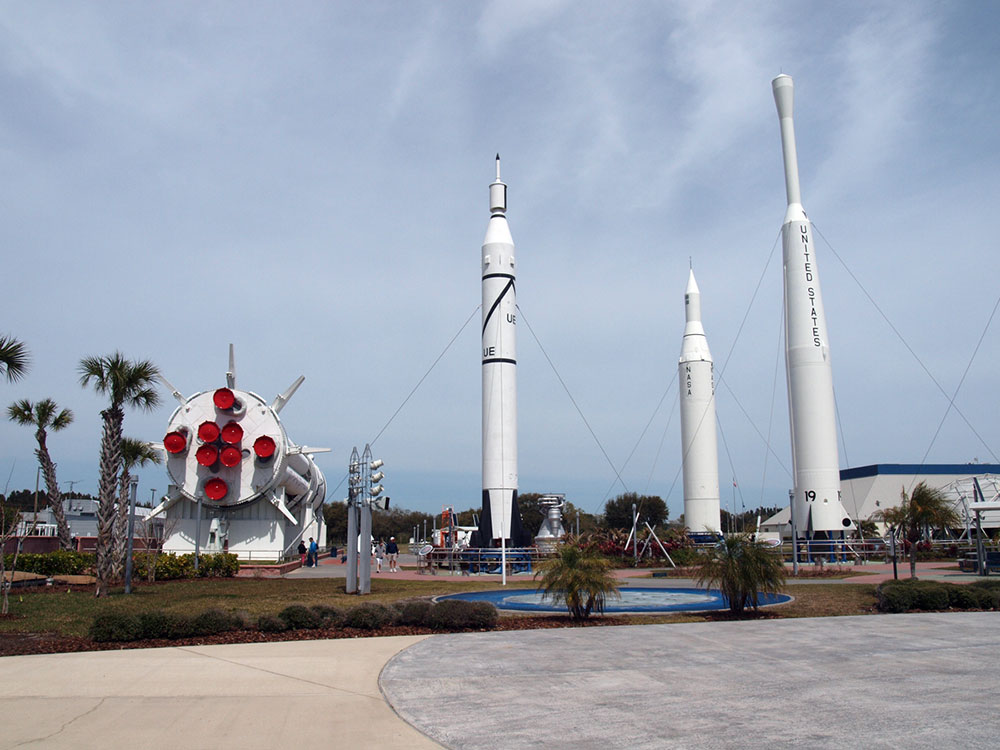
The Rocket Garden is located inside the front entrance, beyond Heroes & Legends.It is an outdoor display of historic rockets that put Americans and satellites in space. Visitors can walk up to and around the base of the rockets. All of the rockets in the garden are legitimate rockets with the exception of the Mercury-Atlas, which is a re-creation replica. The Mercury-Redstone, Mercury-Atlas, and Titan II rockets launched astronauts and the Juno I, Juno II, Thor-Delta, and Atlas-Agena rockets launched satellites from Cape Canaveral. These are mounted upright whereas the largest rocket, a Saturn IB, is mounted on its side. Saturn IB rockets launched Apollo Command/Service Modules into Earth orbit for Apollo, Skylab, and the Apollo-Soyuz Test Project. The Saturn IB is being restored in 2018. In March 2021 a Delta II Launch vehicle was added to the Rocket Garden

The Juno I on display is painted with serial number "UE", a reference to the vehicle that launched the first US satellite, Explorer I. A Juno II launched the first American probe to escape Earth's gravity and fly past the Moon. Atlas-Agena rockets launched early probes to the Moon, Venus, and Mars, as well as the Agena target vehicles used in rendezvous and docking by Gemini spacecraft—a necessary technique for the following Apollo missions. The Thor-Delta was one of the most reliable and frequently used launch vehicles. The Titan II on display is a refurbished Air Force ICBM with a replica Gemini spacecraft, painted to resemble the Gemini 3 booster. It was rescued from the Arizona Boneyard and erected in 2010 to replace a deteriorating mockup composed of two first stages which had been on display for more than 20 years. The Saturn IB on display is SA-209 which was designated for a possible Skylab Rescue mission.

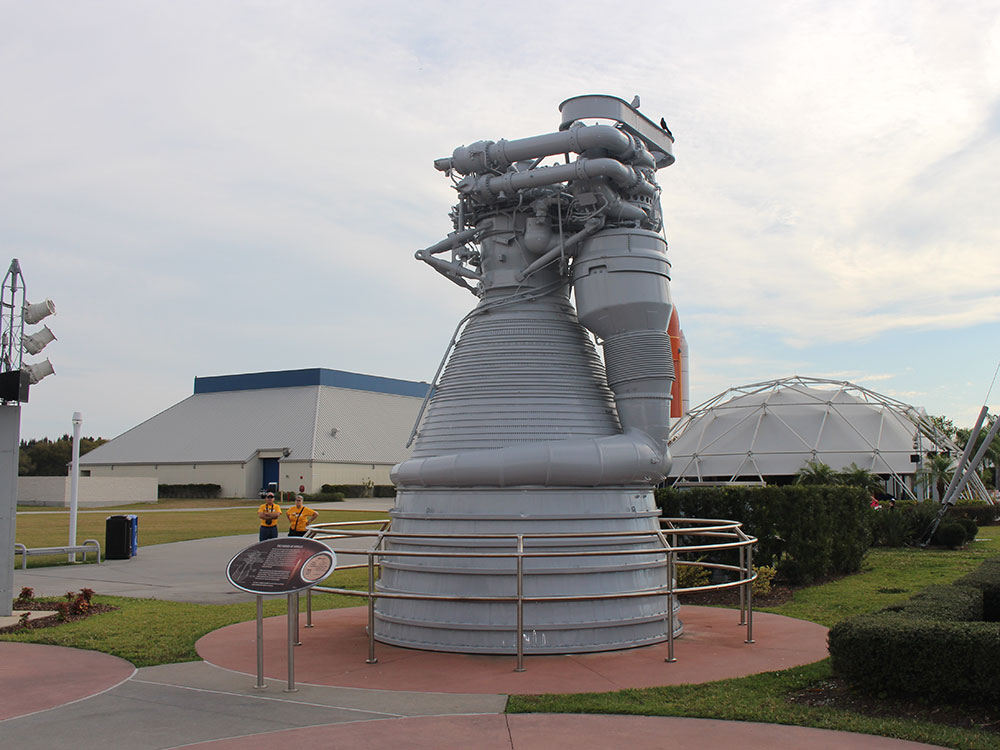
The garden also features mock-ups of capsules from the Mercury, Gemini, and Apollo programs that visitors can get in. An F-1 rocket engine that powered the first stage of the Saturn V is also on display. Free guided tours of the garden are available daily.

The Apollo/Saturn V Center is located north-northwest of Launch Complex 39 on the Kennedy Parkway N near the Shuttle Landing Facility and is only accessible to visitors by bus tours from the Visitors Complex. The center, which opened December 17, 1996, was designed by Bob Rogers and the design team BRC Imagination Arts, for NASA and Delaware North Companies. The opening of the exhibit was historic for NASA as it was the first large exhibit to be opened inside a restricted area, only accessible by Kennedy Space Center tour buses.

The 100,000-square-foot facility was built to house a restored Saturn V launch vehicle and features other exhibits related to the Apollo program. Until the structure was built, the Saturn V was displayed horizontally for many years outdoors just south of the Vehicle Assembly Building and tour buses brought visitors to it.

Other exhibits include the Apollo 14 command module Kitty Hawk, which carried Alan Shepard, Stuart Roosa, and Edgar Mitchell to the Moon in 1971 and orbited it 34 times, during which Shepard and Mitchell made the third crewed lunar landing; an unused Apollo command and service module Skylab Rescue (CSM-119), and an unused Lunar Module (LM-9). CSM-119 was designated for a possible Skylab rescue mission and as a backup for the Apollo-Soyuz Test Project. LM-9 was originally scheduled to be used on Apollo 15, but when missions after Apollo 17 were canceled, a later LM (LM-10) was used instead.

Also on display is a slice of Moon rock that visitors can touch. Other exhibits include a replica of the Lunar Roving Vehicle, a variety of space suits including Alan Shepard's Apollo 14 extravehicular suit, a piece of Apollo 13's Lunar Module returned by the astronauts, lunar samples from Apollo 15 and Apollo 17, and a large cut-away scale model of the Saturn V. Two theaters allow visitors to relive parts of the Apollo program - one simulates the environment inside an Apollo-era firing room during the launch of Apollo 8 and the other simulates the Apollo 11 landing.

In January 2017, "Ad Astra Per Aspera - A Rough Road Leads to the Stars" opened in the Apollo/Saturn V Center to commemorate the fallen astronauts of Apollo 1. The permanent tribute showcases personal memorabilia from the three astronauts, with photos and video from their professional and personal lives. The exhibit also displays the charred three-section Block I hatch from the fire, and a redesigned Block II hatch. The Block II hatch flew on all following Apollo missions that could open quicker in the event of an emergency.

In 2010, the attraction Exploration Space; Explorers Wanted, also designed by BRC Imagination Arts, functioned as part immersive experience, and part futuristic recruitment center. It is now known as Journey to Mars: Explorers Wanted with a focus on Mars exploration. The attraction, which employs large-scale video projections, dimensional exhibits and interactive experiences, is designed to immerse visitors into the adventure and unsolved challenges of future space exploration. The exhibit includes orbital docketing and lunar landing simulators, a full-sized development model of a crew vehicle, a model of a space exploration vehicle, and models of the Mars rover family: Curiosity, Spirit, Opportunity, and Sojourner.

NASA Now is an exhibit that has a revolving display of spacecraft from NASA and its commercial partners. NASA Now, as of summer 2017, has the space-flown Orion EFT-1 designed for NASA's future Space Launch System (SLS) and a scale model of an SLS rocket. There is also a full-scale model of the crew vehicle CST-100 Starliner by Boeing. SpaceX's space-flown COTS-2 Dragon capsule, which is the first commercial vehicle to dock with the International Space Station, is also featured. A pressure vessel for CST-100 Starliner, a scale model of the Dream Chaser cargo vehicle from Sierra Nevada Corporation, a scale model of United Launch Alliance's Atlas V rocket, and a Vector-R rocket from Vector Space Systems are also all in the exhibit. NASA Now is located inside the IMAX theater.

The Space Mirror Memorial, also known as the Astronaut Memorial, is maintained by the Astronauts Memorial Foundation and is located behind the IMAX theater on the grounds of the main Visitor Complex. It honors NASA astronauts along with several military and civilian astronauts who have died in the line of duty.

The Planet Play attraction is a multi-story, highly immersive play structure geared towards children between the ages of 2-12. It opened to the public on January 1, 2021, and features various amenities such as climbing structures, slides, interactive games, and light projections, with the intention of educating children on some of the technologies used in space exploration.

Step. Power. Launch. is an attraction where visitors jump on pressure pads to power up a rocket on a screen. There are 3 sections: Earth, Moon And Mars. When the rocket is completely fueled up, smoke begins to spew from beneath the screen and a launch sequence is shown.

This 3D IMAX theater, located inside the Planet Play building, shows two films: Journey to Space and Asteroid Hunters.

This article uses material from the Wikipedia article "Kennedy Space Center Visitor Complex", and "Kennedy Space Center" which is released under the Creative Commons Attribution-Share-Alike License 3.0

Michael Rivera, CC BY-SA 4.0, via Wikimedia Commons
Visitor7, CC BY-SA 3.0, via Wikimedia Commons
Gillfoto, CC BY-SA 3.0, via Wikimedia Commons