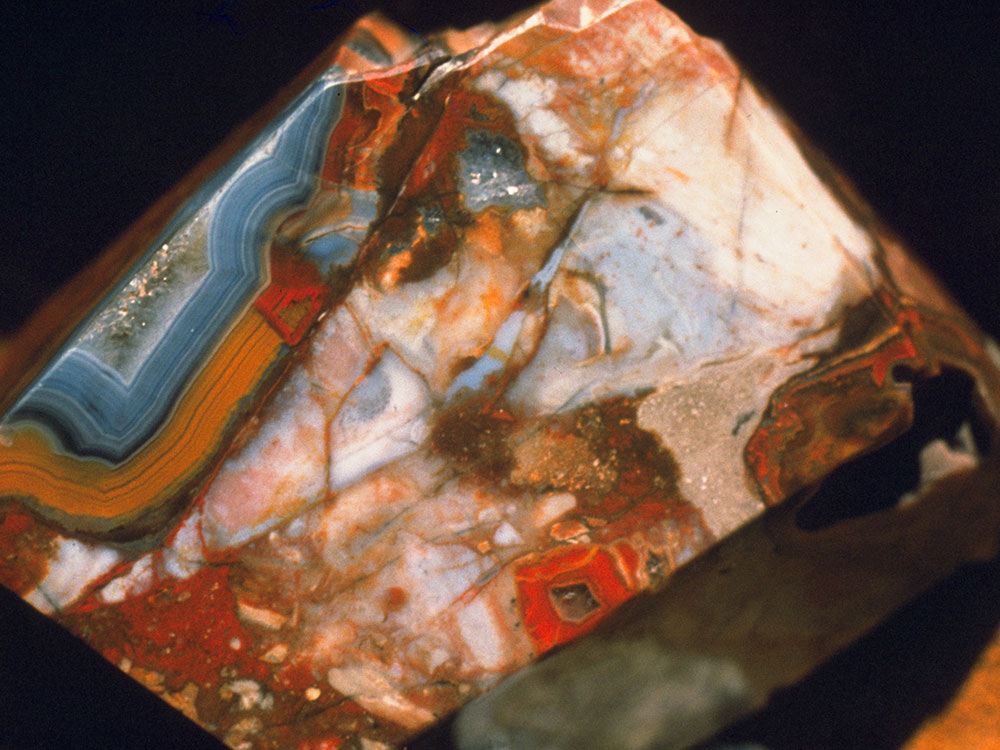
National Monument protecitng quarry pits along the red bluffs above the Canadian River containing rainbow-hued flint
General Information
Last updated 9/14/2022
Ranger-guided quarry tours available daily at 10am and 1pm until October 22, 2022
Head east on E Amarillo Blvd/U.S. Rt. 66 toward N Pierce St, Turn left onto TX-136 N, Turn left onto Cas Johnson Rd, Continue onto Alibates Rd
For thousands of years, people came to the red bluffs above the Canadian River for flint, vital to their existence. Demand for the high-quality, rainbow-hued flint is reflected in the distribution of Alibates flint through the Great Plains and beyond. Indians of the Ice Age Clovis culture used Alibates flint for spear points to hunt the Columbian mammoth before the Great Lakes were formed. The flint usually lies just below the surface at ridge level in a layer up to 6 ft thick. The quarry pits were not very large, between 5 and 25 ft wide and 4 to 7 ft deep. Many of these quarries were exploited by the Antelope Creek people of the Panhandle culture between 1200 and 1450 AD. The stone-slabbed, multiroom houses built by the Antelope Creek people have long been of interest to the public and studied by archaeologists. Today, this area is protected by the U.S. National Park Service and can only be viewed by ranger-led guided tours, which must be reserved in advance.
The monument was authorized as Alibates Flint Quarries and Texas Panhandle Pueblo Culture National Monument on August 31, 1965, but the designation was shortened to the current name on November 10, 1978.
Things to Do
Take a Ranger-Guided Quarry Tour
The monument's signature experience is a ranger-led hike to the ancient flint quarries where Indigenous peoples obtained colorful Alibates flint for tools and trade. Tours are available by reservation only and include interpretation of geology, archaeology, history, and native plant life. The hike is approximately 2 miles round trip with about 170 feet of elevation gain.
Visit the Visitor Center
Explore museum exhibits that explain the significance of Alibates flint, Native American cultures, and the history of the Texas High Plains. The visitor center also features a park film and bookstore.
See Ancient Quarry Sites
During the guided tour, visitors can view quarry pits where people extracted flint for thousands of years. Evidence of flint mining dates back roughly 13,000 years.
View Petroglyphs
Examine ancient rock carvings created by Indigenous peoples that provide insight into the region's cultural history.
Explore Museum Exhibits
Interactive displays help visitors understand how Alibates flint was used for hunting tools, knives, scrapers, and trade throughout North America.
Enjoy Panoramic Views
The mesa-top quarry tour provides sweeping views of the Canadian River breaks, surrounding grasslands, and nearby Lake Meredith landscapes.
Photograph Unique Alibates Flint
The monument is famous for its colorful agatized dolomite, which appears in shades of red, orange, yellow, purple, pink, and blue, making it unlike any other flint found in the world.
Highlights
Alibates Flint
The monument preserves one of the most important prehistoric quarry sites in North America. This distinctive stone was highly prized for its sharp edges and was traded across much of the Great Plains.
Historic Indigenous Culture
Archaeological evidence shows that Native peoples quarried and traded flint from this area for thousands of years, making the site a major center of commerce and tool production.
Scenic High Plains Landscape
The combination of mesas, red bluffs, grasslands, and river breaks creates dramatic scenery that differs from much of Texas.
Free Admission
There is no entrance fee to visit the monument or visitor center, though quarry tours require advance reservations.
This article uses material from the Wikipedia article "Alibates Flint Quarries National Monument", which is released under the Creative Commons Attribution-Share-Alike License 3.0