
Monument preserves the site of the Battle of the Little Bighorn, and serves as a memorial to those who fought in the battle: George Armstrong Custer's 7th Cavalry and a combined Lakota-Northern Cheyenne and Arapaho force
General Information
Summer hours: Memorial Day through Labor Day
Visitor Center/ Museum/ Book Store: 8am to 6pm
Entrance Gate: 8am to 6pm
4.5 mile driving tour road: 8am to 5:30pm
Deep Ravine walking trail: 8am to 5:30pm
Last Stand Hill and Indian Memorial: 8am to 6pm
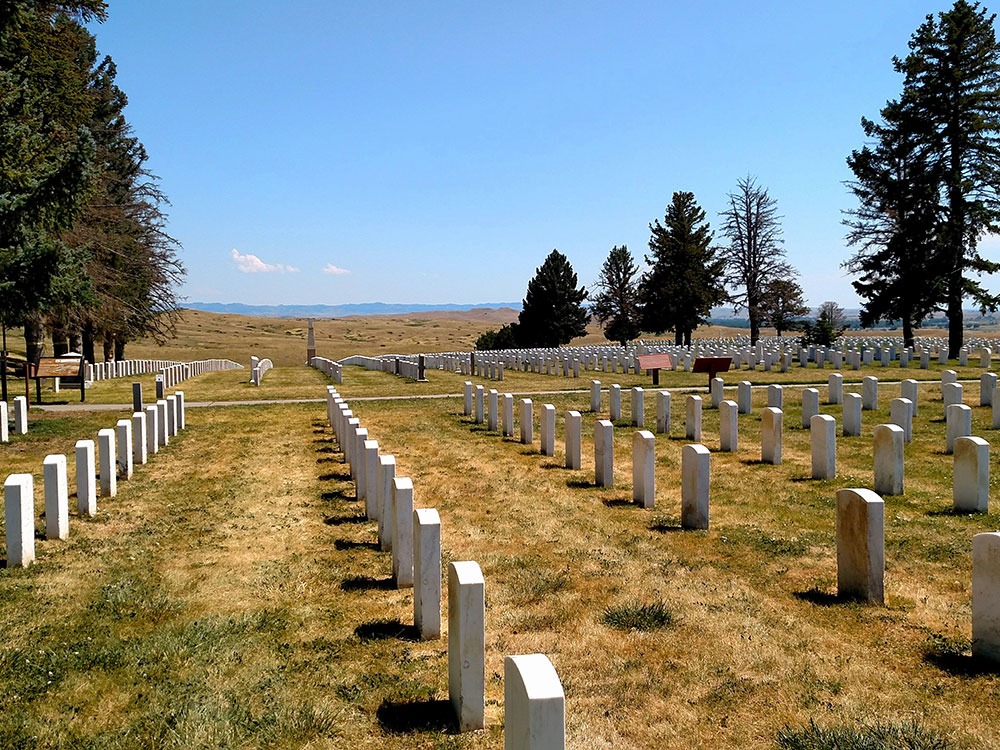
Custer National Cemetery: 8am to 6pm
Fall hours:
Visitor Center/ Museum/ Book Store: 8am to 4:30pm
Entrance Gate: 8am to 4:30pm
4.5 mile driving tour road: 8am to 4:30pm
Deep Ravine walking trail: 8am to 4:30pm
Last Stand Hill and Indian Memorial: 8am to 4:30pm
Custer National Cemetery: 8am to 6pm
Winter hours: October 1st through March 31st
Visitor Center/ Museum/ Book Store: 8am to 4:30pm
Entrance Gate: 8am to 4:30pm
4.5 mile driving tour road: 8am to 4pm
Deep Ravine walking trail: 8am to 4pm
Last Stand Hill and Indian Memorial: 8am to 4:30pm
Custer National Cemetery: 8am to 4:30pm
Spring hours: April 1st through Memorial Day
Visitor Center/ Museum/ Book Store: 8am to 4:30pm
Entrance Gate: 8am to 4:30pm
4.5 mile driving tour road: 8am to 4pm
Deep Ravine walking trail: 8am to 4pm
Last Stand Hill and Indian Memorial: 8am to 4:30pm
Custer National Cemetery: 8am to 4:30pm
Motorcycle $20.00
Per person, walk-in or bicycle $15.00
From Billings (61 miles): Get on I-90 E in Lockwood from 1st Ave N and I-90BL E. Follow I-90 E to US-212 E in Crow Agency. Take exit 510 from I-90 E. Continue on US-212 E to your destination in Garryowen.
Little Bighorn Battlefield National Monument preserves the site of the June 25 and 26, 1876, Battle of the Little Bighorn, near Crow Agency, Montana. It also serves as a memorial to those who fought in the battle: George Armstrong Custer's 7th Cavalry and a combined Lakota-Northern Cheyenne and Arapaho force. Custer National Cemetery, on the battlefield, is part of the national monument. The site of a related military action led by Marcus Reno and Frederick Benteen is also part of the national monument, but is about 3 miles (5 km) southeast of the Little Bighorn battlefield.
History of site:
- 25 and 26 June 1876: Battle of the Little Bighorn
- 1877: Custer, who had been buried there, was reinterred in West Point Cemetery.
- 29 January 1879: The Secretary of War first preserved the site as a U.S. National Cemetery, to protect graves of the 7th Cavalry troopers buried there.
- 7 December 1886: The site was proclaimed National Cemetery of Custer's Battlefield Reservation to include burials of other campaigns and wars. The name has been shortened to "Custer National Cemetery."
- 5 November 1887: Battle of Crow Agency, three miles north of Custer battlefield
- 14 April 1926: Reno-Benteen Battlefield was added
- 1 July 1940: The site was transferred from the United States Department of War to the National Park Service
- 22 March 1946: The site was redesignated "Custer Battlefield National Monument."
- 15 October 1966: The site was listed on the National Register of Historic Places.
- 1976, The American Indian Movement (AIM) protested the centennial commemoration of the site, arguing that the site revered Custer and the Battle of Little Big Horn as a part of a heroic saga of American history and expansion into the American West while those who revered it had been truly "celebrating an act of genocide."
- 11 August 1983: A wildfire destroyed dense thorn scrub which over the years had seeded itself about and covered the site. This allowed archaeologists access to the site.
- 1984, 1985: Archaeological digging on site.
- 10 December 1991: The site was renamed Little Bighorn Battlefield National Monument by a law signed by President George H. W. Bush.
The first memorial on the site was assembled by Captain George K. Sanderson and the 11th Infantry. They buried soldiers' bodies where they were found and removed animal bones. In his official report dated April 7, 1879, Sanderson wrote:
I accordingly built a mound out of cord wood filled in the center with all the horse bones I could find on the field. In the center of the mound I dug a grave and interred all the human bones that could be found, in all, parts of four or five different bodies. This grave was then built up with wood for four feet above ground. The mound is ten feet square and about eleven feet high; is built on the highest point immediately in rear of where Gen'l Custer's body was found ...
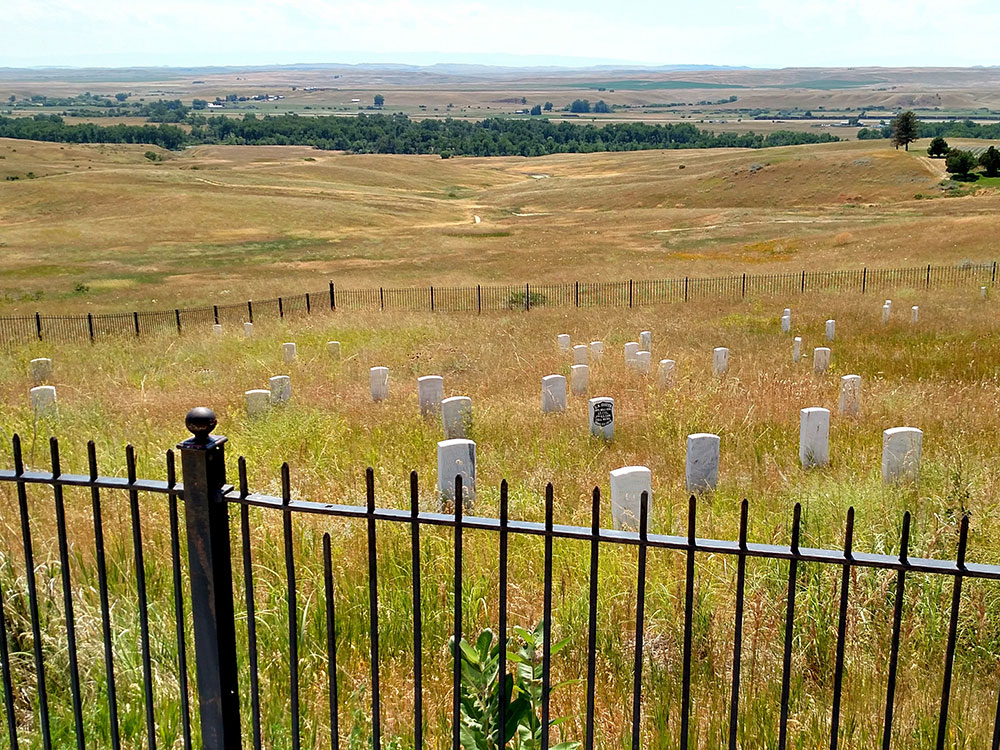
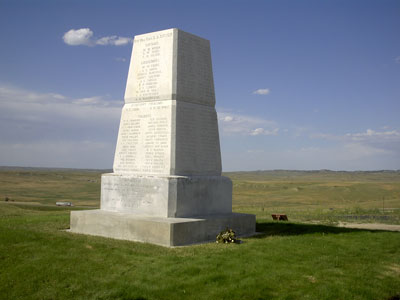
Lieutenant Charles F. Roe and the 2nd Cavalry built the granite memorial in July 1881 that stands today on the top of Last Stand Hill. They also reinterred soldiers' remains near the new memorial, but left stakes in the ground to mark where they had fallen. In 1890 these stakes were replaced with marble markers.
The bill that changed the name of the national monument also called for an "Indian Memorial" to be built near Last Stand Hill.
Markers honoring the Indians who fought at Little Big Horn, including Crazy Horse, have been added to those of the U.S. troops. On Memorial Day, 1999, the first of five red granite markers denoting where warriors fell during the battle were placed on the battlefield for Cheyenne warriors Lame White Man and Noisy Walking.
The warriors' red speckled granite memorial markers dot the ravines and hillsides just as do the white marble markers representing where soldiers fell. Since then, markers have been added for the Sans Arc Lakota warrior Long Road and the Minniconjou Lakota Dog's Back Bone.
On June 25, 2003, an "unknown Lakota warrior marker" was placed on Wooden Leg Hill, east of Last Stand Hill to honor a warrior who was killed during the battle, as witnessed and reported by the Northern Cheyenne warrior Wooden Leg.
The battlefield is the final resting place of the western historian and author Stanley Vestal, a professor at the University of Oklahoma.
Things to Do
Explore One of America's Most Historic Battlefields
Little Bighorn Battlefield National Monument preserves the site of the Battle of the Little Bighorn, fought on June 25-26, 1876. Located on the Crow Reservation in southeastern Montana, the monument commemorates the U.S. Army's 7th Cavalry, the Lakota, Northern Cheyenne, and Arapaho warriors, and all those affected by the conflict.
Walk to Last Stand Hill
One of the monument's most significant locations, Last Stand Hill marks the area where Lieutenant Colonel George A. Custer and many of his soldiers made their final stand. Visitors can follow a paved walking path from the visitor area to view the memorials and battlefield markers.
Visit the Indian Memorial
Dedicated in 2003, the Indian Memorial honors the Native warriors and families who fought to preserve their way of life. The memorial's theme, "Peace Through Unity," encourages visitors to consider multiple perspectives of the battle and its lasting impact.
Drive the Battle Tour Road
The self-guided Battle Tour Road extends approximately 4.5 miles from the visitor area to the Reno-Benteen Entrenchment Site. Interpretive displays and overlook areas along the route help visitors understand the progression of the battle across the landscape.
Explore the National Cemetery
The national cemetery contains the graves of veterans from numerous American military conflicts. Visitors can walk among the historic markers and reflect on the service and sacrifice of those interred there.
Watch the Park Film and Explore Exhibits
The park's orientation film and exhibits provide important background on the battle, the people involved, and the broader history of the Northern Plains. These resources help visitors gain a deeper understanding before exploring the monument.
Attend Ranger Programs
During the summer season, ranger-led programs offer detailed interpretations of the battle, military tactics, Native perspectives, and the historical significance of the site. These presentations bring the battlefield's stories to life.
Top Trails
Deep Ravine Trail
Length: Approximately 0.25 miles round trip
Elevation Gain: Minimal
Difficulty: Easy
This self-guided trail explores the Deep Ravine area, one of the most significant locations associated with the battle. Interpretive information along the route helps visitors better understand the events that unfolded in this portion of the battlefield.
Reno-Benteen Entrenchment Trail
Length: Approximately 1 mile round trip
Elevation Gain: Minimal to Moderate
Difficulty: Easy
Located at the end of the Battle Tour Road, this trail allows visitors to explore the defensive positions occupied by Major Marcus Reno and Captain Frederick Benteen's troops during the battle.
Last Stand Hill Trail
Length: Approximately 0.3 miles round trip
Elevation Gain: Gentle incline
Difficulty: Easy
Beginning near the visitor area, this paved trail leads visitors to Last Stand Hill, the 7th Cavalry Monument, and the Indian Memorial while providing impressive views across the battlefield.
Battlefield Walking Route
Length: Varies based on exploration
Elevation Gain: Minimal
Difficulty: Easy
Visitors can combine the monument's trails, memorials, overlooks, and interpretive sites into a broader walking experience that provides a comprehensive understanding of the battlefield's history and geography.
Sources: National Park Service official Little Bighorn Battlefield National Monument visitor information, including Battle Tour Road, Last Stand Hill, the Indian Memorial, National Cemetery, ranger programs, and visitor activities.
Little Bighorn Battlefield National Monument - Things To Do
Additional National Park Service visitor information covering park orientation, self-guided tours, the visitor center, battlefield features, and educational opportunities.
Little Bighorn Battlefield National Monument - Plan Your Visit
Supplemental information regarding trails, memorials, the Indian Memorial, Custer National Cemetery, and battlefield interpretation.
Five Must-Do Activities at Little Bighorn Battlefield National Monument
This article uses material from the Wikipedia article "Little Bighorn Battlefield National Monument", which is released under the Creative Commons Attribution-Share-Alike License 3.0