
Public aquarium located in Boston, featuring the Giant Ocean Tank, a cylindrical 200,000-US-gallon (760,000 l) tank simulating a Caribbean coral reef
General Information
Saturday–Sunday: 9:00am to 6:00pm
Extended hours during summer and school vacation weeks
Seniors (62+): $32
Youth (3–11): $29
Children under 3: Free
How to Get There
By Car from Downtown Boston: Drive toward the Waterfront and North End via Atlantic Avenue, then turn onto Central Wharf near Long Wharf; the New England Aquarium is located directly on Boston Harbor with nearby parking available at Harbor Garage and other downtown garages.
Overview
The New England Aquarium is a public aquarium located in Boston, Massachusetts. In addition to the main aquarium building, attractions at the New England Aquarium include the Simons IMAX Theatre and the New England Aquarium Whale Watch, which operates from April through November.
Exhibits
Located in the central open atrium of the main building, the principal feature of the Aquarium is the Giant Ocean Tank, a cylindrical 200,000-US-gallon (760,000 l) tank simulating a Caribbean coral reef. This tank houses bonnethead sharks, sea turtles, stingrays, moray eels, barracuda, and many smaller reef-living fish. Open at the top, the concrete tank is surrounded by a walkway that spirals down, allowing visitors access to 52 windows that offer views of the reef from every angle and level.
At the bottom, the tank stands in a large, square 150,000-US-gallon (570,000 l) penguin exhibit, hosting African penguins, and southern rockhopper penguins. The penguin exhibit can be seen from the spiral walkway of the central tank or from elevated viewing areas that completely surround the perimeter. The penguins live on several artificial rock islands in the exhibit. Surrounding the atrium are four levels of smaller exhibits including:
The Thinking Gallery, also known as the Temperate Gallery, featuring Goliath grouper, ancient fishes, rare sea dragons, coastal environments, and thousands of schooling fish.
The Freshwater Gallery focuses on freshwater habitats in South America compared to New England river systems. This gallery features Piranha, anacondas, electric eels, and Atlantic salmon.
The Edge of the Sea tide pool. Visitors are allowed to touch New England tide pool animals including sea stars, sea urchins, snails, hermit crabs, and horseshoe crabs.
The Northern Waters of the World Gallery focuses on New England marine habitats compared to Pacific Northwest habitats. The gallery features shorebirds, colored lobsters, goosefish, Octopus, and countless other invertebrates.
The Tropical Gallery features many colorful tropical fish, cuttlefish, venomous fish including Pterois, scorpionfish, and living corals.
The Blue Planet Action Center presents the challenges the oceans are facing and shows the Aquarium's role in the search for solutions. It also features the life cycles of sharks and lobsters.
The Yawkey Coral Reef Center magnifies some of the smaller creatures in the Caribbean environments. The Reef features batfishes, heterocongrinae, and Diadema antillarum.
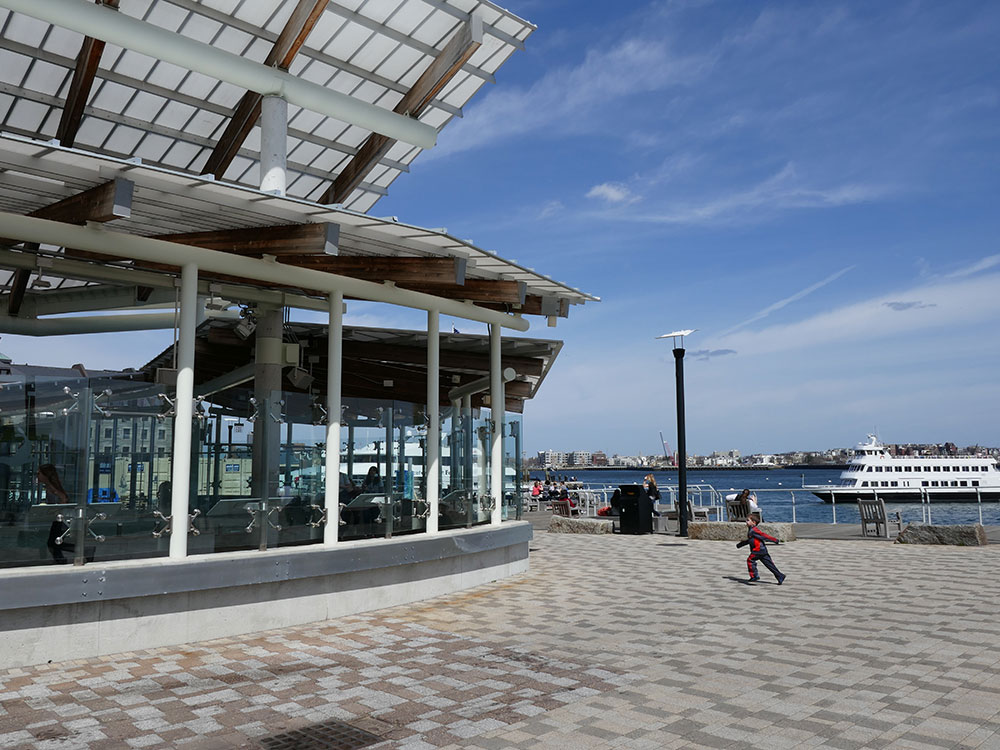
In front of the Aquarium is a harbor seal exhibit, which can be seen for free without entering the building. Four Northern fur seals and four California sea lions are on exhibit behind the Aquarium in the open-air New Balance Foundation Marine Mammal Center on the harborside terrace, which opened in 2009 with views of Boston Harbor. All the New England Aquarium's marine mammals participate in daily training sessions that are open for public viewing and participation.
The "Amazing Jellies" exhibit in the West Wing features Aurelia aurita, sea nettles, Cassiopea, Palauan Lagoon jellies and Phyllorhiza punctata, all from diverse habitats around the world. In 2011, the Trust Family Foundation Shark and Ray Touch Tank opened in the West Wing. At 25,000 US gallons (95,000 l), it is the largest on the east coast. Some of the species in the exhibit include cownose rays, yellow rays and guitarfish.
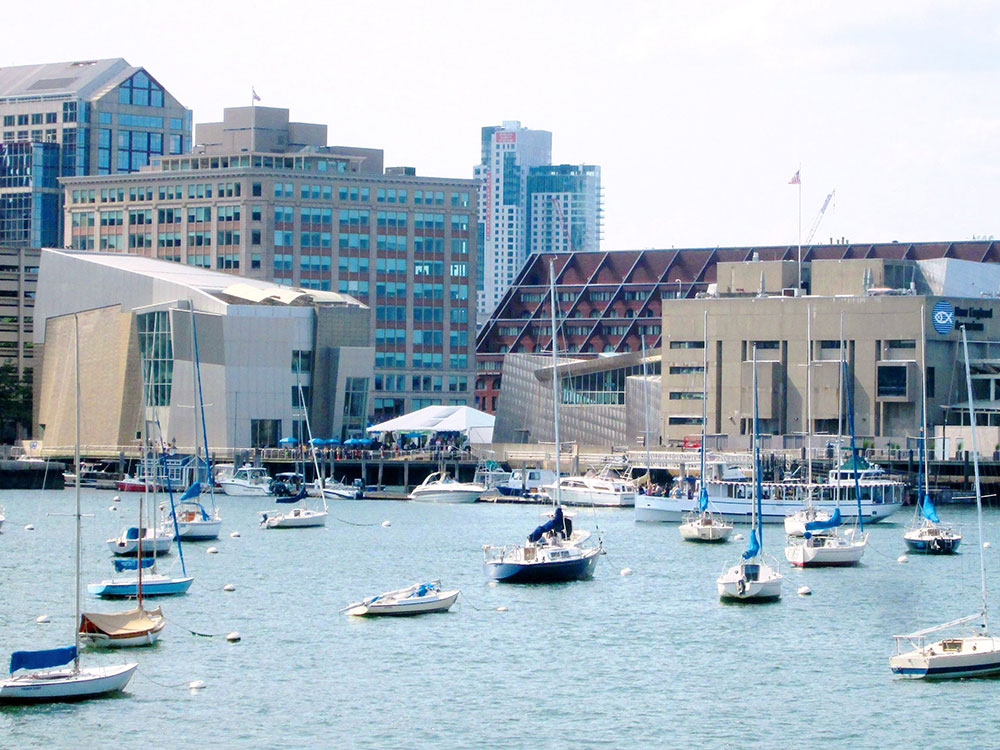
The New England Aquarium is on the Central Wharf along Atlantic Avenue on the waterfront in downtown Boston and adjacent to Long Wharf and the Rose Kennedy Greenway. The Boston Harborwalk goes around the perimeter of the Aquarium. The Aquarium is also a short walk from the Haymarket Station on the Orange and the Green Lines. The Aquarium is within walking distance of the North End, Government Center, and the Financial District.
During the months of April to October, the aquarium hosts a whale watch cruise with partners at Boston Harbor Cruises. Watchers interact with naturalists and educators. The ship whisks the watchers to a location 30 miles (48 km) east of Boston called the Stellwagen Bank National Marine Sanctuary. This rich feeding ground is home to a wide diversity of large whales, such as humpback whales, finback whales, minke whales, pilot whales, and the endangered right whales. Also, in some cases, a white-sided dolphin might be seen. Most trips last around 3 to 4 hours.
This article uses material from the Wikipedia article "New England Aquarium", which is released under the Creative Commons Attribution-Share-Alike License 3.0

_(11061981485)-1000.jpg)
_(11061981485).jpg)
_(11062233115)-1000.jpg)
_(11062233115).jpg)

_IMG_0321-1000.jpg)
_IMG_0321.jpg)