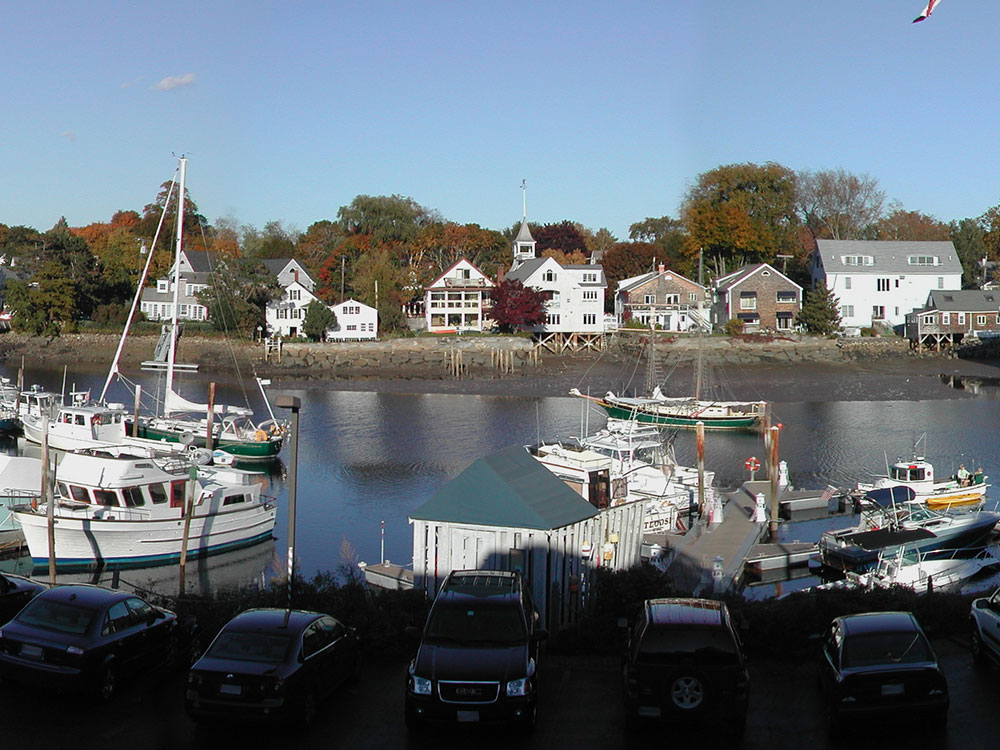

Towns located along the Kennebunk River, and historically shipbuilding and fishing villages, for well over a century the towns have been a popular summer colony and seaside tourist destination
General Information
From Portland to Kennebunk (27 miles):
Get on I-295 S/US-1 S from Elm St. Take I-95 S to Alewive Park Rd in Kennebunk. Take exit 25 from I-95 S. Take ME-35 S/Fletcher St and Storer St to High St.
To Kennebuckport(28 miles): Get on I-295 S/US-1 S from Elm St. Take I-95 S to Biddeford Connector in Biddeford. Take exit 32 from I-95 S. Take US-1 S and Log Cabin Rd to Dock Square in Kennebunkport.
Kennebunk is a town in Maine and is home to several beaches, the Rachel Carson National Wildlife Refuge, the 1799 Kennebunk Inn, many historic shipbuilders' homes, the Brick Store Museum and the Nature Conservancy Kennebunk Plains (known locally as the Blueberry Plains), with 1,500 acres (6 km2) of nature trails and blueberry fields.
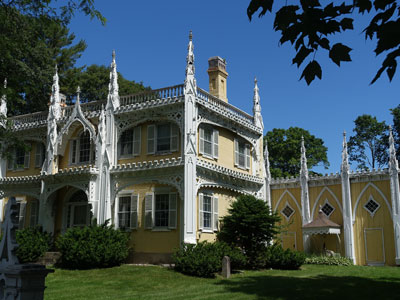
The town is a popular summer tourist destination. Kennebunk contains fine examples of early architecture, the most noted of which is the Wedding Cake House, a Federal-style dwelling extensively decorated with scroll saw Gothic trim. This was added to the house for his wife of many years by George Washington Bourne late in his life, and not as legend has it by a ship captain for a young bride lost at sea.
The Lafayette Elm was a tree which was planted to commemorate General Lafayette's 1825 visit to Kennebunk. It became famous for its age, size, and survival of the Dutch elm disease that destroyed the hundreds of the other elms that once lined Kennebunk's streets. The elm is featured on the town seal. The restored Kesslen Shoe Mill has been renamed the Lafayette Center. Summer Street was Maine's first Historic District that was listed on the National Register of Historic Places.
Once called the "most photographed house in the state" of Maine, the Wedding Cake House, known formally as the George W. Bourne House, is a historic house located in Kennebunk, Maine. The home was built in 1825 by shipbuilder George W. Bourne (1801–1856), who later built a frame barn which he connected to the main house with a carriage house. In 1852, the barn caught fire and the carriage house was demolished to keep the fire from spreading to the house. Bourne, who during a European tour had been impressed by the Gothic beauty of the cathedral at Milan, rebuilt the carriage house and barn in what later came to be known as Carpenter Gothic style. Using hand tools, he crafted five buttresses with pinnacles on top of each. Then in order to tie the new structures in with the existing house, he added six buttresses with pinnacles to the house and then joined them together with intricate woodwork. His only help in doing this was Thomas Durrell, an apprentice ship's carpenter. Bourne spent the rest of his life adding to these embellishments. It has been said of Bourne: "The highly skilled carpenter knew no limits to his skill."
The "Wedding Cake" name was applied to the house due to its wedding cake-like appearance. Legend developed that the busy Bourne, a sea captain, had done the carpentry work to atone for not having taken his bride, Jane, on a proper honeymoon. This was not the case.
In 1983, the home was purchased from the last descendant of George Bourne to live there by Mary Burnett and her daughter Anne. The women completely restored the mansion, completing the work in 1984.
In fall 2005, the home was opened to the public for the first time by current owners Jimmy Barker and Kenneth W. Douglas as a fundraiser for Hurricane Katrina relief.
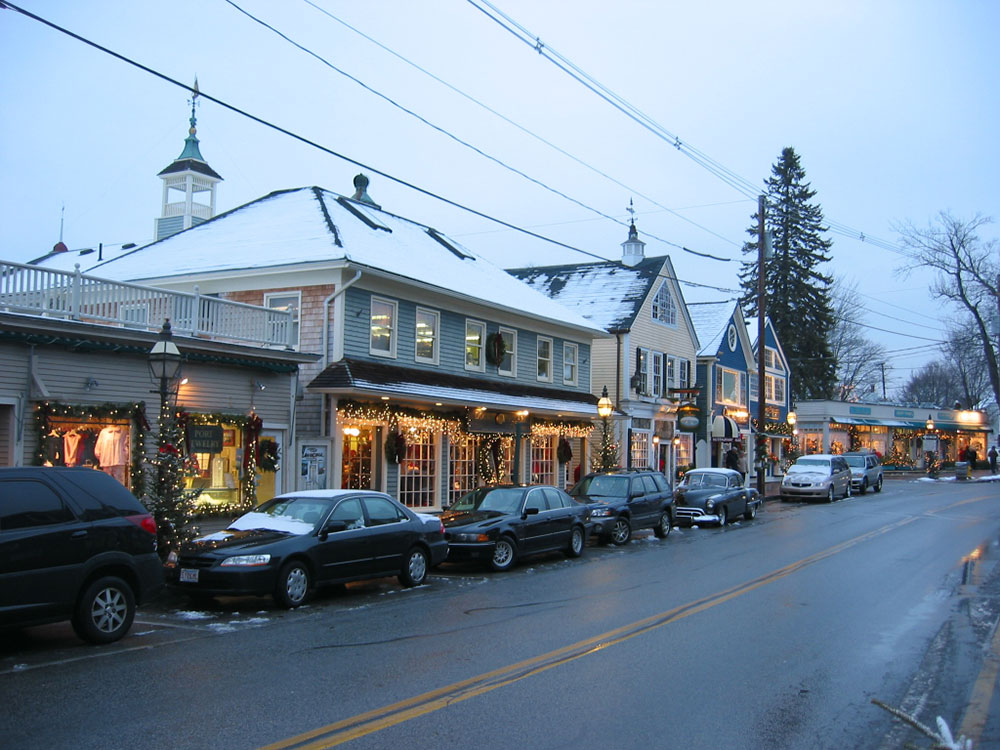
The town center, the area in and around Dock Square, is located along the Kennebunk River, approximately 1 mile (1.6 km) from the mouth of the river on the Atlantic Ocean. Historically a shipbuilding and fishing village, for well over a century the town has been a popular summer colony and seaside tourist destination. The Dock Square area has a district of souvenir shops, art galleries, schooner attractions, seafood restaurants, and bed and breakfasts. Cape Porpoise, while retaining its identity as a fishing harbor, has a very small village area with several restaurants, a church, grocery store, coffee shop, small library, and art gallery. Kennebunkport has a reputation as a summer haven for the upper class and is one of the wealthiest communities in the state of Maine. The town also includes the enclave of Walker Point, which is the summer estate of the Presidential Bush Family.
The town has several distinct areas, each developed during a phase of the town's history. The original town center was at Cape Porpoise, which today has a small village center, is both a summer colony and year-round community, and hosts a working fishing harbor. Inland from Cape Porpoise is a mix of forest and agricultural land, punctuated by a historic town center at Burbank Hill (there are a few historic buildings of interest here, including a schoolhouse and jail). Heading west towards the mouth of the Kennebunk River is Dock Square, the current town center.
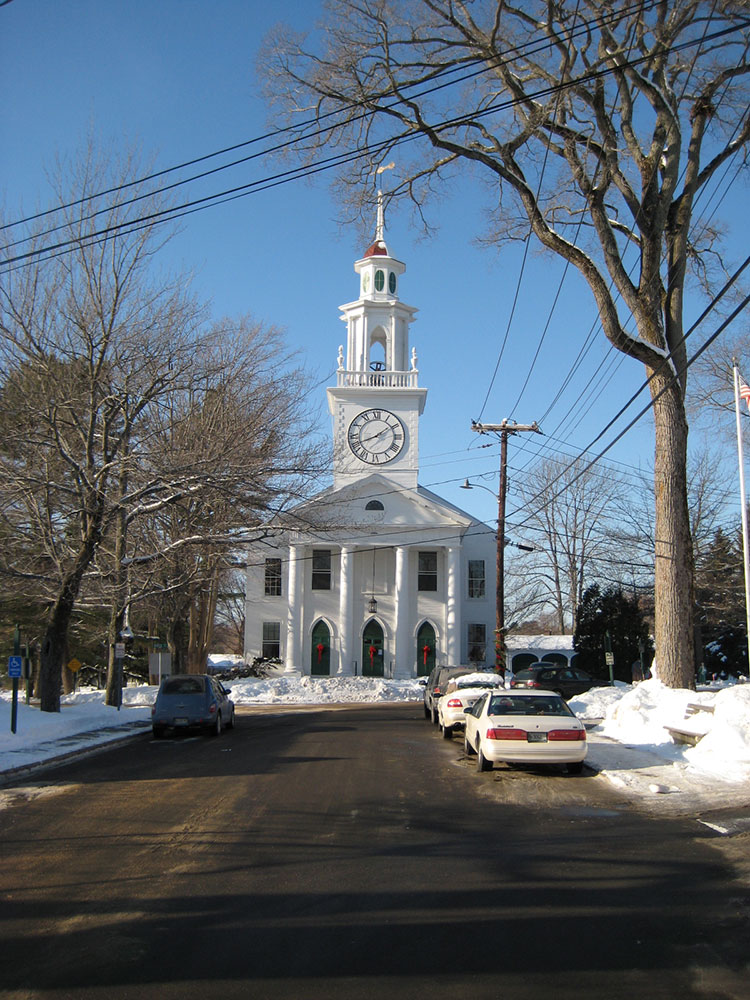
The Kennebunkport Historic District encompasses most of the village center of Kennebunkport, Maine. It includes the town's highest concentration of historic architecture, with many buildings from the late 18th and early 19th century, when Kennebunkport was at its height as a shipping and shipbuilding center. The district was added to the National Register of Historic Places on May 6, 1976.
The town of Kennebunkport lies on the coast of southern Maine, between the Kennebunk River and the Little River. Its main village is located in the southwestern part of the town, on the north bank of the tidal Kennebunk River, inland from the coast. This area was first incorporated as Cape Porpoise in 1653, was abandoned during the wars of the late 17th and early 18th centuries, and was resettled in 1719. It was incorporated as Kennebunkport in 1820. The town's early economic success as a shipbuilding and shipping center, which was eventually supplanted by its development beginning in the 1870s as a summer resort area, which was centered in the Cape Arundel area.
The major roads in Kennebunkport village are Western Avenue, which runs southwest to cross the river into Kennebunk, North Street, which runs inland, and Ocean and Maine Streets, which run parallel to the river, southward toward Cape Arundel. The district extends along these roads, and includes numerous properties on the side streets which connect them. It has 147 buildings, of which only 24 were built after 1925. Most of these later structures (for example, the 1960 town offices) are in sympathetic styles. Residential properties in the district are typically high-quality vernacular interpretations of architectural styles popular at the time of their construction. A few houses date to the colonial period, including the 1745 Gideon Walker House on South Street, which was altered to plans by John Calvin Stevens in 1910. The largest number of buildings in the district are from the Federal period, when Kennebunkport was at its economic height. One of the finest houses from this period is the Capt. Nathaniel Lord Mansion, separately listed on the National Register in 1973..
Cape Porpoise, Maine is a small coastal village in the town of Kennebunkport, Maine, and was the original English settlement of the town. It is northeast of Dock Square and southwest of Goose Rocks Beach. The village occupies the mainland adjacent to Cape Porpoise Harbor. More than a dozen islands protect the deep natural harbor. Goat Island Light marks the harbor entrance between Goat and Folly islands.
This article uses material from the Wikipedia article "Kennebunk, Maine", "Kennebunkport, Maine", "Cape Porpoise, Maine", "Wedding Cake House (Kennebunk, Maine)", and "Kennebunkport Historic District", which is released under the Creative Commons Attribution-Share-Alike License 3.0