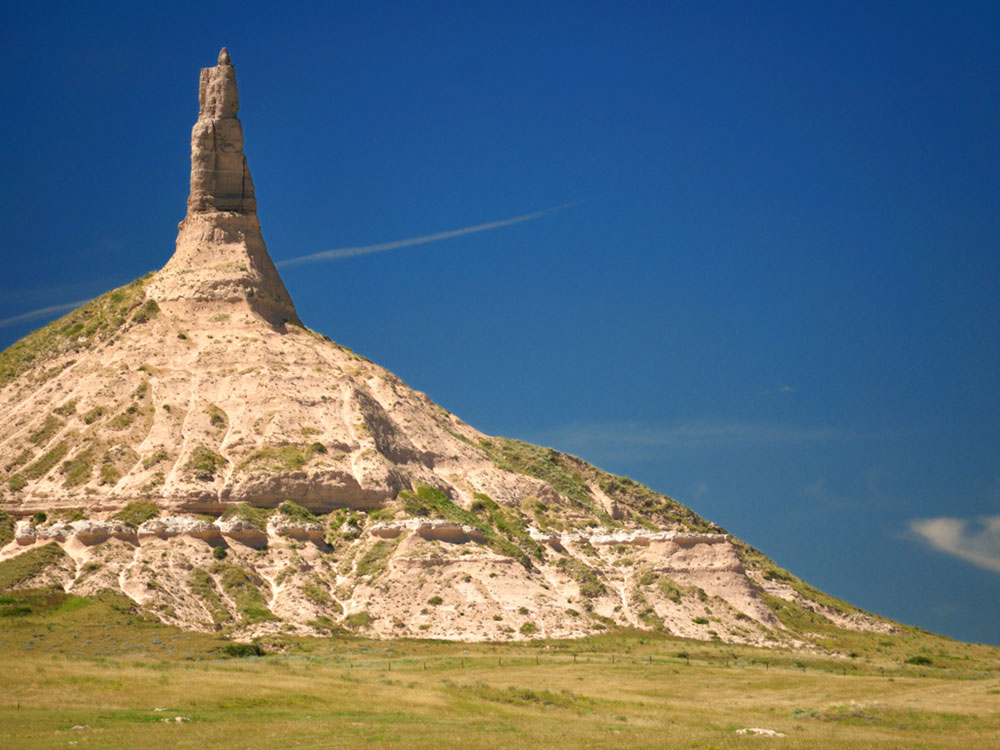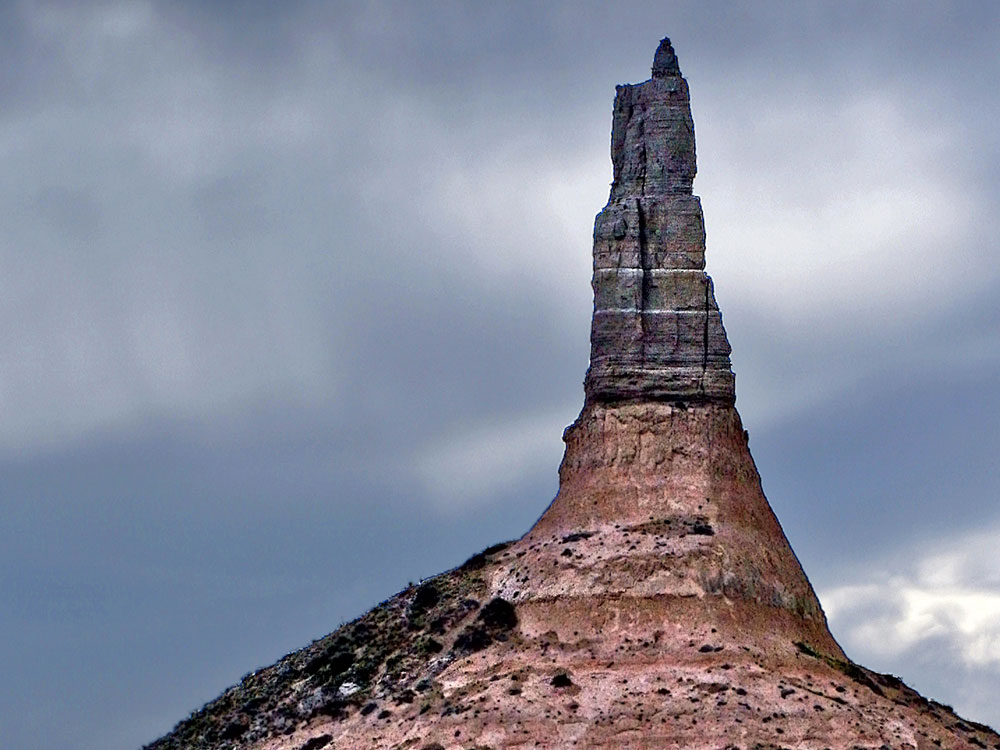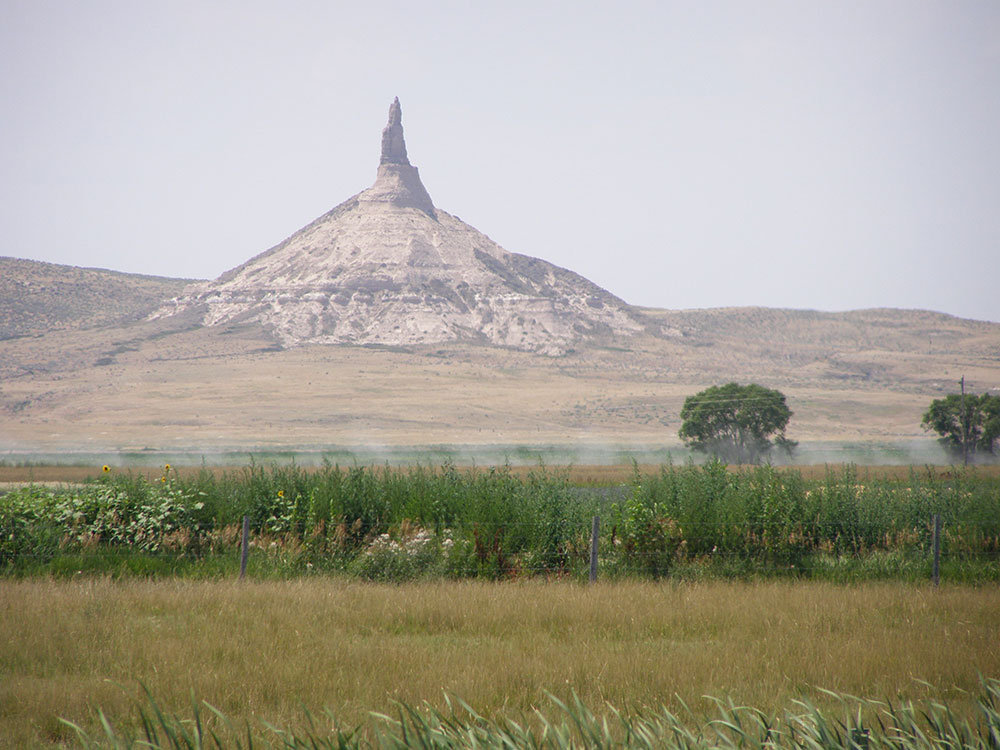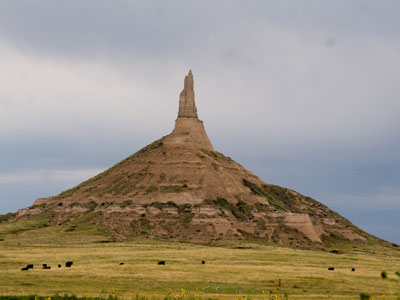
A towering spirelike sandstone formation that served as a major landmark for westward‑bound travelers.
General Information
- Seasonal Hours May 1 to October 1: Open daily 9am to 4pm
- Off-Season Hours October 2 to April 30 Saturday to Sunday: 9am to 4pm
- Adults (19 and over): $8.00
- Children (5 to 18): $4.00
- Children (4 & under): Free
How to Get There
From Scottsbluff (23 miles): Head south on Ave C toward W 20th St. Turn left onto W 20th St. Turn right onto US-26 E/Heartland Expy. Turn right onto NE-79ELink. Turn left onto NE-92 E. Turn right onto Nebraska 62F Recreation Rd. Turn right onto County Rd 98.
Overview
Chimney Rock is a prominent geological rock formation in Morrill County in western Nebraska. Rising nearly 300 feet (91 m) above the surrounding North Platte River valley, the peak of Chimney Rock is 4,228 feet (1,289 m) above sea level. The formation served as a landmark along the Oregon Trail, the California Trail, and the Mormon Trail during the mid-19th century. The trails ran along the north side of the rock, which remains a visible landmark for modern travelers along U.S. Route 26 and Nebraska Highway 92. Chimney Rock National Historic Site was designated in 1956 and is an affiliated area of the National Park Service, operated by History Nebraska.
History
Prior to exploration and settlement by European immigrants, the Native Americans of the area—mainly the Lakota Sioux. The first non-natives to see the pillar were probably the Astorians of Robert Stuart in their eastward journey from the Pacific Ocean in 1813. Chimney Rock was recorded in many journals after the Stuart expedition.
The name "Chimney Rock" probably originated from early fur traders. The first recorded mention of "Chimney Rock" was in 1827 by Joshua Pilcher. Pilcher had journeyed up the Platte River valley to the Salt Lake rendezvous of the Rocky Mountain fur trappers. The formation went through a variety of names before becoming Chimney Rock such as Chimley Rock and Chimney Tower, as well as euphemisms based on the original Native American name, such as Elk's Peak and Elk Brick.
A small town named Chimney Rock once stood near the base of the formation. A post office was established at the town of Chimney Rock in 1913, and remained in operation until 1922.
Chimney Rock consists primarily of Brule clay interlayered with volcanic ash and Arikaree sandstone. The harder sandstone layers near the top have protected the pillar since it broke away from the retreating cliff line to the south. Chimney Rock rises approximately 286 feet (87 m) above its surroundings.
Chimney Rock was designated a National Historic Site on August 9, 1956, and is a National Park Service affiliated area, maintained and administered by History Nebraska with NPS technical support. Chimney Rock and Independence Rock further west in Wyoming are two of the prominent features along the Oregon Trail. Chimney Rock is located 20 miles southeast of Scotts Bluff National Monument, on Nebraska Highway 92.
The Ethel and Christopher J. Abbot Visitor Center features museum exhibits and a video about pioneers and the migrations in the West, as well as a gift shop.
This article uses material from the Wikipedia article "Chimney Rock National Historic Site", which is released under the Creative Commons Attribution-Share-Alike License 3.0