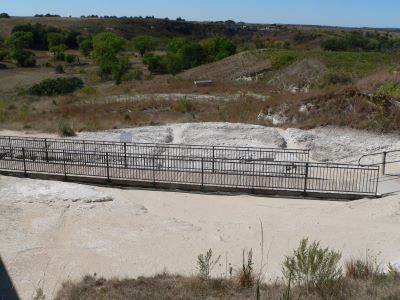
A paleontological site preserving exceptionally detailed prehistoric fossils within an active excavation environment.
General Information
May 25–August 31: Tuesday–Sunday 9:30am–4:30pm; Closed Monday
September 1–October 12: Wednesday–Saturday 9:30am–4:30pm, Sunday 1:30pm–4:30pm; Closed Monday & Tuesday
Children under 3: Free
UNSM Members: Free with membership card
Blue Star Military Program: Free with ID
How to Get There
Take US-20 West from Sioux City, continue into Nebraska toward Royal, then follow signs north to the park entrance.
Overview
The Ashfall Fossil Beds offer an unparalleled window into the Miocene epoch, preserving the remains of rhinoceroses, horses, camels, and other wildlife that perished nearly 12 million years ago. Encased in volcanic ash from a distant supervolcano eruption, these fossils remain in extraordinary condition, allowing visitors to observe articulated skeletons exactly as they were discovered. The Rhino Barn, an enclosed excavation structure, provides a rare opportunity to witness paleontologists uncovering fossils still embedded in their ancient resting place. Visitors can explore interpretive displays detailing the geology, ecosystem, and dramatic natural events that created this remarkable site.
Beyond the fossil beds, the surrounding prairie landscape tells its own story, shaped by millions of years of ecological shifts across the Great Plains. Trails guide travelers through rolling grasslands, where volcanic ash once blanketed a watering hole that drew herds of animals seeking relief. Educational programs and hands-on exhibits deepen the experience, while the site’s active research environment highlights its ongoing scientific importance. Ashfall Fossil Beds stands as a rare convergence of natural history, geology, and paleontology, inviting visitors to step back through deep time and witness a prehistoric world preserved in ash.
Things to Do
Visit One of the World's Most Remarkable Fossil Sites
Ashfall Fossil Beds State Historical Park, located near Royal in northeastern Nebraska, preserves an extraordinary prehistoric fossil deposit created by a massive volcanic eruption approximately 12 million years ago. The site contains the remains of ancient animals that perished after volcanic ash from eruptions in what is now Idaho blanketed the Great Plains. Often called Nebraska's "Pompeii of Prehistoric Animals," Ashfall offers visitors a rare opportunity to observe fossils exactly where they were discovered.
Observe Fossils In Place
The park's Rhino Barn protects an active fossil excavation site where visitors can view the skeletons of rhinoceroses, three-toed horses, camels, deer-like animals, turtles, and birds preserved in their original burial positions. Elevated walkways allow visitors to observe paleontologists and researchers working at the site while learning about the fossilization process.
Explore the Visitor Center
The visitor center features exhibits, fossil displays, educational programs, and interactive presentations explaining the volcanic eruption, prehistoric ecosystems, and scientific discoveries made at Ashfall Fossil Beds. Visitors can gain insight into the Miocene Epoch and the animals that once inhabited the region.
Learn About Ancient Nebraska
Interpretive exhibits explain how volcanic ash traveled hundreds of miles across the Great Plains, gradually affecting wildlife populations and preserving one of the most complete prehistoric ecosystems ever discovered in North America.
Enjoy Prairie Wildlife and Natural Scenery
The park also protects native prairie habitats that support deer, songbirds, hawks, butterflies, and a variety of wildflowers. Visitors can experience the modern prairie landscape while learning about the ancient environment preserved beneath their feet.
Top Trails
Fossil Hills Trail
Length: Approximately 1 mile loop
Elevation Gain: Minimal
Difficulty: Easy
This interpretive trail provides views of the surrounding prairie and includes educational signage about the park's geology, fossil discoveries, and prehistoric environments.
Prairie Trail
Length: Approximately 0.5 miles loop
Elevation Gain: Minimal
Difficulty: Easy
Visitors can enjoy a short walk through native grasslands while observing local wildlife, prairie plants, and landscapes similar to those that existed during the age of the fossils.
Rhino Barn Interpretive Walk
Length: Approximately 0.25 miles
Elevation Gain: Minimal
Difficulty: Easy
This short route around the excavation facility allows visitors to view fossil beds and exhibits while learning about ongoing paleontological research and conservation efforts.
Educational Nature Walks
Length: Variable short distances
Elevation Gain: Minimal
Difficulty: Easy
Seasonal programs and guided walks provide opportunities to learn about prairie ecology, fossil preservation, and the scientific significance of one of the world's most important Miocene fossil sites.
Sources: Nebraska Game and Parks Commission official Ashfall Fossil Beds State Historical Park information, including details on the Rhino Barn, fossil excavation sites, visitor center exhibits, trails, and educational programs. https://outdoornebraska.gov/location/ashfall-fossil-beds/
Additional information verified through the University of Nebraska State Museum and Ashfall Fossil Beds resources covering Miocene-era fossils, volcanic ash deposits, paleontological research, and prairie conservation efforts at the site.
This article uses material from the Wikipedia articles and official tourism pages for the Ashfall Fossil Beds State Historical Park, which are released under the Creative Commons Attribution-Share-Alike License 3.0.
_1-1000.jpg)