Urban park and sculpture garden in St. Louis in the city's "Gateway Mall" area
General Information
How to Get There
From St. Louis (1 mi): Take I-64 east toward downtown and exit onto Market Street to reach the sculpture park between office buildings and public plazas.
Overview
Citygarden is an urban park and sculpture garden in St. Louis, Missouri owned by the City of St. Louis but maintained by the Gateway Foundation. It is located between Eighth, Tenth, Market, and Chestnut streets, in the city's "Gateway Mall" area. Before being converted to a garden and park, the site comprised two empty blocks of grass. Citygarden was dedicated on June 30, 2009, and opened one day later, on July 1, 2009.
Citygarden is 2.9 acres (1.2 ha) in size—occupying two square city blocks—and cost US$30 million to develop. St. Louis' Gateway Foundation, a not-for-profit organization supporting public art, funded the design and construction of the garden. While the city owns the land on which Citygarden was developed, the foundation owns the statues and covers all park maintenance costs except water and electricity.
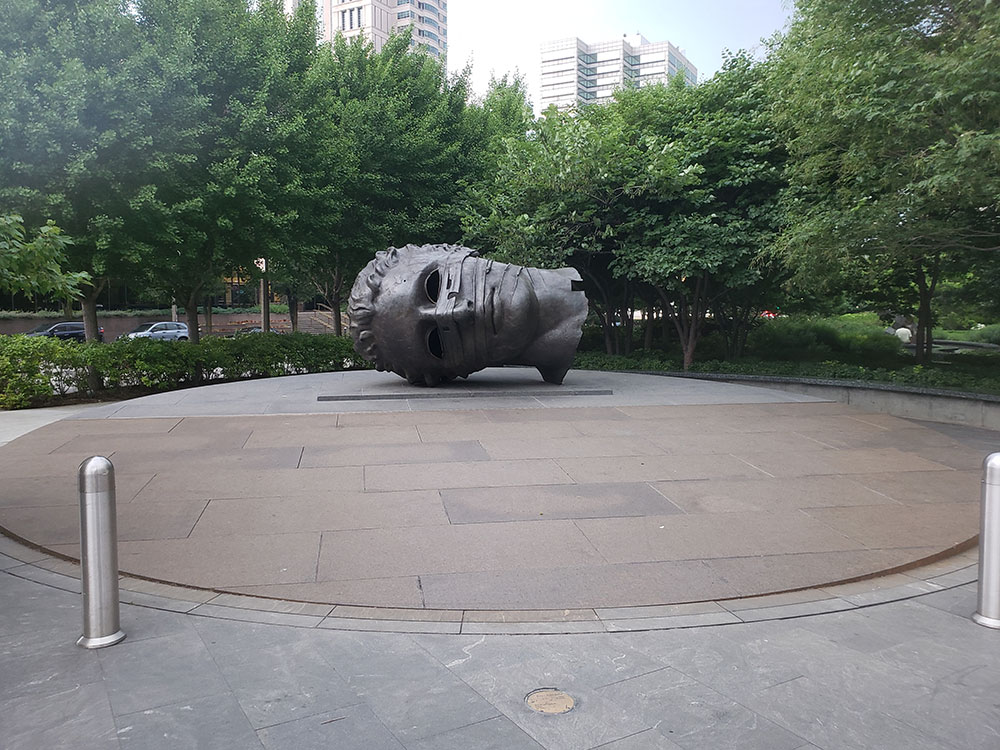
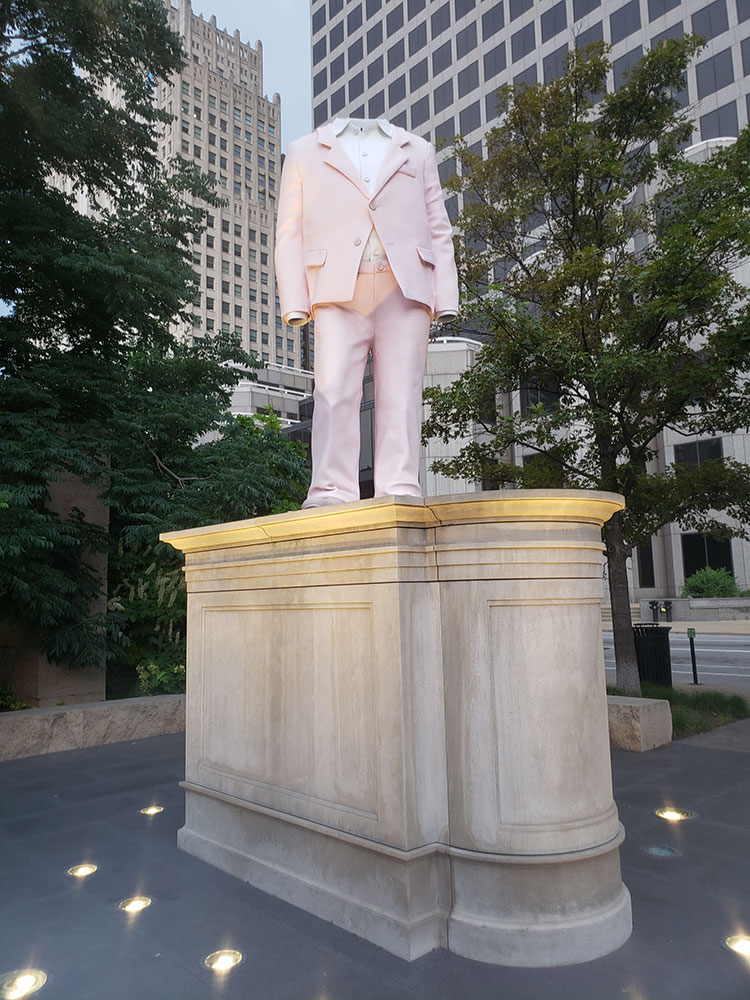
The park was designed so larger works of art rest on wide lawns, while smaller spaces are reserved for more private areas. It is home to 24 sculptures, some of which were created by Fernand Léger, Keith Haring, Aristide Maillol, Laura Ford, Tony Smith, Jim Dine, Kan Yasuda, Bernar Venet, Mark di Suvero, Niki de Saint Phalle, Tom Otterness, Tom Claassen, Jack Youngerman, Ju Ming, Jean-Michel Folon, Mimmo Paladino, Jonathan Clarke, Donald Baechler, and Martin Puryear. One statue, by Igor Mitoraj, features a large bronze head lying on its side, while works by Julian Opie comprise digital screens displaying walking people. The sculptures range in medium from various metals—bronze, stainless steel, and cast aluminum—fiberglass and even polyester. On September 20, 2011, a 9-foot (2.7 m) aluminum sculpture of a bodiless pink suit, by Erwin Wurm and titled Big Suit, was installed in the garden.
- Eros Bendato (1999), by Igor Mitoraj, on exhibition in Kraków, Poland.
- 2 Arcs x 4 and 230.5 Degree Arc x 5 (1999) comprise a series of three steel sculptures by Bernar Venet. One sculpture consists of five steel beams bent into a 230.5-degree arc, another arc is 232.5 degrees, and the last is 235.5 degrees.
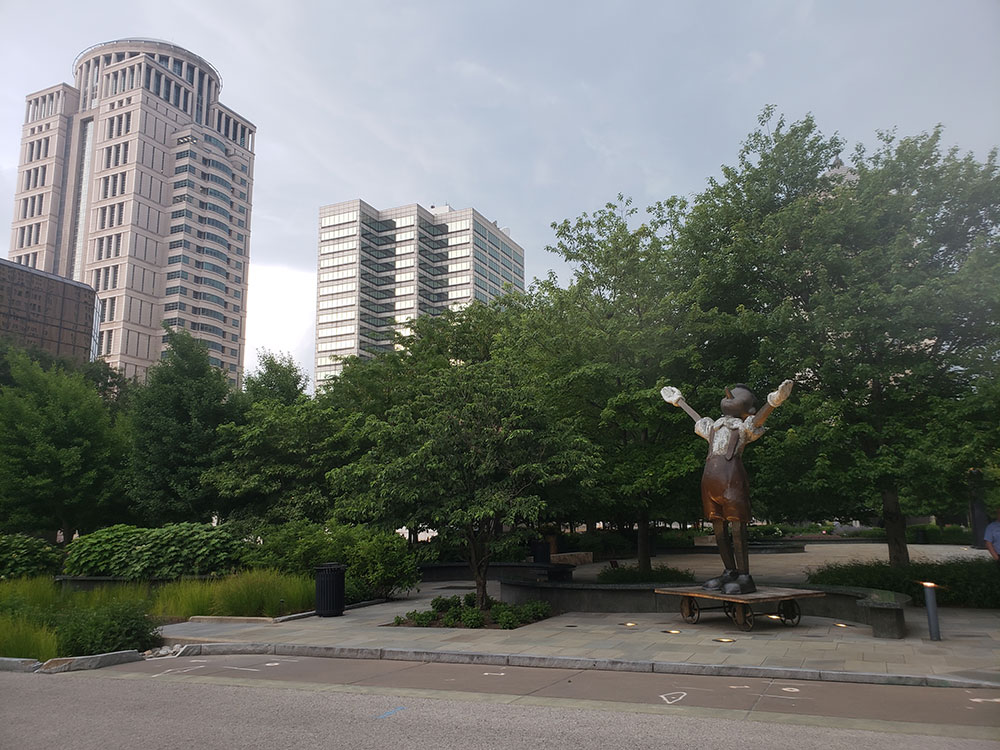
- Big White Gloves, Big Four Wheels (2009) is a statue of Pinocchio by Jim Dine.
- Eros Bendato ("Eros Bound"; 1999) is a large bronze head by sculptor Igor Mitoraj. Located on the corner of Eighth and Market streets, the statue lays sideways on a slanted granite circle, which is covered by a steady stream of water.
- Femmes au perroquet ("Women with parrot"; 1952) is a bronze relief situated on the wall of the restaurant building. Created by the Cubist artist Fernand Léger, this work features a group of women with a parakeet.
- Four Rectangles Oblique IV (1979) is a kinetic sculpture by George Rickey.
- La Rivière ("The River"; 1938-1943), by Aristide Maillol, depicts a nude woman washing her hair. It is located in the basin outside the restaurant building. Another version of this sculpture can be found at New York City's Museum of Modern Art.
- This is Bruce and Sarah Walking (2007) is an LED panel that displays two people walking. The work, created by Julian Opie, is located next to Tenth Street. Another version of the installation, depicting walkers "Julian" and "Kiera," is located in another part of Citygarden.
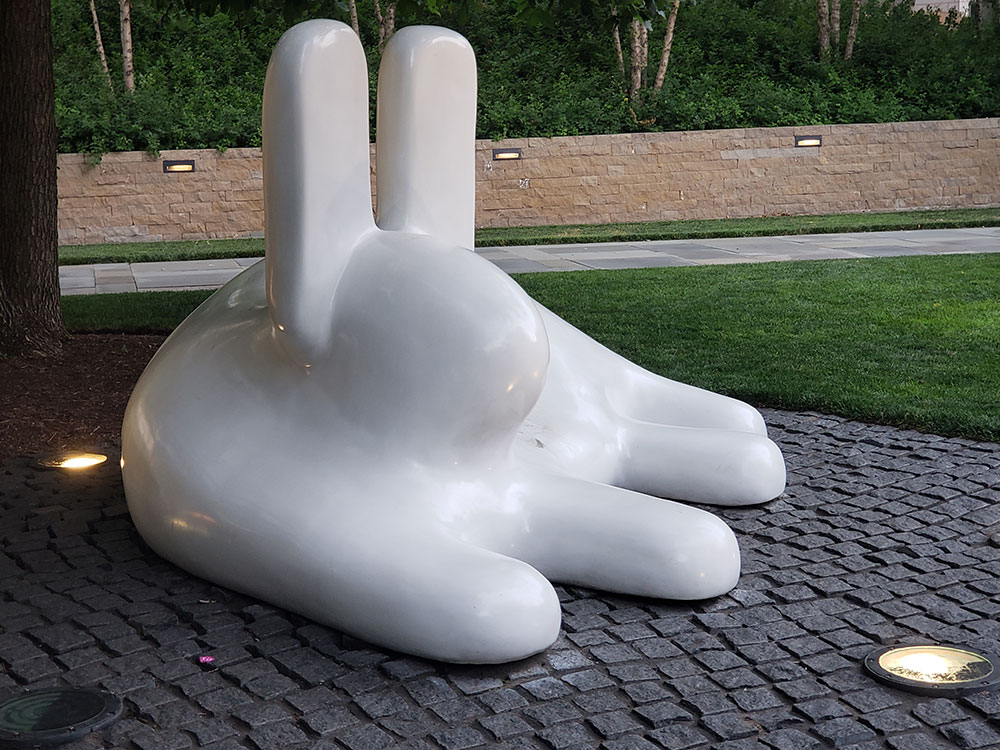
- Untitled (Two Rabbits) (2004), by Tom Claassen, consists of two rabbits cast in bronze and then painted white.
- Voyage (1999), by Jean-Michel Folon, depicts a boat sitting amid a pool of water. The boat has two passengers: a man with a hat—the everyman—on one end, and a sleeping cat on the other end.
- Zenit (1999) is a bronze horse sculpted by Mimmo Paladino. Instead of a rider, the horse carries a small stellated dodecahedron on its back.
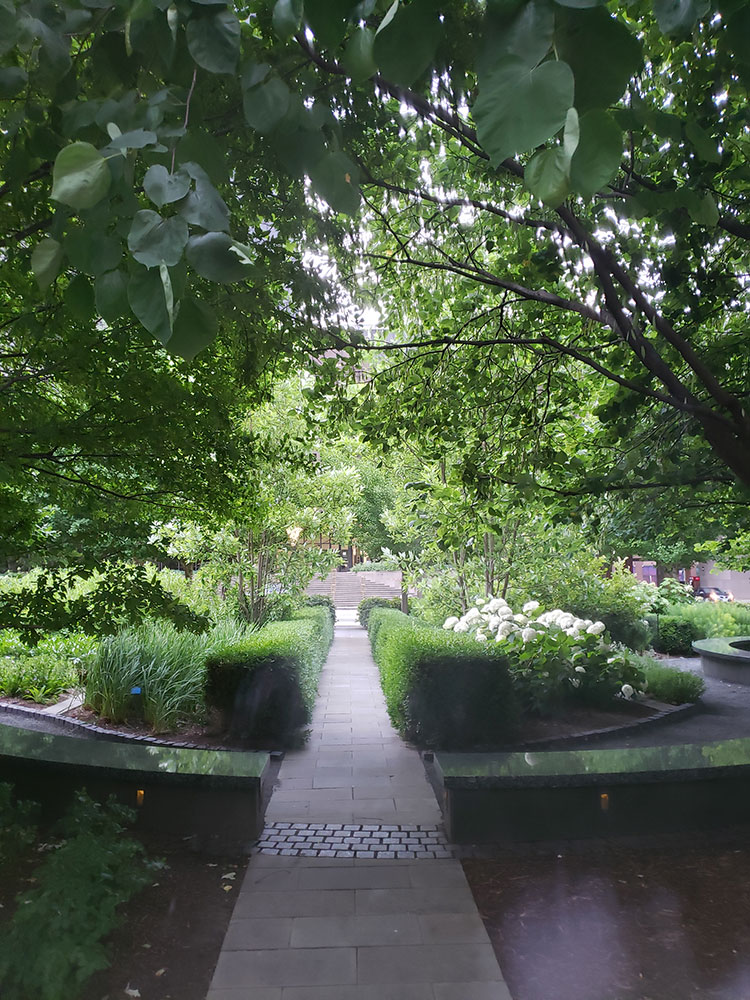
Citygarden is not enclosed from the street and can be entered from any direction. The park includes six rain gardens, a 102-fountain "spray plaza" in which children can play, as well as a 180 feet (55 m)-long pool with a 6-foot (1.8 m)-tall waterfall. The fountain's water is recycled, and filtered rainwater is also used. A low, winding, 1,110-foot (340 m)-long, granite-topped "meander wall" runs through the park's southern half and acts as seating for visitors. In the northern half, a 550-foot (170 m)-long curved wall of yellow Missouri limestone stretches across the property. A 16-foot (4.9 m) LED video screen is on the wall; it displays movies and artworks, as well as some baseball games.
The garden also includes Ginkgo biloba trees, native plants, and spacious sidewalks, features that Warren Byrd of Nelson Byrd Woltz Landscape Architects said could be adapted by other sections of the Gateway Mall.
The park is divided into three horizontal sections, and architects considered the rivers and other natural characteristics of the St. Louis area when designing the park. The northern limestone wall represents the Mississippi River bluffs, while the southern snaking meander wall stands is inspired by the region's waterways. Between the two zones are the rain gardens, larger trees, and larger sculptures, an area that meant to represent a floodplain. The main paths of the park were plotted to match the locations of alleyways that park designers saw in a 1916 Sanborn map.
This article uses material from the Wikipedia article "Citygarden", which is released under the Creative Commons Attribution-Share-Alike License 3.0