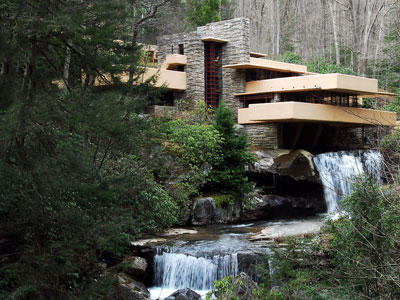
Fallingwater

lachrimae72, CC0, via Wikimedia Commons; Image Size Adjusted

House designed by the architect Frank Lloyd Wright in 1939 built partly over a waterfall and is considered one of Wright's greatest masterpieces both for its dynamism and for its integration with its striking natural surroundings.

General Information

Hours:
Thruday to Tuesday: 8:00am to 4:00pm
Closed Wednesday
Fees:
Guided Architectural Tour: $35.00
Guided Grounds Walking Tour: $25.00
Grounds Pass: $15.00
Pet Policy:
Pets NOT allowed
Closest cities with hotels:
Uniontown, PA, 23 miles
Seasons:
All year
Address:
1491 Mill Run Rd, Mill Run, PA 15464
Website:
fallingwater.org/
Rating:
5.0
MILL RUN Weather Forecast

From Pittsburgh (67 miles): Get on I-579 S. Get on I-376 E from Boulevard of the Allies. Follow I-376 E and I-76 to PA-31 W in Donegal Township. Take exit 91 from I-76. Take PA-381 S to Fallingwater Road in Mill Run.

Fallingwater is a house designed by the architect Frank Lloyd Wright in 1939 in the Laurel Highlands of southwest Pennsylvania, about 70 miles (110 km) southeast of Pittsburgh. The house was built partly over a waterfall on Bear Run in the Mill Run section of Stewart Township, located in the Laurel Highlands of the Allegheny Mountains. The house was designed as a weekend home for Liliane and Edgar J. Kaufmann, the owner of Kaufmann's Department Store.

After its completion, Time called Fallingwater Wright's "most beautiful job" and it is listed among Smithsonian's "Life List of 28 Places to See Before You Die." The house was designated a National Historic Landmark in 1966. In 1991, members of the American Institute of Architects named Fallingwater the "best all-time work of American architecture" and in 2007, it was ranked 29th on the list of America's Favorite Architecture according to the AIA.

The house and seven other Wright constructions were inscribed as a World Heritage Site under the title "The 20th-Century Architecture of Frank Lloyd Wright" in July 2019.

Fallingwater stands as one of Wright's greatest masterpieces both for its dynamism and for its integration with its striking natural surroundings. Fallingwater has been described as an architectural tour de force of Wright's organic architecture. Wright's passion for Japanese architecture was strongly reflected in the design of Fallingwater, particularly in the importance of interpenetrating exterior and interior spaces and the strong emphasis placed on harmony between man and nature.

The organically designed private residence was intended to be a nature retreat for its owners. The house is well-known for its connection to the site. It is built on top of an active waterfall that flows beneath the house.

The fireplace hearth in the living room integrates boulders found on the site and upon which the house was built—a ledge rock which protrudes up to a foot through the living room floor was left in place to link the outside with the inside. Wright had initially intended that the ledge be cut flush with the floor but this had been one of the family's favorite sunning spots, so Kaufmann suggested that it be left as it was. The stone floors are waxed while the hearth is left plain, giving the impression of dry rocks protruding from a stream.

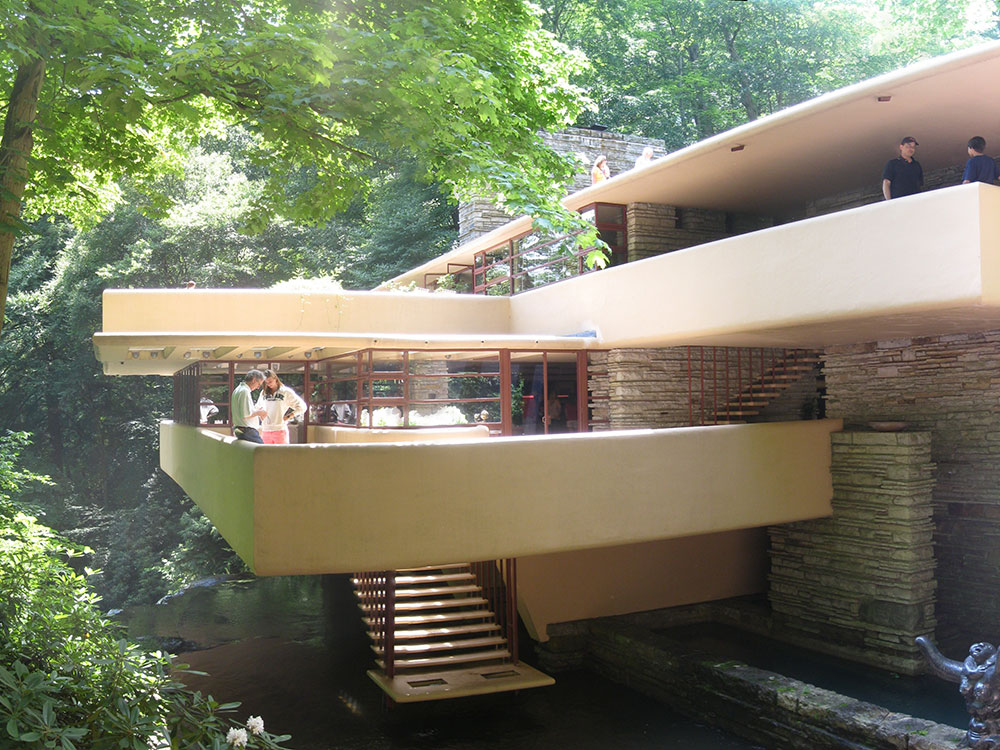
Integration with the setting extends even to small details. For example, where glass meets stone walls no metal frame is used; rather, the glass and its horizontal dividers were run into a caulked recess in the stonework so that the stone walls appear uninterrupted by glazing. From the cantilevered living room, a stairway leads directly down to the stream below, and in a connecting space which connects the main house with the guest and servant level, a natural spring drips water inside, which is then channeled back out. Bedrooms are small, some with low ceilings to encourage people outward toward the open social areas, decks, and outdoors.

Bear Run and the sound of its water permeate the house, especially during the spring when the snow is melting, and locally quarried stone walls and cantilevered terraces resembling the nearby rock formations are meant to be in harmony. The design incorporates broad expanses of windows and balconies which reach out into their surroundings. In conformance with Wright's views, the main entry door is away from the falls.

On the hillside above the main house stands a four-bay carport, servants' quarters, and a guest house. These attached outbuildings were built two years later using the same quality of materials and attention to detail as the main house. The guest quarters feature a spring-fed swimming pool which overflows and drains to the river below.

Wright had initially planned to have the house blend into its natural settings in rural Pennsylvania. In doing so, he limited his palette to two colors, a light ochre for the concrete and his signature Cherokee red for the steel.

After Fallingwater was deeded to the public, three carport bays were enclosed at the direction of Kaufmann Jr. to be used by museum visitors to view a presentation at the end of their guided tours on the Western Pennsylvania Conservancy (to which the home was entrusted). Kaufmann Jr. designed its interior himself to specifications found in other Fallingwater interiors by Wright.

After his father's death in 1955, Kaufmann Jr. inherited Fallingwater, continuing to use it as a weekend retreat until the early 1960s. Increasingly concerned with ensuring Fallingwater's preservation and following his father's wishes, he entrusted the home and approximately 1,500 acres of land to the Western Pennsylvania Conservancy in tribute to his parents. He guided the organization's thinking about Fallingwater's administration, care, and educational programming and was a frequent visitor as guided tours began in 1964. Kaufmann's partner, architect and designer Paul Mayén, also contributed to the legacy of Fallingwater with a design for the visitor center, completed in 1981. The house attracts more than 160,000 visitors from around the world each year.

This article uses material from the Wikipedia article "Fallingwater", which is released under the Creative Commons Attribution-Share-Alike License 3.0
Ruhrfisch, CC BY-SA 3.0, via Wikimedia Commons; Image Size Adjusted