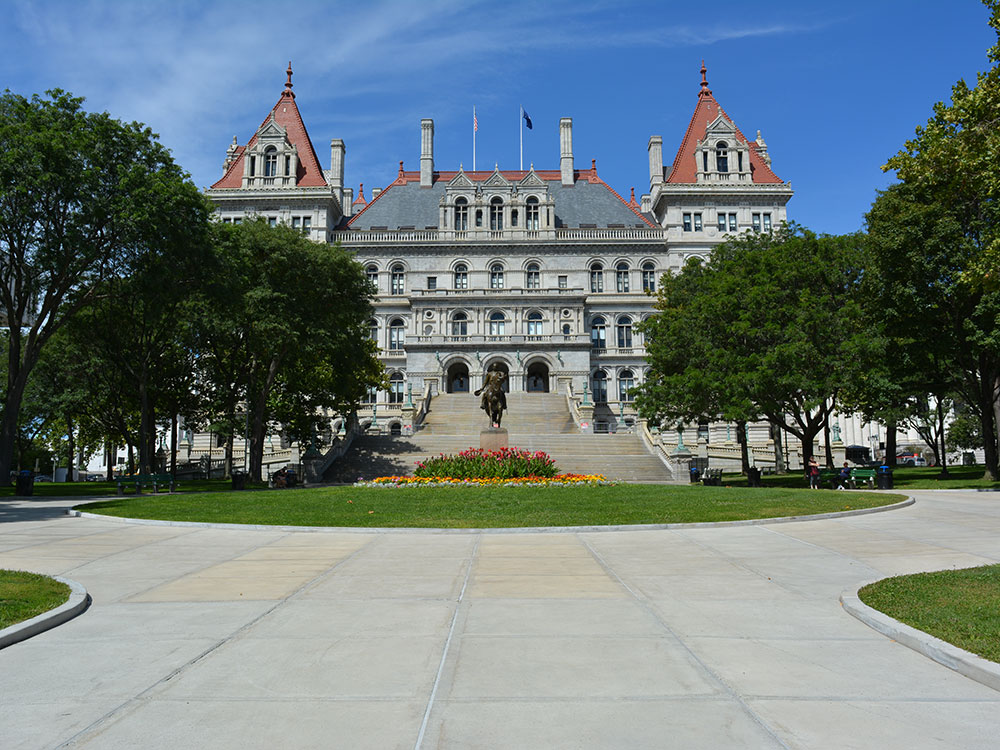
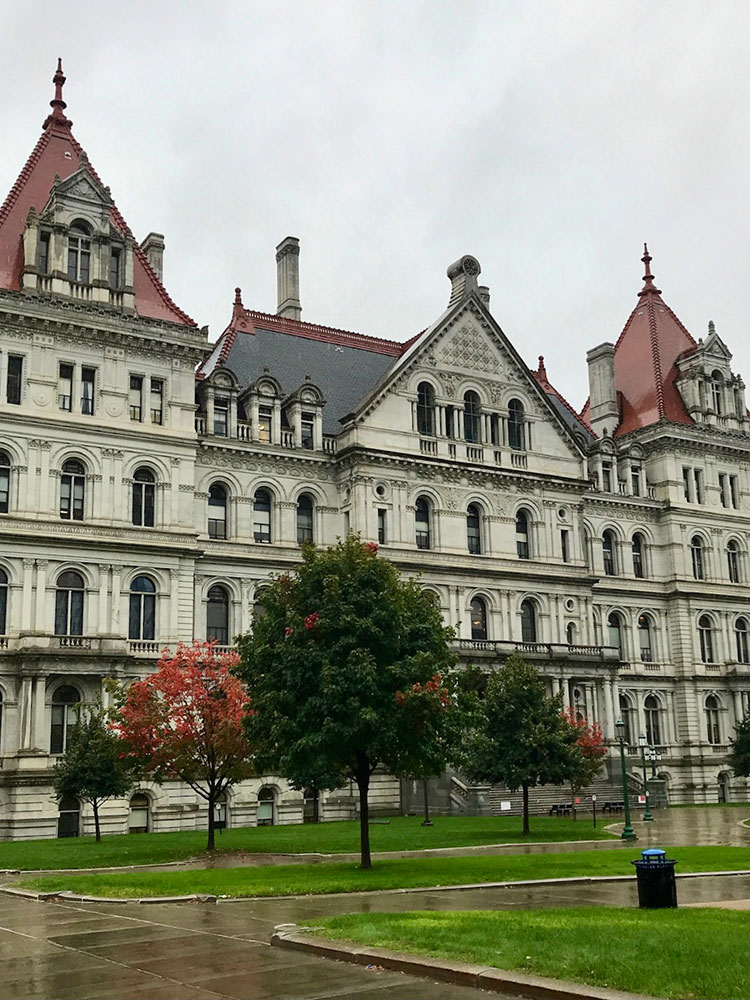
Seat of the New York State government located in Albany, New York and is listed on the National Register of Historic Places
General Information
Free guided tours available Monday–Saturday: 10am, 12pm, 2pm, and 3pm
Sunday tours: 12pm and 2pm
Closed Thanksgiving, Christmas, and New Year's Day
How to Get There
From New York City (approximately 150 miles): Take I-87 N (New York State Thruway) to Exit 23 (I-787), then follow I-787 N to Exit 4, continue on Madison Ave W, and turn right on Eagle St — the Capitol is at the top of State St in downtown Albany.
Overview
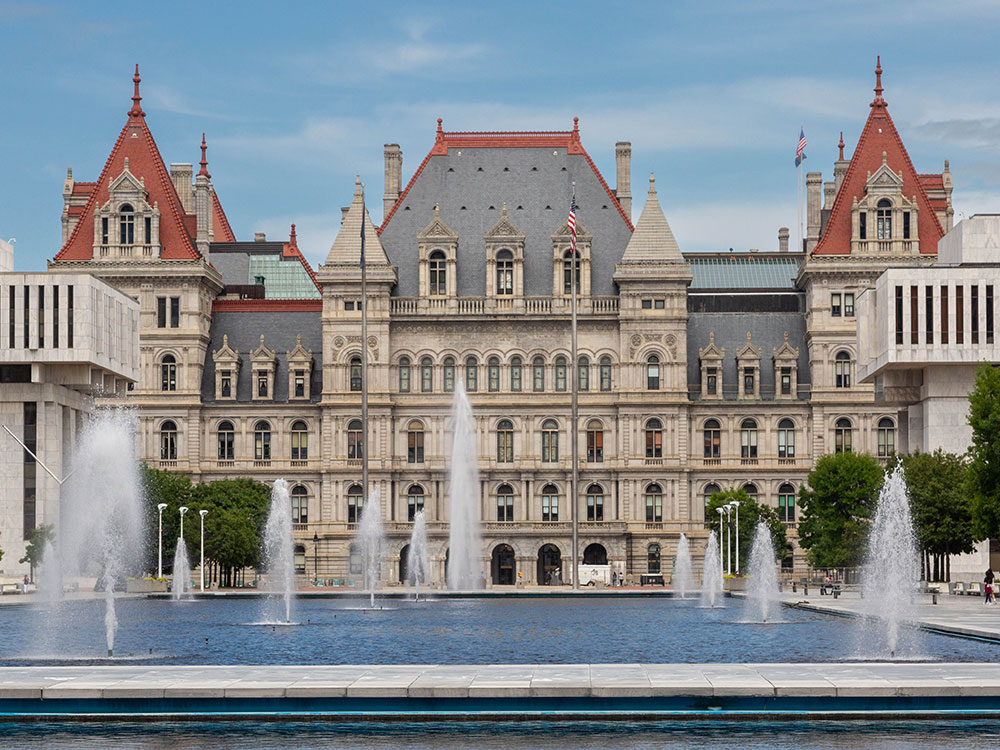
The New York State Capitol, the seat of the New York State government, is located in Albany, New York. The capitol building is part of the Empire State Plaza complex on State Street in Capitol Park. It was listed on the National Register of Historic Places in 1971, then included as a contributing property when the Lafayette Park Historic District was listed in 1978. The New York State Capitol was declared a National Historic Landmark in 1979.
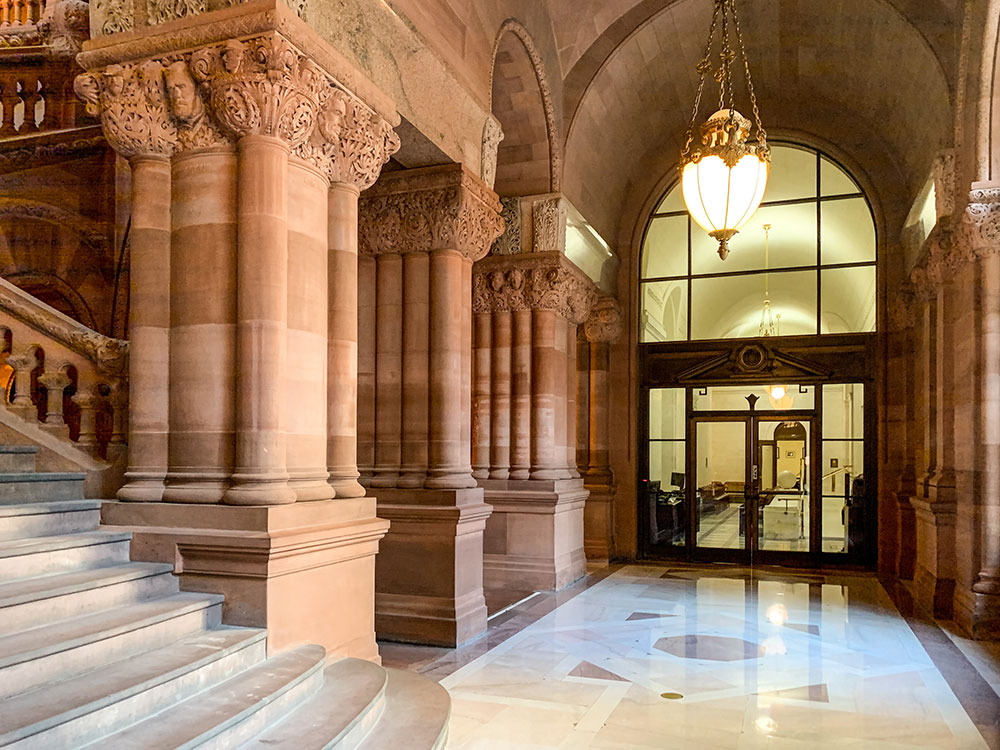
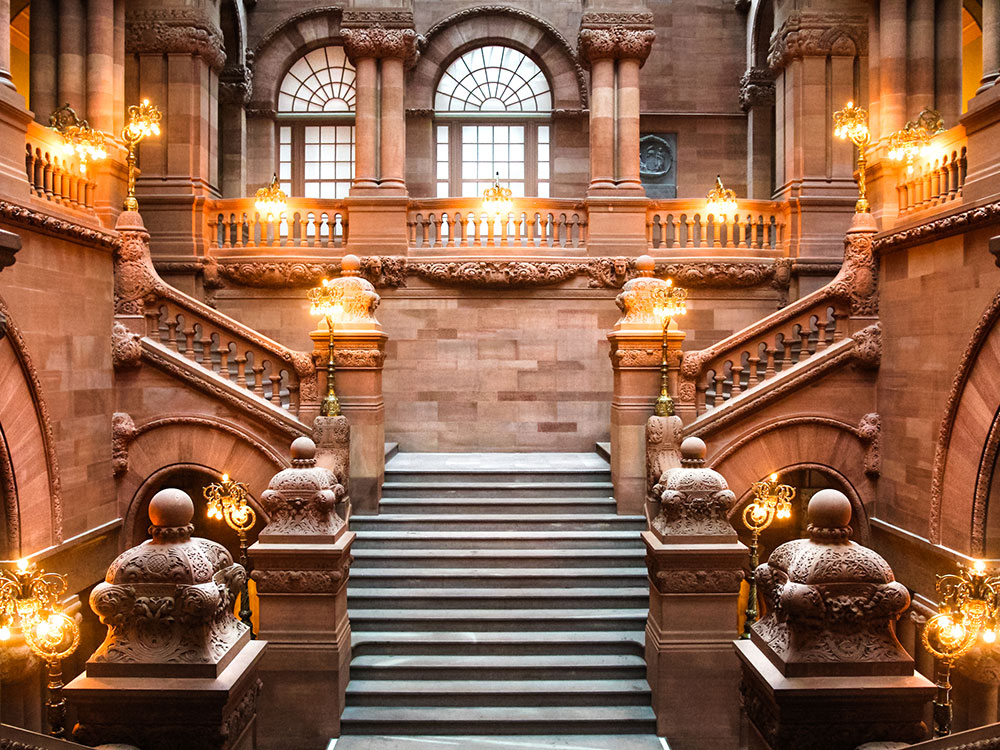
The state capitol's ground floor was built in the Classical/Romanesque style. Lieutenant Governor William Dorsheimer then dismissed Fuller in favor of Eidlitz and Richardson who built the next two floors in a Renaissance Classical style, noticeable on the exterior two floors as light, open columnwork. The increasing construction costs became an ongoing source of conflict in the legislature, and it was difficult to secure the necessary funding. Eidlitz and Richardson were dismissed by Grover Cleveland upon his election to governorship and his review of the increasing costs of construction. He hired Perry to complete the project. The legislative chambers, the fourth floor and roof work were all finished in Victorian-modified Romanesque that was distinctively Richardson's design. It "was Richardson who dominated the final outcome of the grand building, which evolved into his distinguished Romanesque style" (which came to be known as Richardsonian Romanesque). It is claimed Richardson was imitating the Hôtel de Ville (City Hall) in Paris, France. The Chazy limestone for its construction was quarried at the Clark Quarry in Essex County, New York.
The central open court is dominated by a shaft intended to support a massive dome. The dome and tower were never completed, as it was found the building's weight was causing stress fractures and making the building shift downhill toward State Street. To stop this movement, a large, 166-foot (51 m) long exterior Eastern Staircase was added to support the front facade. The Capitol exterior is made of white granite from Hallowell, Maine, and the building incorporates Westchester marble cut by state prisoners at Sing Sing. The granite structure is 220 feet (67 m) tall at its highest point, and it is one of eleven U.S. state capitols that does not have a domed roof. Tunnels connect it to the Empire State Plaza and Alfred E. Smith Building. The building's exterior underwent restoration from 2000 until fall 2014.
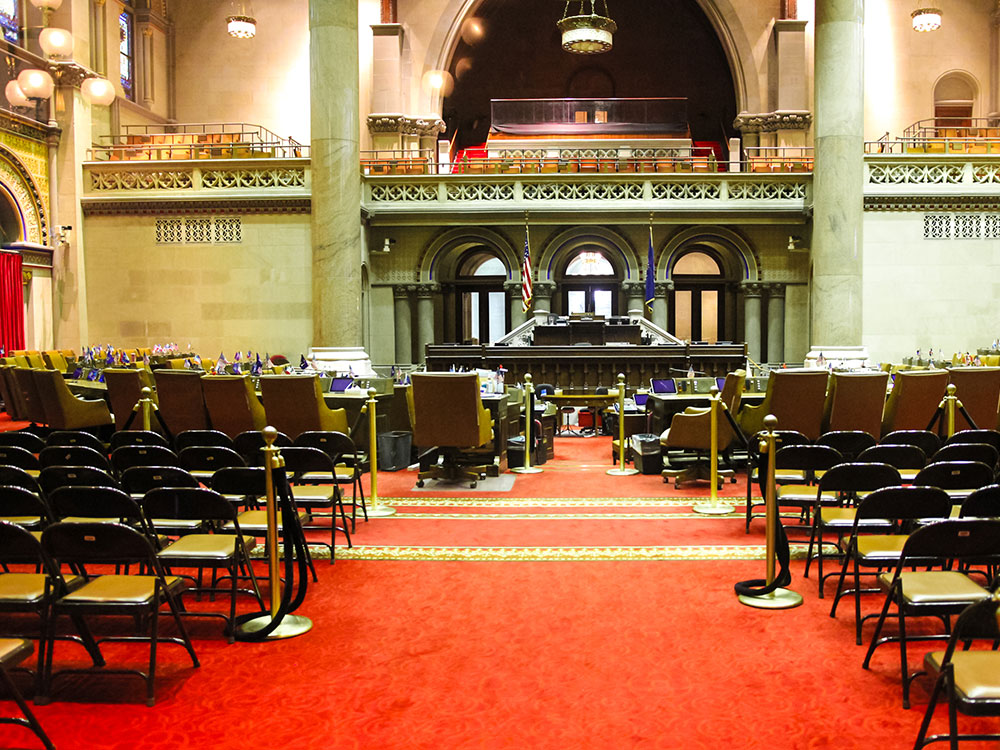
The Assembly Chamber was built with the world's largest open arched span. However, this produced very inconvenient acoustic results. A more serious problem was the structure's shifting foundations that made the vaults unstable. A lower false ceiling was introduced to prevent rock shards from the vaults from falling to the assembly floor.
The Capitol initially featured two large murals by Boston artist William Morris Hunt painted directly on to the Assembly Chamber's sandstone walls. The two enormous works, named The Flight of Night and The Discoverer, each some 45-feet long, were later covered when the Assembly's vaulted ceiling proved unstable and the ceiling was lowered four feet below the murals. Earlier, the murals had been damaged by moisture in the building and had begun to flake. Plans for later murals by Hunt were abandoned due to lack of funding.
The ceiling murals of battle scenes in the Governor's Reception Room are the work of William de Leftwich Dodge.
In front of the Capitol is an equestrian sculpture of Civil War General Philip Sheridan, designed by John Quincy Adams Ward and Daniel Chester French and completed in 1916.
Official guided tours of the Capitol are offered at various times on weekdays beginning at the Information Desk located in the State Street Lobby of the Capitol. There is a Visitor Center for the New York State Capitol and Empire State Plaza, located on Concourse Level of the Plaza near the underground entrance to the Capitol.
Official tour guides offers a special Hauntings Tour during October. The best known alleged-ghost is that of Samuel Abbott, a night watchman who died during a severe fire on March 29, 1911. There is also a "demon" carved into the elaborate stonework, supposedly by an angry stoneworker.
This article uses material from the Wikipedia article "New York State Capitol", which is released under the Creative Commons Attribution-Share-Alike License 3.0