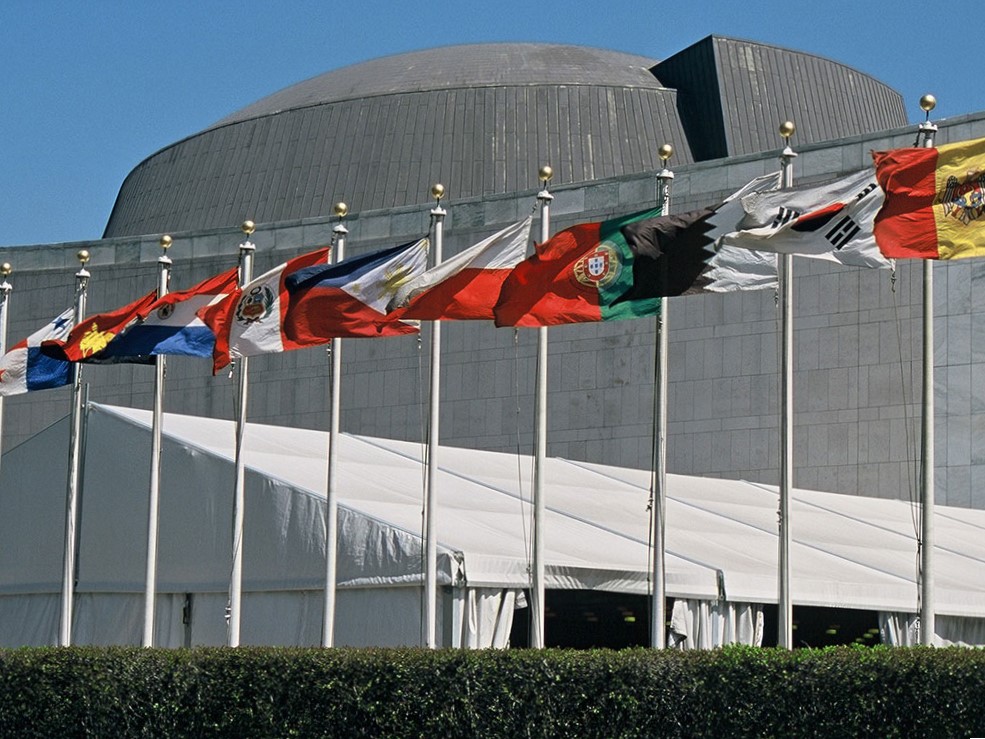
Complex that has served as the official headquarters of the United Nations since its completion in 1951 and holds the seats of the principal organs of the UN, including the General Assembly and the Security Council
General Information
Churchyard open from 7am to 6pm daily
The United Nations is headquartered in New York City in a complex that has served as the official headquarters of the United Nations since its completion in 1951.
The headquarters holds the seats of the principal organs of the UN, including the General Assembly and the Security Council, but excluding the International Court of Justice, which is seated in the Hague.
The complex includes a number of major buildings. While the Secretariat building is most predominantly featured in depictions of the headquarters, it also includes the domed General Assembly building, the Dag Hammarskjöld Library, as well as the Conference and Visitors Center, which is situated between the General Assembly and Secretariat buildings, and can be seen only from the FDR Drive or the East River. Just inside the perimeter fence of the complex stands a line of flagpoles where the flags of all 193 UN member states, 2 observer states, plus the UN flag, are flown in English alphabetical order.
The General Assembly Building, housing the United Nations General Assembly, holds the General Assembly Hall, which has a seating capacity of 1,800. At 165 ft (50 m) long by 115 ft (35 m) wide, it is the largest room in the complex.
The Hall has two murals by the French artist Fernand Léger. At the front of the chamber is the rostrum containing the green marble desk for the President of the General Assembly, Secretary-General and Under-Secretary-General for General Assembly Affairs and Conference Services and matching lectern for speakers. Behind the rostrum is the UN emblem on a gold background. Flanking the rostrum is a paneled semi-circular wall that tapers as it nears the ceiling and surrounds the front portion of the chamber. In front of the paneled walls are seating areas for guests and within the wall are windows which allow interpreters to watch the proceedings as they work. The ceiling of the hall is 75 ft (23 m) high and surmounted by a shallow dome ringed by recessed light fixtures. The entrance to the hall bears an inscription from the Gulistan by Iranian poet Saadi.
Original plans called for the back wall of the General Assembly Hall, behind the rostrum, to be adorned with the seals of the sixty countries that were part of the UN in 1952. Though fifty-four seals were eventually completed, these plans were scrapped in 1955 because Secretary-General Dag Hammarskjöld felt they would distract from the purpose of the room. The General Assembly Hall was last altered in 1980 when capacity was increased to accommodate the increased membership. Each of the 192 delegations has six seats in the hall with three at a desk and three alternate seats behind them.
The Conference Building faces the East River between the General Assembly Building and the Secretariat. The Conference Building holds the Security Council Chamber, which was a gift from Norway and was designed by the Norwegian architect Arnstein Arneberg. The oil canvas mural depicting a phoenix rising from its ashes by Norwegian artist Per Krogh hangs at the front of the room.
The second floor of the building houses the Economic and Social Council (ECOSOC) chamber, which was a gift from Sweden. It was designed by Sven Markelius and was renovated in 2013. This renovation added a set of curtains named "Dialogos" by Ann Edholm.
The 39-story Secretariat Building was completed in 1950. It houses offices for the Secretary General, the Under-Secretary-General for Legal Affairs and United Nations Legal Counsel, the Under-Secretary-General for Political Affairs and Office of Disarmament Affairs, and the Department for General Assembly and Conference Management (DGACM).
The library was founded with the United Nations in 1946. It was originally called the United Nations Library, later the United Nations International Library. In the late 1950s the Ford Foundation gave a grant to the United Nations for the construction of a new library building; Dag Hammarskjöld was also instrumental in securing the funding for the new building. The Dag Hammarskjöld Library was dedicated and renamed on November 16, 1961. The building was a gift from the Ford Foundation and is located next to the Secretariat at the southwest corner of the headquarters campus. The library holds 400,000 books, 9,800 newspapers and periodical titles, 80,000 maps, and the Woodrow Wilson Collection containing 8,600 volumes of League of Nations documents and 6,500 related books and pamphlets. The library's Economic and Social Affairs Collection is housed in the DC-2 building.
While outside of the complex, the headquarters also includes two large office buildings that serve as offices for the agencies and programmes of the organization. These buildings, known as DC-1 and DC-2, are located at 1 and 2 UN Plaza respectively. DC1 was built in 1976. There is also an identification office at the corner of 46th Street, inside a former bank branch, where pre-accredited diplomats, reporters, and others receive their grounds passes. UNICEF House (3 UN Plaza) and the UNITAR Building (807 UN Plaza) are also part of headquarters. In addition, the Church Center for the United Nations (777 UN Plaza) is a private building owned by the United Methodist Church as an interfaith space housing the offices of several non-governmental organizations. The Office of Internal Oversight Services (OIOS) is located at 380 Madison Avenue.
The complex contains gardens, which were originally private gardens before being opened to the public in 1958. The complex is notable for its gardens and outdoor sculptures. Iconic sculptures include the "Knotted Gun", called Non-Violence, a statue of a Colt Python revolver with its barrel tied in a knot, which was a gift from the Luxembourg government and Let Us Beat Swords into Plowshares, a gift from the Soviet Union. The latter sculpture is the only appearance of the "swords into plowshares" quotation, from Isaiah 2:4, within the complex. Contrary to popular belief, the quotation is not carved on any UN building. Rather, it is carved on the "Isaiah Wall" of Ralph Bunche Park across First Avenue. A piece of the Berlin Wall also stands in the UN garden.
Other prominent artworks on the grounds include Peace - a Marc Chagall stained glass window memorializing the death of Dag Hammarskjöld - the Japanese Peace Bell which is rung on the vernal equinox and the opening of each General Assembly session, a Chinese ivory carving made in 1974 (before the ivory trade was largely banned in 1989), and a Venetian mosaic depicting Norman Rockwell's painting The Golden Rule. A full-size tapestry copy of Pablo Picasso's Guernica, by Jacqueline de la Baume Dürrbach, is on the wall of the United Nations building at the entrance to the Security Council room. In 1952, two Fernand Léger murals were installed in the General Assembly Hall. The works are meant to merely be decorative with no symbolism. One is said to resemble cartoon character Bugs Bunny and U.S. President Harry S. Truman dubbed the other work "Scrambled Eggs".
Two large murals by Brazilian artist Cândido Portinari, entitled Guerra e Paz (War and Peace) are located at the delegates hall. The works are a gift from the United Nations Association of the United States of America and Portinari intended to execute them in the United States. However, he was denied a visa due to his communist convictions and decided to paint them in Rio de Janeiro. They were later assembled in the headquarters. After their completion in 1957, Portinari, who was already ill when he started the masterpiece, succumbed to lead poisoning from the pigments his doctors advised him to abandon.
This article uses material from the Wikipedia article "Headquarters of the United Nations", which is released under the Creative Commons Attribution-Share-Alike License 3.0