General Information
Tuesday 10am to 8pm
Wednesday 10am to 8pm
Thursday 10am to 6pm
Friday 10am to 6pm
Saturday 10am to 6pm
Sunday 1pm to 5pm
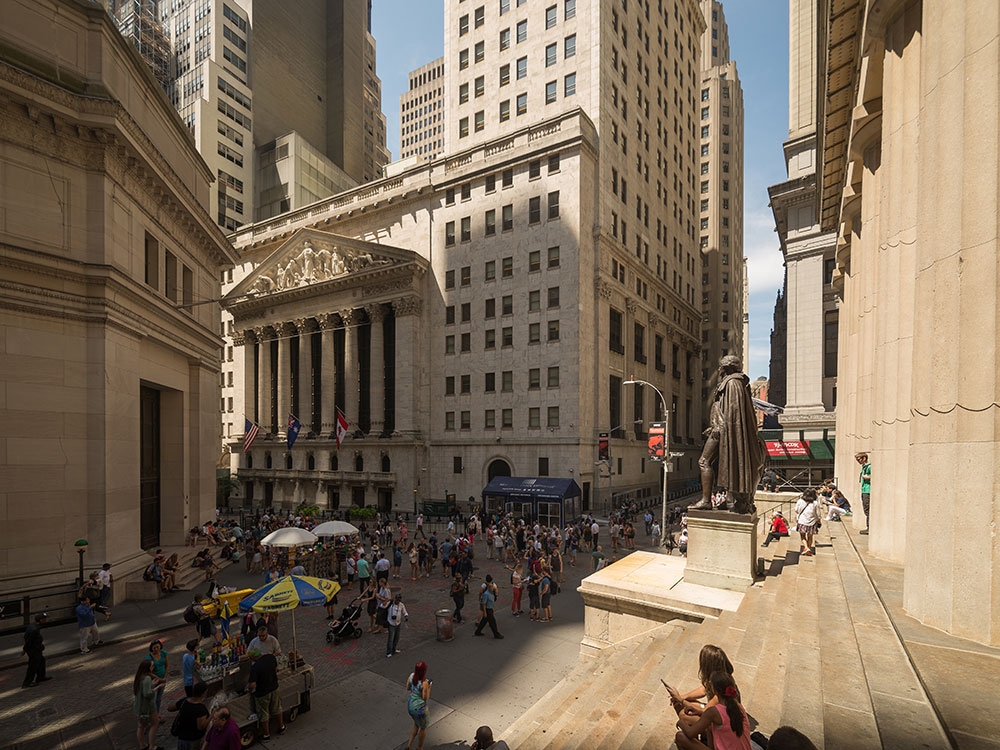
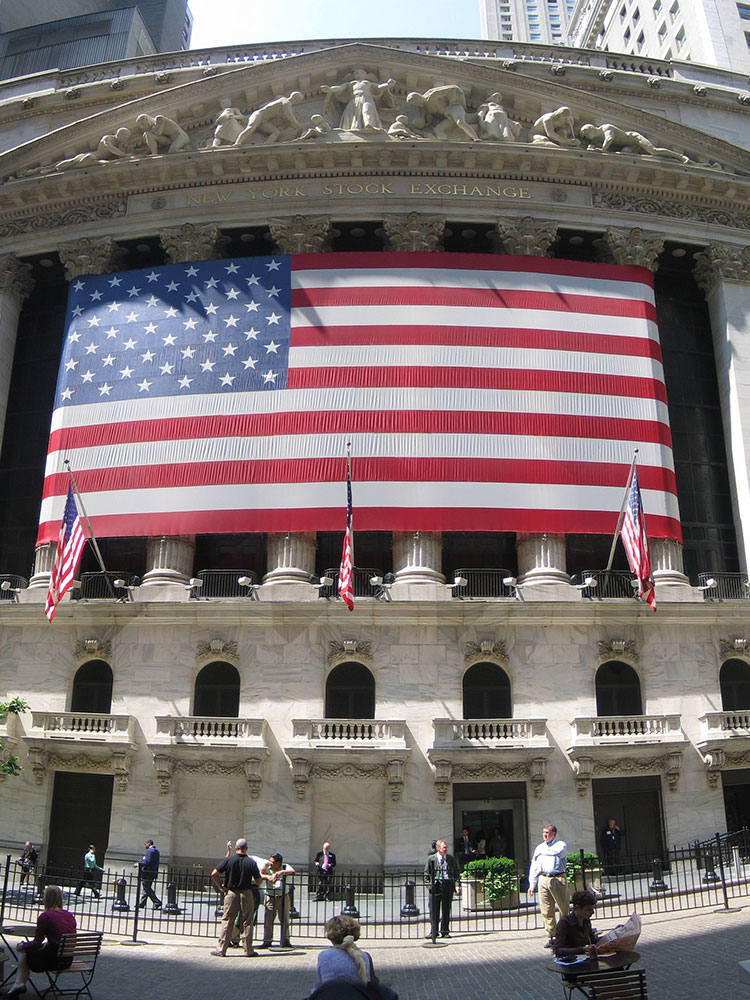
The New York Stock Exchange in the Financial District of Lower Manhattan is by far the world's largest stock exchange by market capitalization of its listed companies at US$30.1 trillion as of February 2018. The average daily trading value was approximately US$169 billion in 2013. The NYSE trading floor is at the New York Stock Exchange Building on 11 Wall Street and 18 Broad Street and is a National Historic Landmark. An additional trading room, at 30 Broad Street, was closed in February 2007.
L-BBE, CC BY 3.0, via Wikimedia Commons; Image Size Adjusted
The main New York Stock Exchange Building, built in 1903, was designed in the Beaux Arts style by George B. Post. The adjacent structure at 11 Wall Street, completed in 1922, was designed in a similar style by Trowbridge & Livingston. The buildings were both designated a National Historic Landmark in 1978. 18 Broad Street is also a New York City designated landmark.
The New York Stock Exchange (sometimes referred to as "The Big Board")[42] provides a means for buyers and sellers to trade shares of stock in companies registered for public trading. The NYSE is open for trading Monday through Friday from 9:30 am - 4:00 pm ET, with the exception of holidays declared by the Exchange in advance.
The NYSE trades in a continuous auction format, where traders can execute stock transactions on behalf of investors. They will gather around the appropriate post where a specialist broker, who is employed by a NYSE member firm (that is, he/she is not an employee of the New York Stock Exchange), acts as an auctioneer in an open outcry auction market environment to bring buyers and sellers together and to manage the actual auction. They do on occasion (approximately 10% of the time) facilitate the trades by committing their own capital and as a matter of course disseminate information to the crowd that helps to bring buyers and sellers together. The auction process moved toward automation in 1995 through the use of wireless handheld computers (HHC). The system enabled traders to receive and execute orders electronically via wireless transmission. On September 25, 1995, NYSE member Michael Einersen, who designed and developed this system, executed 1000 shares of IBM through this HHC ending a 203-year process of paper transactions and ushering in an era of automated trading.
The NYSE's opening and closing bells mark the beginning and the end of each trading day. The opening bell is rung at 9:30 am ET to mark the start of the day's trading session. At 4 pm ET the closing bell is rung and trading for the day stops. There are bells located in each of the four main sections of the NYSE that all ring at the same time once a button is pressed. There are three buttons that control the bells, located on the control panel behind the podium which overlooks the trading floor. The main bell, which is rung at the beginning and end of the trading day, is controlled by a green button. The second button, colored orange, activates a single-stroke bell that is used to signal a moment of silence. A third, red button controls a backup bell which is used in case the main bell fails to ring.
This article uses material from the Wikipedia article "New York Stock Exchange", which is released under the Creative Commons Attribution-Share-Alike License 3.0
Arild VĂ¥gen, CC BY-SA 4.0, via Wikimedia Commons; Image Size Adjusted
Phil Whitehouse from London, United Kingdom, CC BY 2.0, via Wikimedia Commons; Image Size Adjusted
I, Gfk, CC BY-SA 3.0, via Wikimedia Commons; Image Size Adjusted