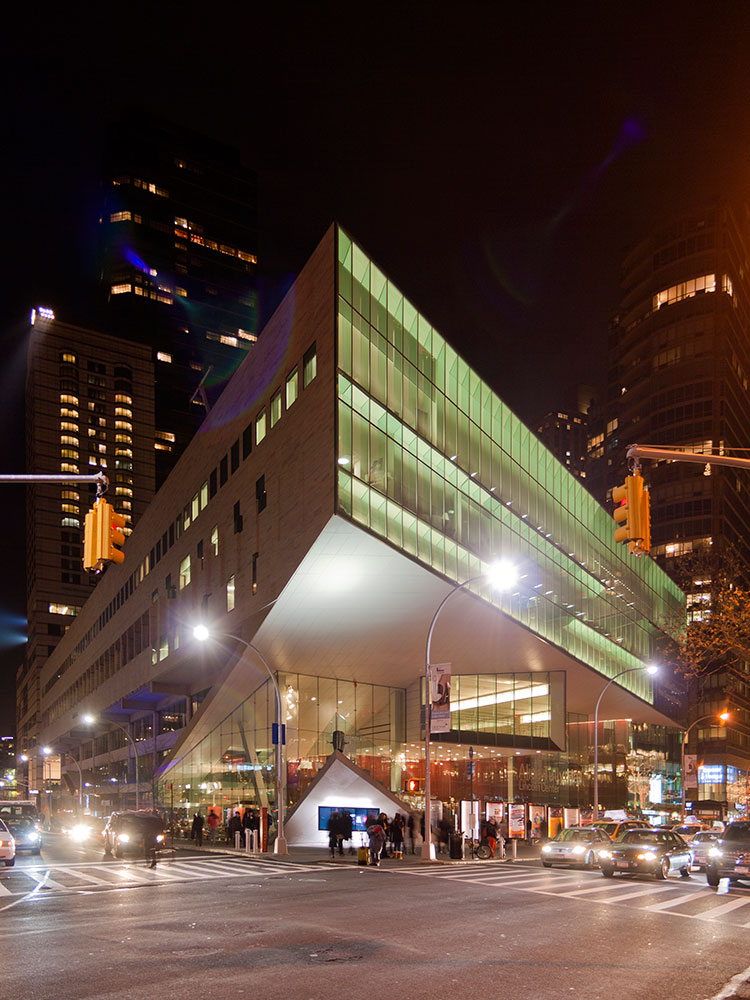
Lincoln Center

Rhododendrites, CC BY-SA 4.0, via Wikimedia Commons; Image Size Adjusted

16.3-acre complex of buildings houses nationally and internationally renowned performing arts organizations including the New York Philharmonic, the Metropolitan Opera, and the New York City Ballet

General Information

Hours:
Open 7am to 6pm daily
Churchyard open from 7am to 6pm daily
Fees:
No fees
Pet Policy:
No pets allowed
Seasons:
All year
Rating:
5.0
New York City, NY Weather Forecast

Lincoln Center for the Performing Arts (also simply known as Lincoln Center) is a 16.3-acre (6.6-hectare) complex of buildings in the Lincoln Square neighborhood of Manhattan. It has thirty indoor and outdoor facilities and is host to 5 million visitors annually. It houses nationally and internationally renowned performing arts organizations including the New York Philharmonic, the Metropolitan Opera, and the New York City Ballet. Juilliard School of Music also became part of the Lincoln Center complex.

Buildings and structures in Lincoln Center:

  • Samuel B. and David Rose Building (includes Walter Reade Theater)
  • Juilliard School
  • Alice Tully Hall
  • Vivian Beaumont Theater (includes Mitzi E. Newhouse Theater and Claire Tow Theater)
  • Elinor Bunin Monroe Film Center
  • David Geffen Hall
  • New York Public Library for the Performing Arts (includes Bruno Walter Auditorium)
  • Metropolitan Opera House
  • Josie Robertson Plaza with Revson Fountain
  • Damrosch Park
  • David H. Koch Theater
  • David Rubenstein Atrium
  • Jazz at Lincoln Center

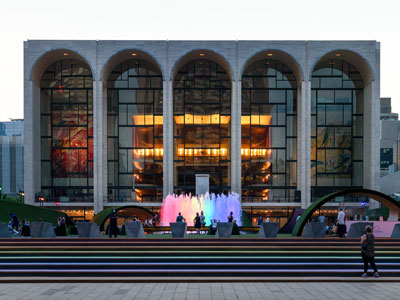
The Metropolitan Opera House (also known as The Met) is an opera house located on Broadway at Lincoln Square on the Upper West Side of Manhattan in New York City. Part of Lincoln Center for the Performing Arts, the theater was designed by Wallace K. Harrison. It opened in 1966, replacing the original 1883 Metropolitan Opera House at Broadway and 39th Street. With a seating capacity of approximately 3,850, the house is the largest repertory opera house in the world. Home to the Metropolitan Opera Company, the facility also hosts the American Ballet Theatre in the summer months.

The Met is one of the most technologically advanced stages in the world. Its vast array of hydraulic elevators, motorized stages and rigging systems have made possible the staging requirements of grand opera in repertory and have made possible complex productions such as Franco Zeffirelli's 1981 production of La bohème, as well as productions of mammoth operas, including Prokofiev's War and Peace, Verdi's Aida and Wagner's four-part, 16-hour Der Ring des Nibelungen. The Met stage has also been home to several world premieres of operas, including John Corigliano's The Ghosts of Versailles, Phillip Glass's The Voyage and the US premiere of Nico Muhly's Two Boys in 2013.

When the Metropolitan Opera is on hiatus, the Opera House is home to the annual Spring season of American Ballet Theatre (ABT). It regularly hosts touring opera and ballet companies including the Kirov, Bolshoi, and the La Scala companies. In addition, the Met has presented recitals by Vladimir Horowitz, Renée Fleming, Kathleen Battle, and others. Philip Glass's Einstein on the Beach was staged independently at the Met in 1976. Concerts by Barbra Streisand, The Who, Paul McCartney and others have been successful as well.

Situated at the western end of Lincoln Center Plaza, the Metropolitan Opera House faces Columbus Avenue and Broadway and forms an axis with Philip Johnson's David Koch Theater (formerly the New York State Theater) and David Geffen Hall (formerly Avery Fisher Hall), designed by Max Abramovitz, with the plaza's fountain at the center. Although west-east roads do not run through Lincoln Center itself, the Metropolitan Opera House is parallel to the block from West 63rd Street to West 64th Street. The rear of the House meets Amsterdam Avenue, and extends to the plaza entrance.

The building is clad in white travertine and the east facade is graced with its distinctive series of five concrete arches and large glass and bronze facade, towering 96 feet above the plaza. On the north, south and west sides of the building, hundreds of vertical fins of travertine running the full height of the structure give the impression that the facade is an uninterrupted mass of travertine when viewed from certain angles. The building totals 14 stories, 5 of which are underground.

On display in the lobby, and visible to the outside plaza, are two murals created for the space by Marc Chagall. The murals are approximately 30 ft (9.1 m) by 36 ft (11 m). The south wall holds the work entitled The Triumph of Music while the north wall contains The Sources of Music.

The multi-story lobby is dominated by a concrete and terrazzo cantilevered stairway that connects the main level with the lower level lounges and upper floors. The centerpiece of the lobby is an array of eleven "crystal chandeliers resembling constellations with sparkly moons and satellites spraying out in all directions"; the auditorium contains 21 matching chandeliers, the largest of which measures 18 ft (5.5 m) in diameter. Twelve of the chandeliers in the auditorium are on motorized winches, and raised to the ceiling prior to performances so as not to obstruct sight lines of the audience on the upper levels.

The lobby also contains sculptures by Aristide Maillol and Wilhelm Lehmbruck as well as portraits of notable performers and members of the Met company. 3,000 square feet of velour covers the walls in the front of house spaces, with gold leaf, bronze, Italian marble and concrete being the architectural surfaces in these spaces. A restaurant occupies space on the Grand Tier level, and spaces for patrons, guild members, and the Metropolitan Opera Club exist as well throughout the lobbies.

The auditorium is fan-shaped and decorated in gold and burgundy with seating for 3,794 and 245 standing positions on six levels. Over 4,000 squares of gold leaf cover the domed petal-shaped ceiling from which the 21 crystal chandeliers hang. The walls of the auditorium are paneled in kevazingo bubinga, a rosewood noted for its acoustic quality. The auditorium is known to be acoustically significant—small conversation and quiet moments in music can be heard well at the top of the Family Circle some 146 feet (45 m) away from the stage.

The stage complex is one of the largest and most complex of its kind in the world, extending 80 ft (24 m) deep from the curtain line to the rear wall. The overall dimensions of the stage with wing space are 90 ft (27 m) deep and 103 ft (31 m) wide. The stage contains 7 hydraulic elevators that are 60 ft (18 m) wide, with double decks; three slipstages (large spaces on either side of and behind the main stage, each capable of holding a complete stage setting), the upstage one containing a 60 ft (18 m) diameter turntable; 103 motorized battens (linesets) for overhead lifting; and two 100 ft (30 m)-tall fully enveloping cycloramas.

The large and highly mechanized stage and support space smoothly facilitates the rotating presentation of up to four different opera productions each week. The auditorium occupies a fourth of the building's interior area; massive storage spaces below the stage allow for production storage within the opera house, and large workshops for scenery construction, costumes, wigs and electric equipment, as well as kitchens, offices, an employee canteen and dressing room spaces for the principals, chorus, supernumeraries, ballet and children's chorus surround the stage complex on multiple floors. Two large rehearsal halls (situated three floors below the stage) have nearly the dimensions of the Main Stage, allowing for blocking rehearsals and space for full orchestra set ups.

This article uses material from the Wikipedia article "Metropolitan Opera House (Lincoln Center)", which is released under the Creative Commons Attribution-Share-Alike License 3.0

Trinity Church
ajay_suresh, CC BY 2.0, via Wikimedia Commons; Image Size Adjusted
Trinity Church
Robert Mintzes, CC BY-SA 3.0, via Wikimedia Commons; Image Size Adjusted