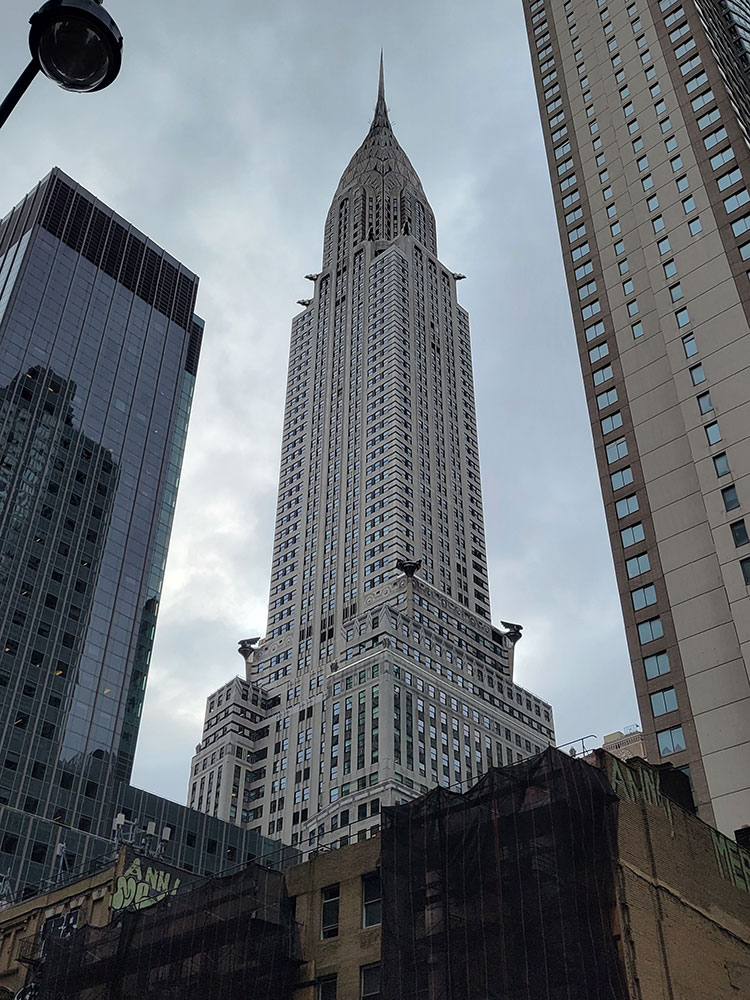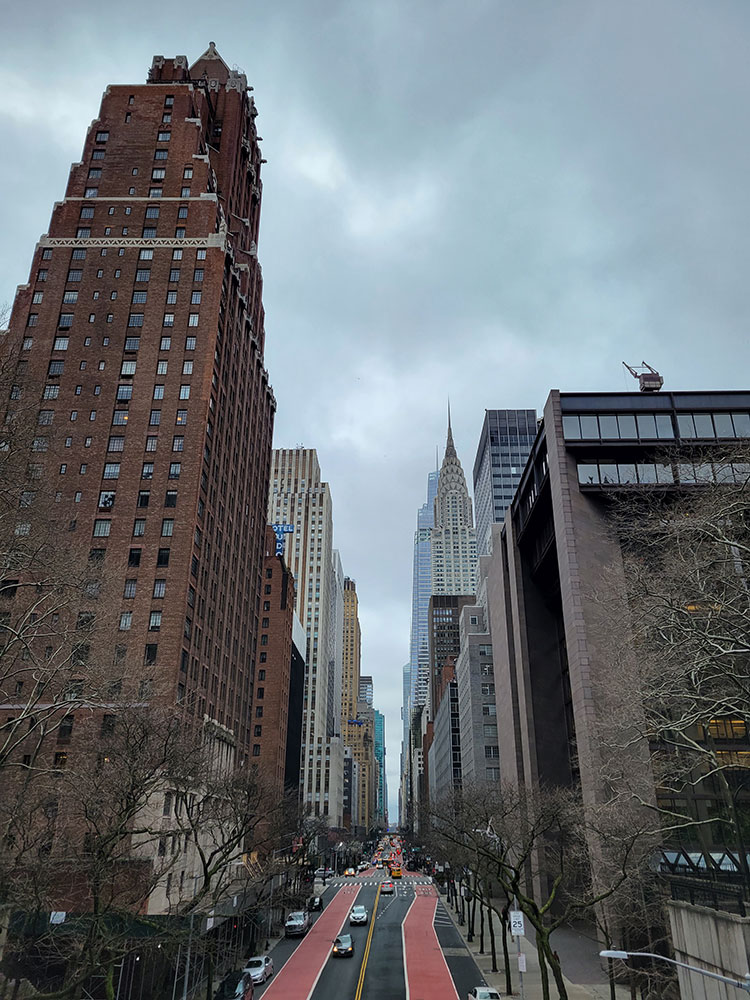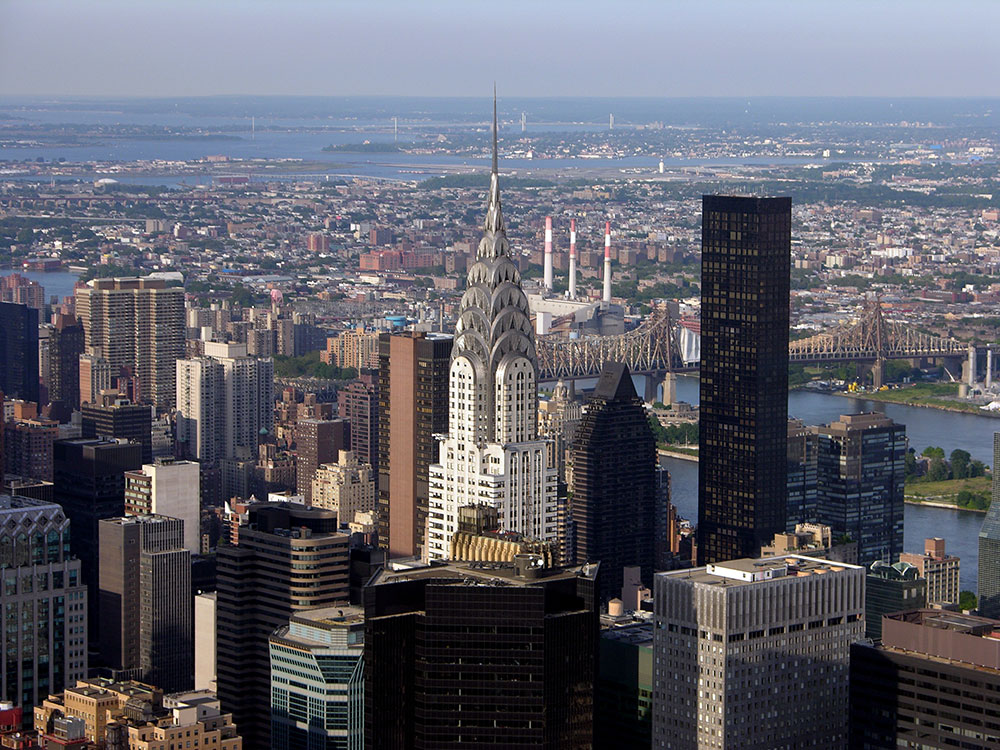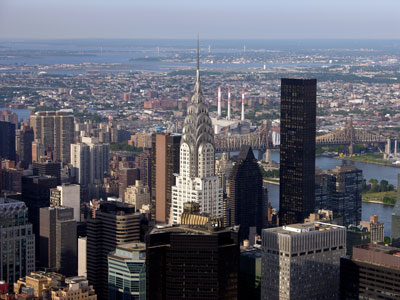
Art Deco skyscraper in the Turtle Bay neighborhood on the East Side of Manhattan is the tallest brick building in the world with a steel framework
General Information
The Chrysler Building is an Art Deco skyscraper in the Turtle Bay neighborhood on the East Side of Manhattan, at the intersection of 42nd Street and Lexington Avenue near Midtown Manhattan. At 1,046 feet (319 m), it is the tallest brick building in the world with a steel framework, and was the world's tallest building for 11 months after its completion in 1930. As of 2019, the Chrysler is the 11th-tallest building in the city, tied with The New York Times Building.
Originally a project of real estate developer and former New York State Senator William H. Reynolds, the building was constructed by Walter Chrysler, the head of the Chrysler Corporation. The construction of the Chrysler Building, an early skyscraper, was characterized by a competition with 40 Wall Street and the Empire State Building to become the world's tallest building. Although the Chrysler Building was built and designed specifically for the car manufacturer, the corporation did not pay for its construction and never owned it; Walter Chrysler decided to fund the entire cost so his children could inherit it. An annex was completed in 1952, and the building was sold by the Chrysler family the next year, with numerous subsequent owners.
When the Chrysler Building opened, there were mixed reviews of the building's design, ranging from views of it as inane and unoriginal to the idea that it was modernist and iconic. Perceptions of the building have slowly evolved into its now being seen as a paragon of the Art Deco architectural style; and in 2007, it was ranked ninth on the List of America's Favorite Architecture by the American Institute of Architects. The building was designated a New York City landmark in 1978, and was added to the National Register of Historic Places as a National Historic Landmark in 1976.
The Chrysler Building is considered a leading example of Art Deco architecture. It is constructed of a steel frame in-filled with masonry, with areas of decorative metal cladding. The structure contains 3,862 exterior windows. Approximately fifty metal ornaments protrude at the building's corners on five floors reminiscent of gargoyles on Gothic cathedrals. The 31st-floor contains gargoyles and replicas of the 1929 Chrysler radiator caps, the 61st-floor eagles, a nod to America's national bird.
The ground floor exterior is covered in polished black granite from Shastone, while the three floors above it are clad in white marble from Georgia. There are two main entrances, on Lexington Avenue and on 42nd Street, each three floors high with Shastone granite surrounding each proscenium-shaped entryway. At some distance into each main entryway, there are revolving doors "beneath intricately patterned metal and glass screens", designed so as to embody the Art Deco tenet of amplifying the entrance's visual impact. A smaller side entrance on 43rd Street is one story high. There are storefronts consisting of large Nirosta-steel-framed windows at ground level, with office windows on the second through fourth floors.
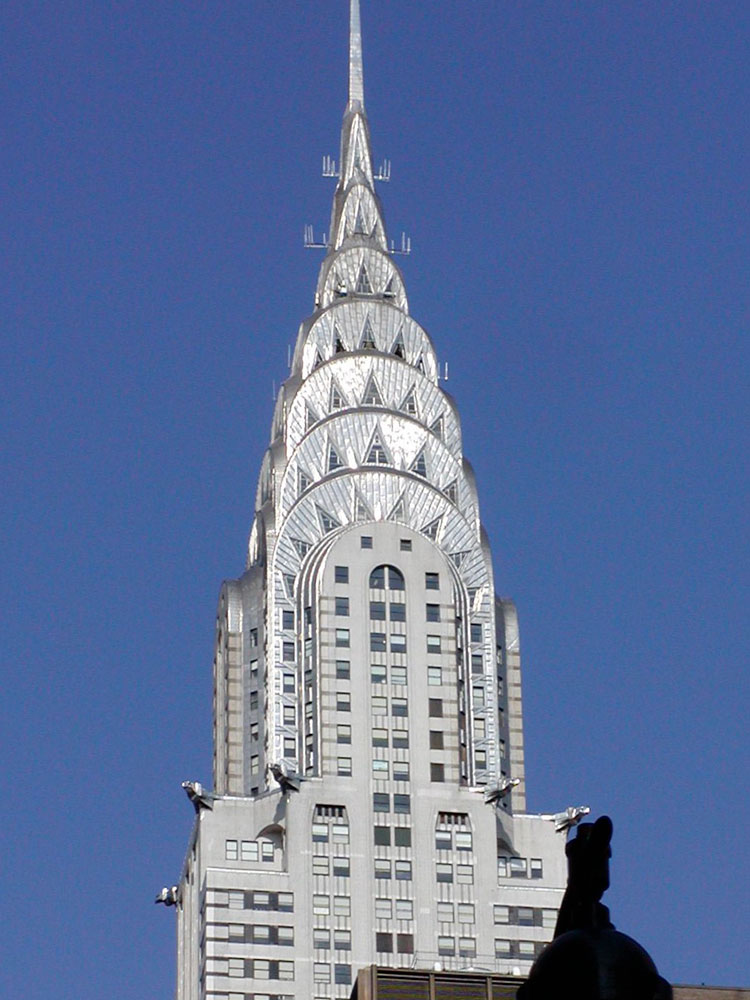
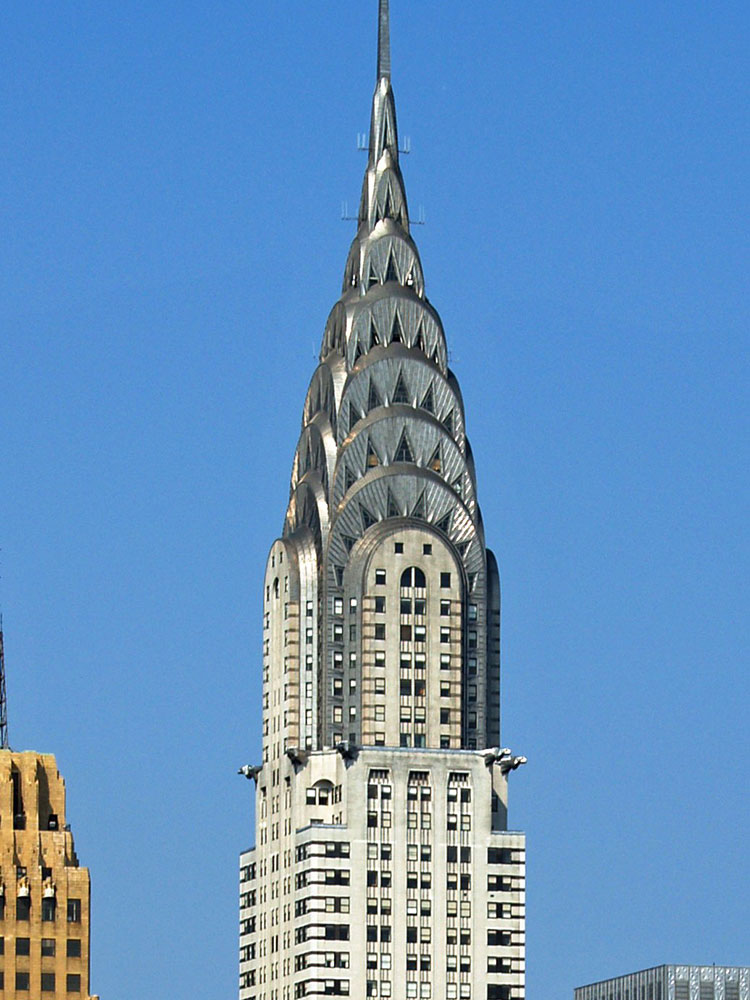
The Chrysler Building is renowned for, and recognized by, its terraced crown, which is an extension of the main tower. Composed of seven radiating terraced arches, Van Alen's design of the crown is a cruciform groin vault of seven concentric members with transitioning setbacks, mounted one behind another. The entire crown is clad with Nirosta steel, ribbed and riveted in a radiating sunburst pattern with many triangular vaulted windows, reminiscent of the spokes of a wheel. The windows are repeated, in smaller form, on the terraced crown's seven narrow setbacks. Due to the curved shape of the dome, the Nirosta sheets had to be measured on site, so most of the work was carried out in workshops on the building's 67th and 75th floors. According to Robinson, the terraced crown "continue[s] the wedding-cake layering of the building itself. This concept is carried forward from the 61st floor, whose eagle gargoyles echo the treatment of the 31st, to the spire, which extends the concept of 'higher and narrower' forward to infinite height and infinitesimal width. This unique treatment emphasizes the building's height, giving it an other worldly atmosphere reminiscent of the fantastic architecture of Coney Island or the Far East."
The crown and spire are illuminated by a combination of fluorescent lights framing the crown's distinctive triangular windows and colored floodlights that face toward the building, allowing it to be lit in a variety of schemes for special occasions.
This article uses material from the Wikipedia article "Chrysler Building", which is released under the Creative Commons Attribution-Share-Alike License 3.0
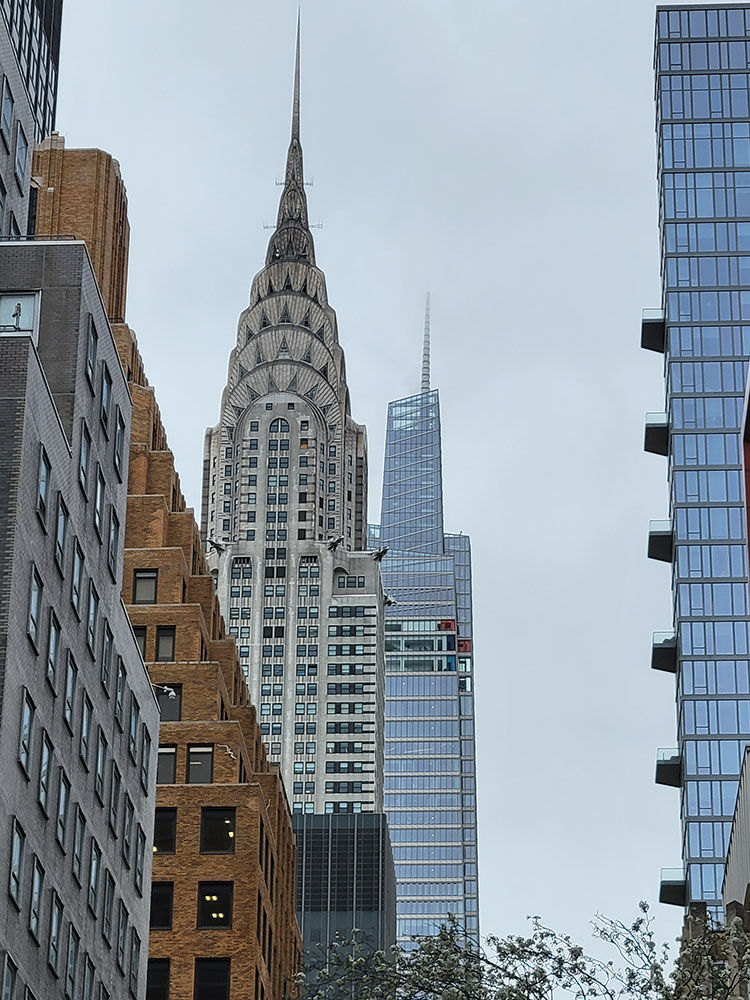
The original uploader was Petri Krohn at English Wikipedia.Later versions were uploaded by Cacophony at en.wikipedia., CC BY-SA 3.0, via Wikimedia Commons; Image Size Adjusted
PortableNYCTours, CC BY-SA 4.0, via Wikimedia Commons; Image Size Adjusted
Misterweiss at English Wikipedia, Public domain, via Wikimedia Commons; Image Size Adjusted
w:User:Overandderivative work: Overand, Public domain, via Wikimedia Commons; Image Size Adjusted
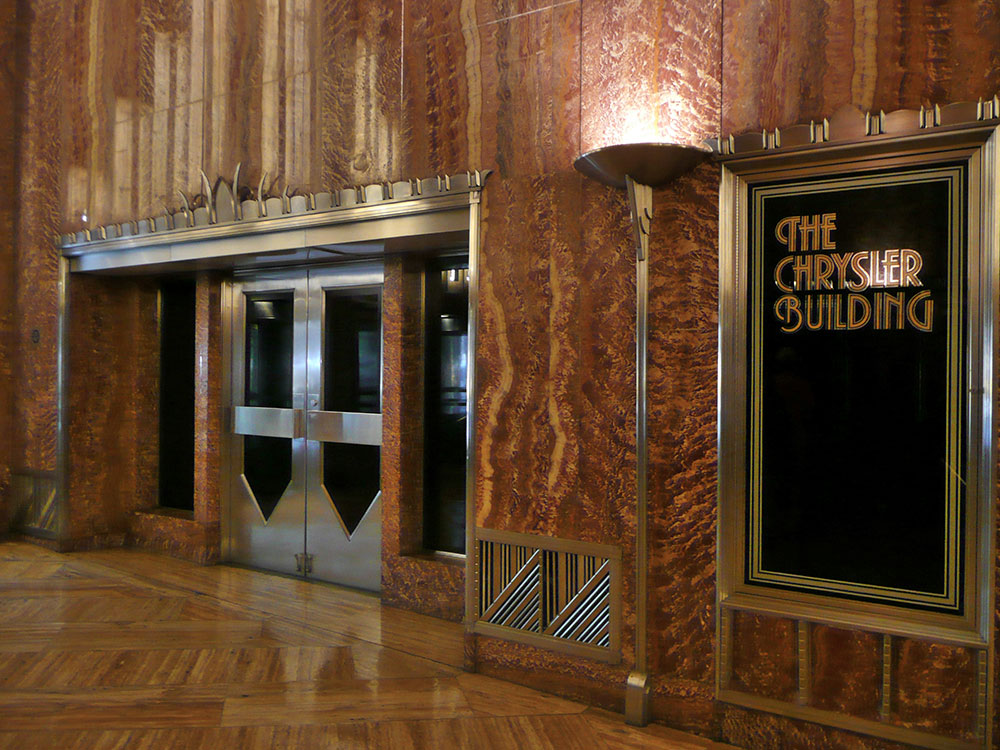
Dorff, CC BY-SA 3.0, via Wikimedia Commons; Image Size Adjusted
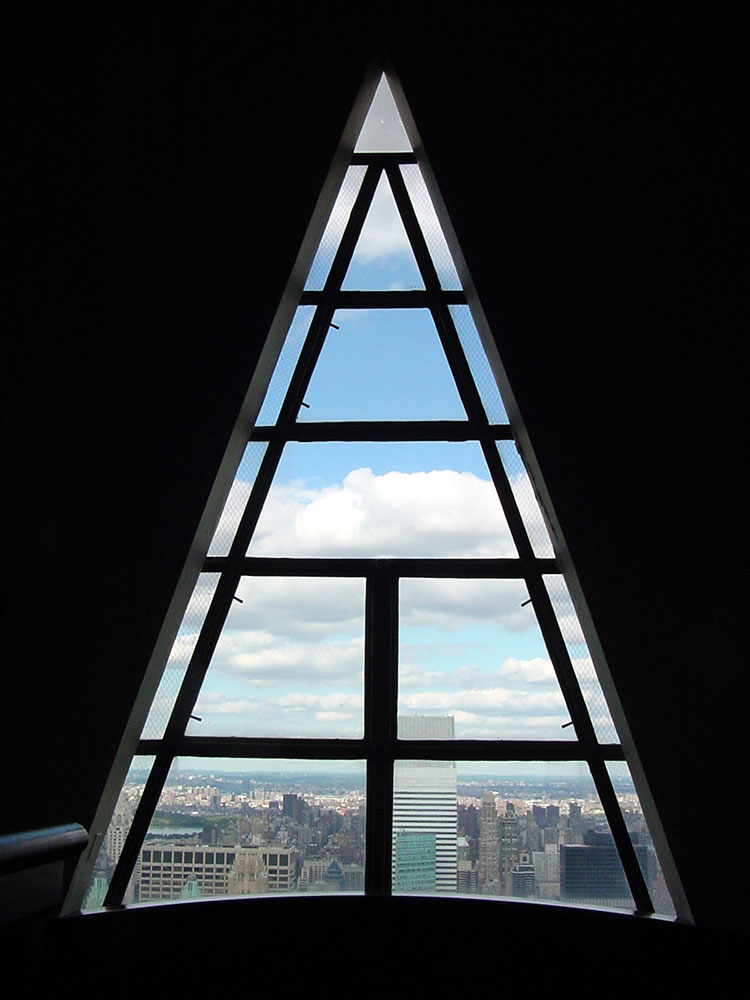
Julius Schorzman, CC BY-SA 2.0, via Wikimedia Commons; Image Size Adjusted
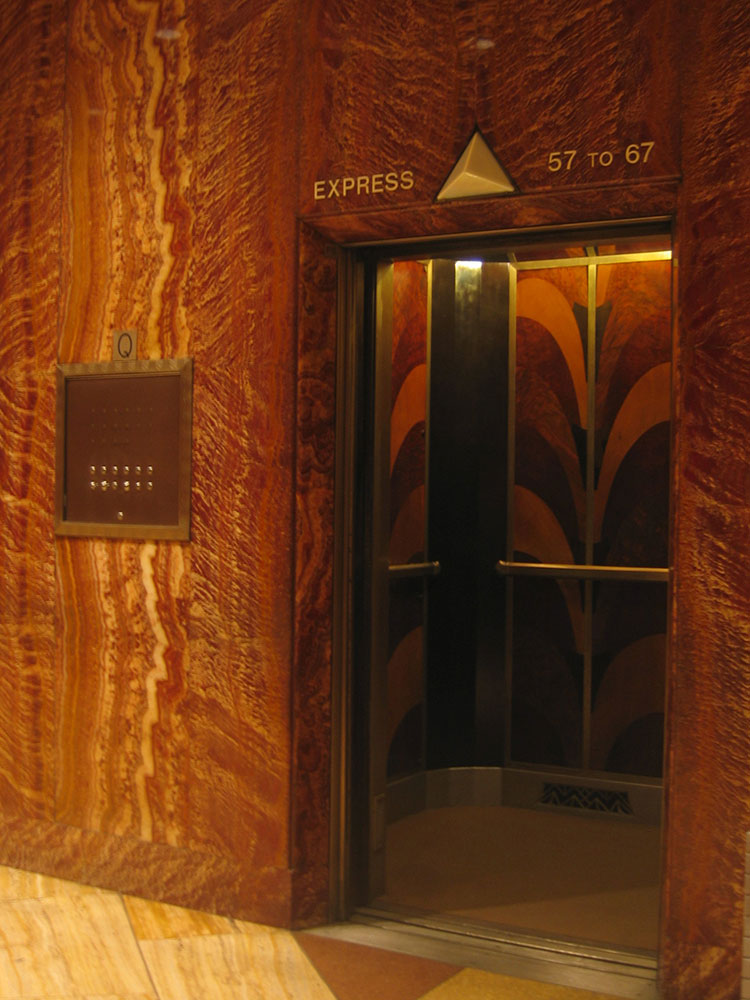
kmf164, CC BY-SA 2.0, via Wikimedia Commons; Image Size Adjusted