Central Park

Anthony Quintano from Hillsborough, NJ, United States, CC BY 2.0, via Wikimedia Commons; Image Size Adjusted

Most visited urban park in the United States, with an estimated 42 million visitors annually as of 2016, and is the most filmed location in the world

General Information

Hours:
Open 6am to 1am daily
Fees:
No fees
Pet Policy:
Pets allowed but dogs are never allowed in:
All ballfields and recreational courts
All playgrounds
All sand volleyball courts
All water bodies, streams, and ornamental fountains
Elm islands at the Mall
Great Lawn Oval
Hallett Nature Sanctuary
Lilac Walk
Stephanie and Fred Shuman Running Track
Sheep Meadow
Seasons:
All year
Rating:
5.0
New York City, NY Weather Forecast

Central Park is an urban park in New York City located between the Upper West and Upper East Sides of Manhattan. It is the fifth-largest park in the city by area, covering 843 acres (341 ha). It is the most visited urban park in the United States, with an estimated 42 million visitors annually as of 2016, and is the most filmed location in the world.

Following proposals for a large park in Manhattan during the 1840s, it was approved in 1853 to cover 778 acres (315 ha). In 1857, landscape architects Frederick Law Olmsted and Calvert Vaux won a design competition for the park with their "Greensward Plan". Construction began the same year; existing structures, including a majority-Black settlement named Seneca Village, were seized through eminent domain and razed. The park's first areas were opened to the public in late 1858. Additional land at the northern end of Central Park was purchased in 1859, and the park was completed in 1876. After a period of decline in the early 20th century, New York City parks commissioner Robert Moses started a program to clean up Central Park in the 1930s. The Central Park Conservancy, created in 1980 to combat further deterioration in the late 20th century, refurbished many parts of the park starting in the 1980s.

Central Park Alice in Wonderland
Image by Alfred Hutter, Attribution, via Wikimedia Commons; Image Size Adjusted

Main attractions include landscapes such as the Ramble and Lake, Hallett Nature Sanctuary, the Jacqueline Kennedy Onassis Reservoir, and Sheep Meadow; amusement attractions such as Wollman Rink, Central Park Carousel, and the Central Park Zoo; formal spaces such as the Central Park Mall and Bethesda Terrace; and the Delacorte Theater. The biologically diverse ecosystem has several hundred species of flora and fauna. Recreational activities include carriage-horse and bicycle tours, bicycling, sports facilities, and concerts and events such as Shakespeare in the Park. Central Park is traversed by a system of roads and walkways and is served by public transportation.

Its size and cultural position make it a model for the world's urban parks. Its influence earned Central Park the designations of National Historic Landmark in 1963 and of New York City scenic landmark in 1974. Central Park is owned by the New York City Department of Parks and Recreation but has been managed by the Central Park Conservancy since 1998, under a contract with the municipal government in a public-private partnership. The Conservancy, a non-profit organization, raises Central Park's annual operating budget and is responsible for all basic care of the park.

Central Park is divided into three sections: the "North End" extending above the Jacqueline Kennedy Onassis Reservoir; "Mid-Park", between the reservoir to the north and the Lake and Conservatory Water to the south; and "South End" below the Lake and Conservatory Water. The park has five visitor centers: Charles A. Dana Discovery Center, Belvedere Castle, Chess & Checkers House, the Dairy, and Columbus Circle.

The park has natural-looking plantings and landforms, having been almost entirely landscaped when built in the 1850s and 1860s. It has eight lakes and ponds that were created artificially by damming natural seeps and flows. There are several wooded sections, lawns, meadows, and minor grassy areas. There are 21 children's playgrounds, and 6.1 miles (9.8 km) of drives.

Central Park is the fifth-largest park in New York City, behind Pelham Bay Park, the Staten Island Greenbelt, Van Cortlandt Park, and Flushing Meadows-Corona Park, with an area of 843 acres (341 ha; 1.317 sq mi; 3.41 km2).

Central Park Alice in Wonderland

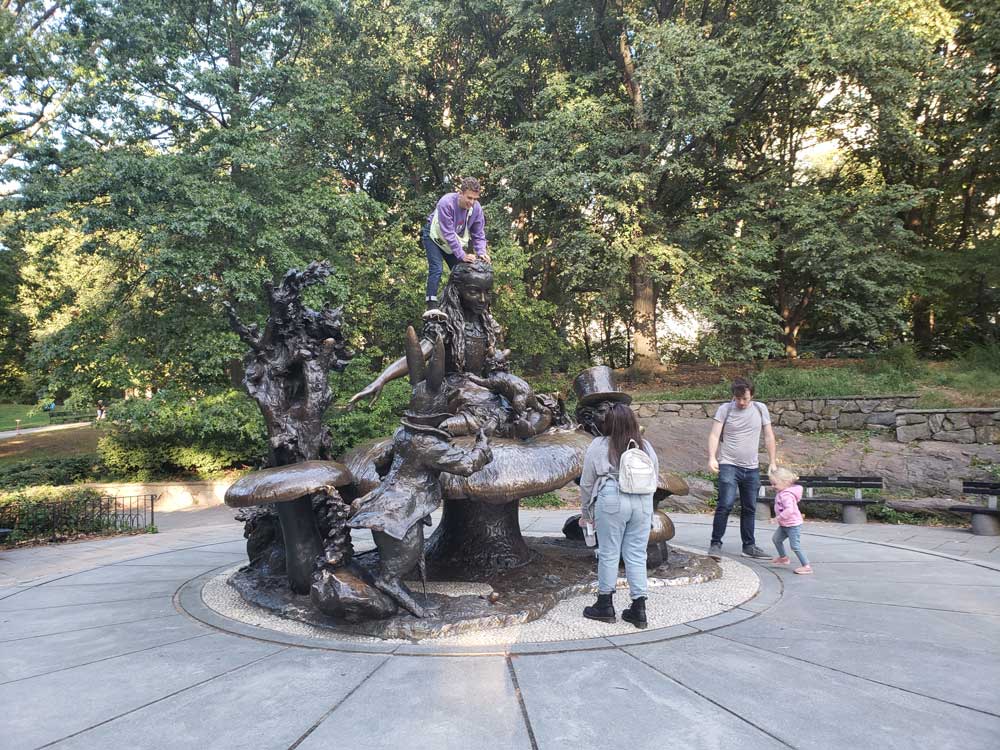
One large sculpture depicts Alice, from Lewis Carroll's 1865 classic Alice's Adventures in Wonderland. The statue is located on East 74th Street on the north side of Central Park's Conservatory Water. Alice is pictured sitting on a giant mushroom reaching toward a pocket watch held by the White Rabbit. Peering over her shoulder is the Cheshire Cat, flanked on one side by the Dormouse, and on the other by Mad Hatter, who in contrast to the calm Alice looks ready to laugh out loud at any moment. Publisher and philanthropist George T. Delacorte Jr. ordered the sculpture from José de Creeft, in honor of Delacorte's late wife, Margarita, and to the enjoyment of the children of New York. Unveiled in 1959, de Creeft's sculpture tries to follow John Tenniel's whimsical Victorian illustrations from the first edition of the book. According to various sources, Alice is said to look like de Creeft's daughter Donna. The Alice in Wonderland project's architects and designers were Hideo Sasaki and Fernando Texidor, who inserted some plaques with inscriptions from the book in the terrace around the sculpture. Margarita's favorite poem, "Jabberwocky" is also included; chiseled in a granite circle surrounding the sculpture.

The design of the sculpture attracts many children who want to climb its many levels, resulting in the bronze's glowing patina, polished by thousands of tiny hands over the years since the sculpture was unveiled. It was cast at Modern Art Foundry in Astoria Queens.

Central Park Conservatory Water

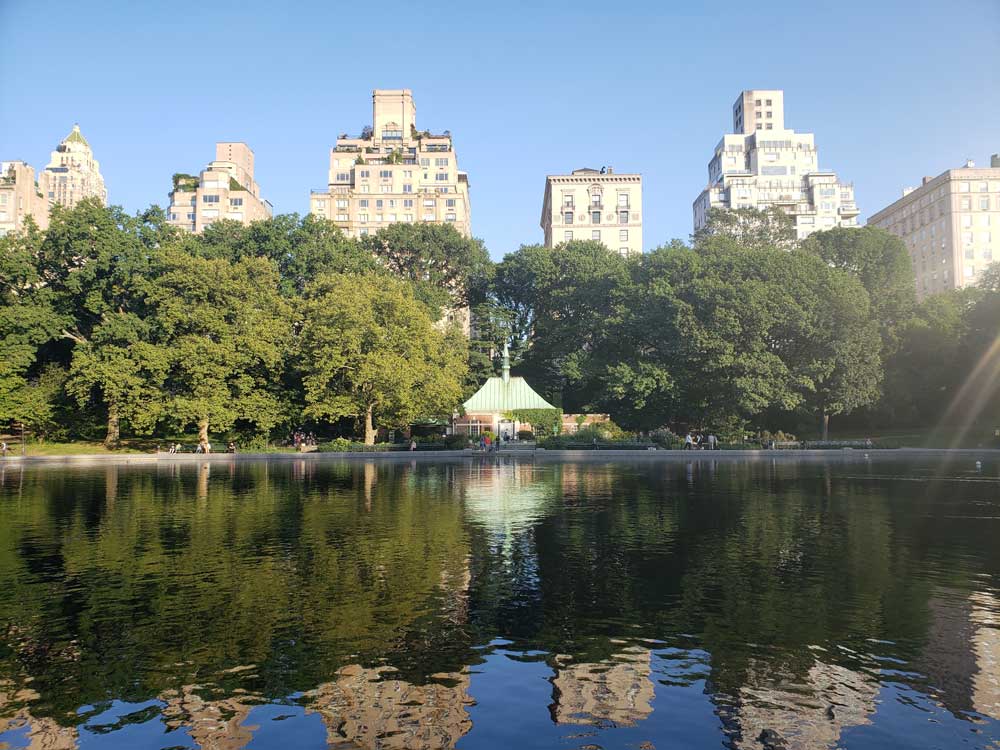
Conservatory Water is a pond located in a natural hollow within Central Park in Manhattan, New York City. It is located west of Fifth Avenue, centered opposite East 74th Street. The pond is surrounded by several landscaped hills, including Pilgrim Hill dotted by groves of Yoshino cherry trees and Pug Hill, resulting in a somewhat manicured park landscape, Conservatory Water is named for a glass-house for tropical plants and was intended to be entered from Fifth Avenue by a grand stair. The shore of Conservatory Water contains the Kerbs Memorial Boathouse, where patrons can rent and navigate radio-controlled model boats, as well as bronze sculptures.

The Jacqueline Kennedy Onassis Reservoir, also known as Central Park Reservoir, is a decommissioned reservoir in Central Park, stretching from 86th to 96th Streets. It covers 106 acres (43 ha) and holds over 1,000,000,000 US gallons (3,800,000 m3) of water.

Croton Aqueduct Board president Nicholas Dean proposed the construction of Central Park around its receiving reservoir (later the Great Lawn and Turtle Pond) in the 1850s. As part of this project, the Central Park Reservoir was completed in 1862. The reservoir was decommissioned in 1993, after it was deemed obsolete, and control was transferred to the Department of Parks and Recreation in 1999. The Central Park Reservoir was renamed in honor of Jacqueline Kennedy Onassis in 1994 to commemorate her contributions to the city, and because she lived nearby.

The Reservoir covers 106 acres (43 ha) and holds over 1,000,000,000 US gallons (3,800,000 m3) of water. Though no longer used to distribute New York City's water supply, it provides water for the Pool and the Harlem Meer. It is a popular place of interest in Central Park. There is a 1.58-mile (2.54 km) jogging track around it used by many runners, and it is also encircled by the park's bridle trail. Bill Clinton, Barack Obama, Madonna, and Jacqueline Kennedy Onassis have all run the track. The Reservoir is often visited by tourists, especially when its double pink "Yoshino" cherry trees (Prunus x yedoensis), followed by "Kanzan" cherry trees Prunus serrulata, are blooming.

The rhododendrons along the "Rhododendron Mile" were a gift to the city from Mrs Russell Sage in 1909. The Reservoir area is one of the main ecological sanctuaries in the park, attracting more than 20 species of waterbirds: coots, mergansers, northern shovelers, ruddy ducks, buffleheads, loons, cormorants, wood ducks, American black ducks, gadwall, grebes, herons and egrets, along with various species of gulls, may be seen in addition to the familiar mallards and Canada geese, making it a popular venue for birdwatchers.

Central Park Sheep Meadow

Sheep Meadow is a 15-acre meadow near the southwestern section of Central Park, between West 66th and 69th Streets in Manhattan, New York City. It is adjacent to Central Park Mall to the east, The Ramble and Lake to the north, West Drive to the west, and Heckscher Playground and Ballfields to the south. Sheep Meadow has a long history as a gathering place for large-scale demonstrations and political movements. These have included festivals, rallies, concerts, and protests.

The Loeb Boathouse, on the eastern shore of the Lake, is one of several boat landings that have existed on the Lake throughout its history. Boating concessions were granted in the early 1860s, and rowboating on the Lake soon became popular. Six docks on the Lake were built by 1865, although the boats were stored near Bethesda Terrace. In 1870, Olmsted and Vaux suggested the construction of a permanent boathouse to launch and store the boats, and the Victorian style boathouse was finished by 1873 or 1874. However, it fell into disrepair in the mid-20th century and was destroyed by 1950.

In 1983, the boathouse was renovated for $750,000, and a 40-seat restaurant opened within the boathouse. Today, the Loeb Boathouse contains a formal dining room, dining terraces, and concession stands, as well as a rowboat rental.

Strawberry Fields is a 2.5-acre (1.0 ha) landscaped section in Central Park, designed by the landscape architect Bruce Kelly, that is dedicated to the memory of former Beatles member John Lennon. It is named after the Beatles' song "Strawberry Fields Forever", written by Lennon. The song itself is named for the former Strawberry Field children's home in Liverpool, England, located near Lennon's childhood home.

The entrance to the memorial is located on Central Park West at West 72nd Street, near where John Lennon was murdered outside his home, the Dakota. The memorial is a triangular piece of land falling away on the two sides of the park, and its focal point is a circular pathway mosaic of inlaid stones, with a single word, the title of Lennon's most famous song "Imagine". The mosaic, in the style of Portuguese pavement, is based on a Greco-Roman design. It was created by Italian craftsmen and was donated as a gift by the Italian city of Naples.

A "floral border" surrounds Strawberry Fields. Along the borders of the area surrounding the mosaic are benches which are endowed in memory of other individuals and maintained by the Central Park Conservancy. Along a path toward the southeast, a plaque on a low glaciated outcropping of schist lists the nations which contributed to building the memorial. Lennon's widow Yoko Ono, who still lives in The Dakota, contributed over a million dollars for the landscaping and the upkeep endowment.

The mosaics at the heart of a series of open and secret glades of lawn and glacier-carved rock outcroppings, bounded by shrubs and mature trees and woodland slopes, all designated a "quiet zone". A woodland walk winds through edge plantings between the glade-like upper lawn and the steep wooded slopes; it contains native rhododendrons and hollies, Carolina allspice (Calycanthus floridus), mountain laurel (Kalmia latifolia), viburnums, and jetbead. Wild shrub roses and a mature pink Magnolia soulangeana flank the main walk. At the farthest northern tip of the upper series of lawns enclosed by woodland are three dawn redwood trees, which lose their needles but regain them every spring, an emblem of eternal renewal. The trees can be expected to reach a height of 36 metres (118 ft) within 100 years, and eventually they will be visible from great distances in the park.

Central Park The Mall

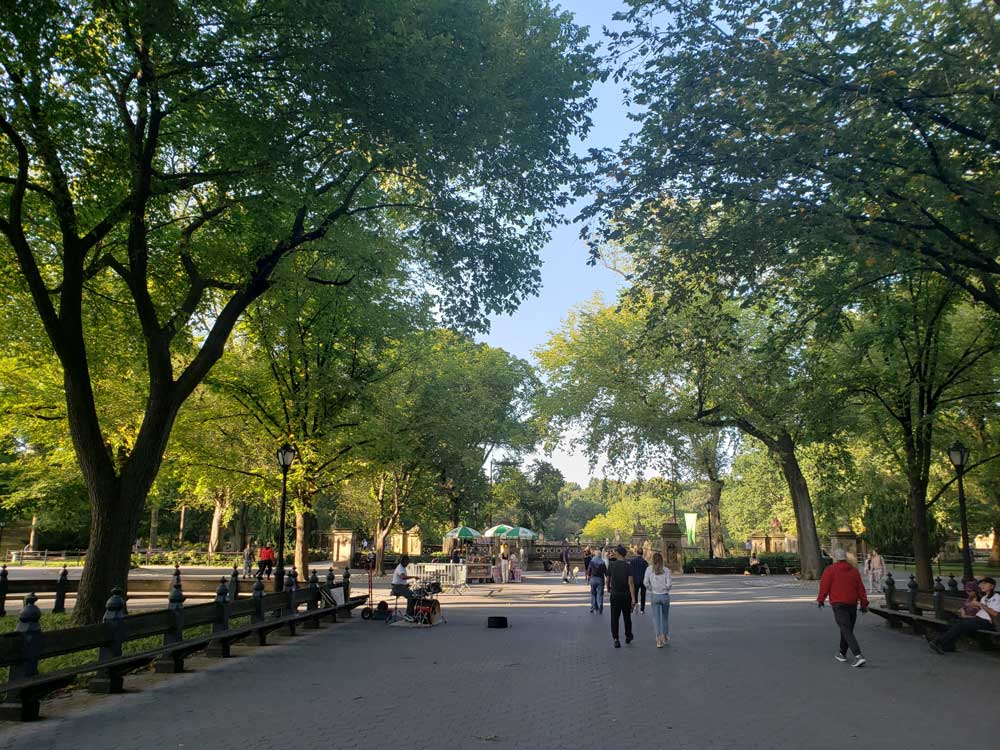
The Central Park Mall is a pedestrian esplanade in Central Park. It was designed so that a carriage could disgorge its passengers at the south end, then drive round and pick them up again overlooking Bethesda Terrace, whose view of the Lake and Ramble formed the "ultimatum of interest". To the east of the Mall, the wisteria pergola parallels the Mall at the top of a slope; it provides screening and separation from the Mall for another outdoor concert stage in New York's Central Park, Central Park SummerStage.

Facing onto the Mall near its upper end is the neo-classical half-domed Naumburg Bandshell The Naumburg Orchestral Concerts, founded in 1905 and the world's oldest, continuous free outdoor classical music concert series take place there as a gift to the public, each summer. The bandshell has deteriorated over the years and was considered for demolition in 1989. Despite being preserved, it has never been fully restored.

Rumsey Playfield, a small venue and bandshell for concerts, is located just east of the Mall. Located southwest of the intersection of Terrace and East Drives. Rumsey Playfield is also known as "the SummerStage" for the series of free corporate-sponsored concerts of the same name involving local and national talent that take place there every summer, and is also the site of the televised Friday morning summer concert series for the ABC morning program Good Morning America.

Wollman Rink is a public ice rink in the southern part of Central Park, named after the Wollman family who donated the funds for its original construction. The rink is open for ice skating from late October to early April; from late May to September it is repurposed into Victorian Gardens, a seasonal amusement park for children.

Wollman Rink opened in 1950, having been proposed four years earlier. The rink was closed for renovations in late 1980 and reopened in November 1986. Following the renovation, The Trump Organization operated the rink under contract with the New York City government until 1995 and again from 2001 until 2021. The Victorian Gardens amusement park is operated by Central Amusement International, LLC, who also operates the Luna Park amusement park in Coney Island, Brooklyn.

Central Park Belvedere Castle
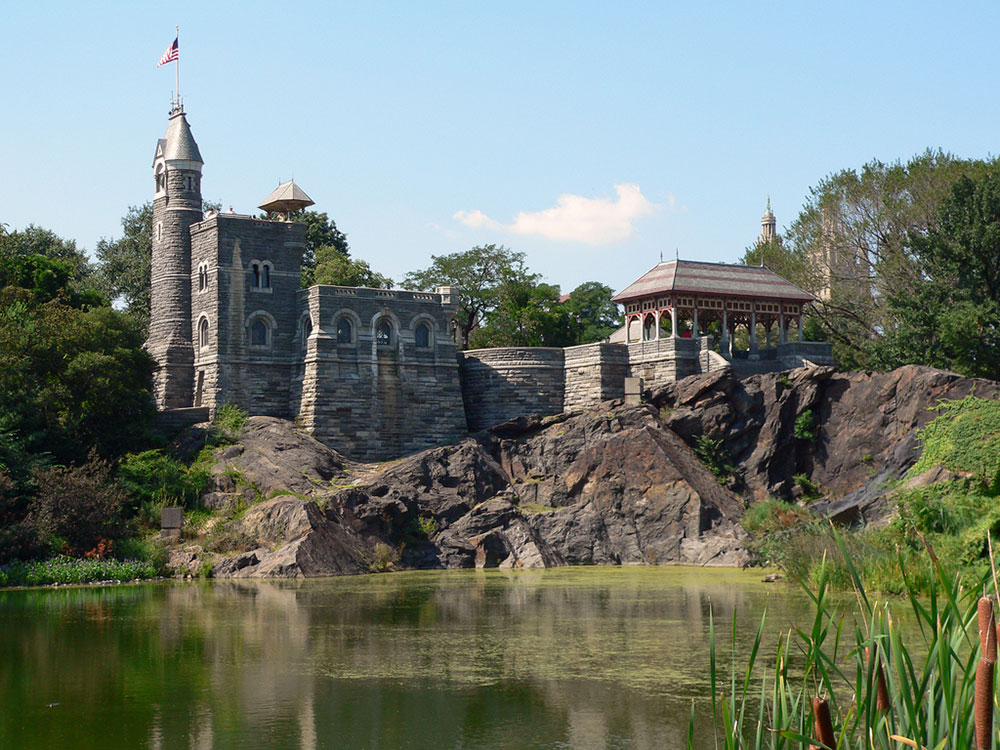
Stig Nygaard from Copenhagen, Denmark, CC BY 2.0, via Wikimedia Commons

Belvedere Castle is a folly in Central Park that contains exhibit rooms and an observation deck, and since 1919, has also housed the official Central Park weather station.

Belvedere Castle was designed by Frederick Law Olmsted and Calvert Vaux in 1867-1869. An architectural hybrid of Gothic and Romanesque styles, Vaux's design called for a Manhattan schist and granite structure with a corner tower with conical cap, with the existing lookout over parapet walls between them. Its name comes from belvedere, which means "beautiful view" in Italian.

Belvedere Castle was originally built as a shell with open doorway and window openings. The main tower was given a more medieval design, with a weather antenna on top, but during the castle's 1983 renovation, the tower was restored to a German style with a flag, a weather vane, and an anemometer on top. The two fanciful half-timbered wooden pavilions deteriorated without painting and upkeep and were removed before 1900.

Starting in 1919, Belvedere Castle housed the New York Meteorological Observatory, which had been taken over by the United States Weather Bureau. The current weather station in Central Park, an Automated Surface Observing System (ASOS), is located immediately south of the castle, though wind equipment is still located on the main tower.

The castle caps Vista Rock, a 130-foot-tall (40 m) outcropping of schist and the park's second-highest natural elevation. (Summit Rock, at 83rd Street overlooking Central Park West, is higher at 137.5 feet (41.9 m).) Constructed of Manhattan schist quarried in the park and dressed with gray granite, it tops the natural-looking woodlands of The Ramble, as seen from the formal Bethesda Terrace. The natural rock was tunneled through for the innovative sunken transverse roadway that still carries commercial and other traffic unobtrusively through the park.

The castle serves now as a visitor center and gift shop. Free family and community programs hosted at Belvedere Castle include birding and other Central Park Conservancy discovery programs for families as well as a variety of history and natural history programs led by NYC Urban Park Rangers, including stargazing/astronomy and wildlife-education events.

The eastern elevation formerly faced a rectangular receiving reservoir that was part of the Croton Aqueduct system. The reservoir was filled in with city building rubble, beginning with spoil from construction of the New York City Subway's IND Eighth Avenue Line (now carrying the A, B, C, and D trains) in the 1930s. Today, the eastern elevation overlooks the Great Lawn and Turtle Pond, which occupies the former site of the receiving reservoir.

Central Park Great Lawn Oval

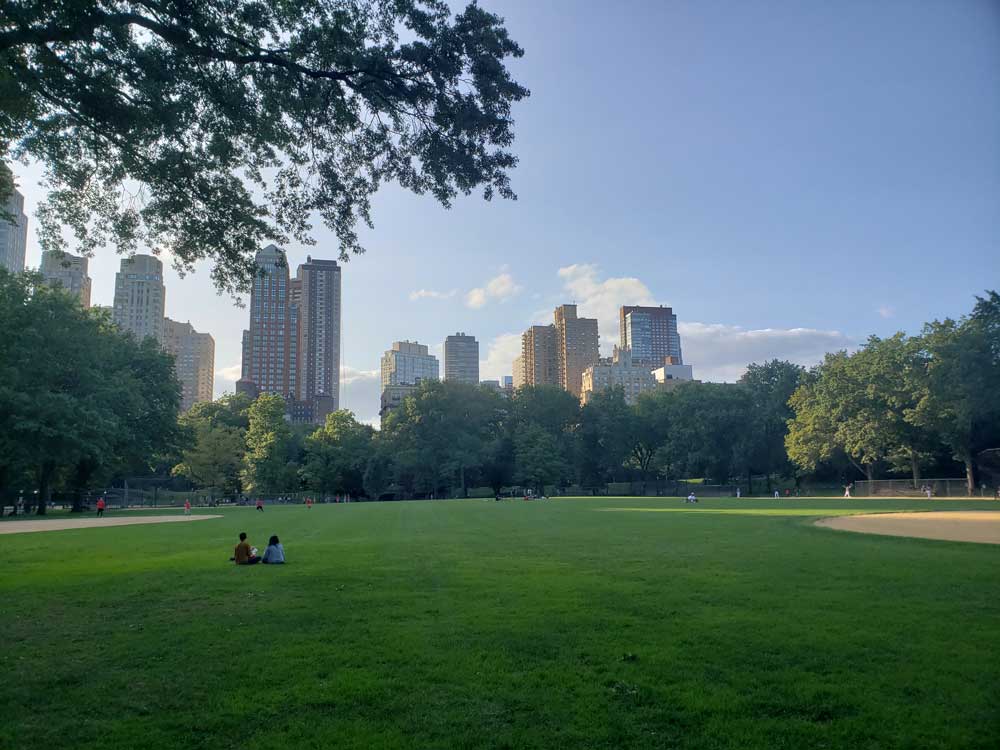
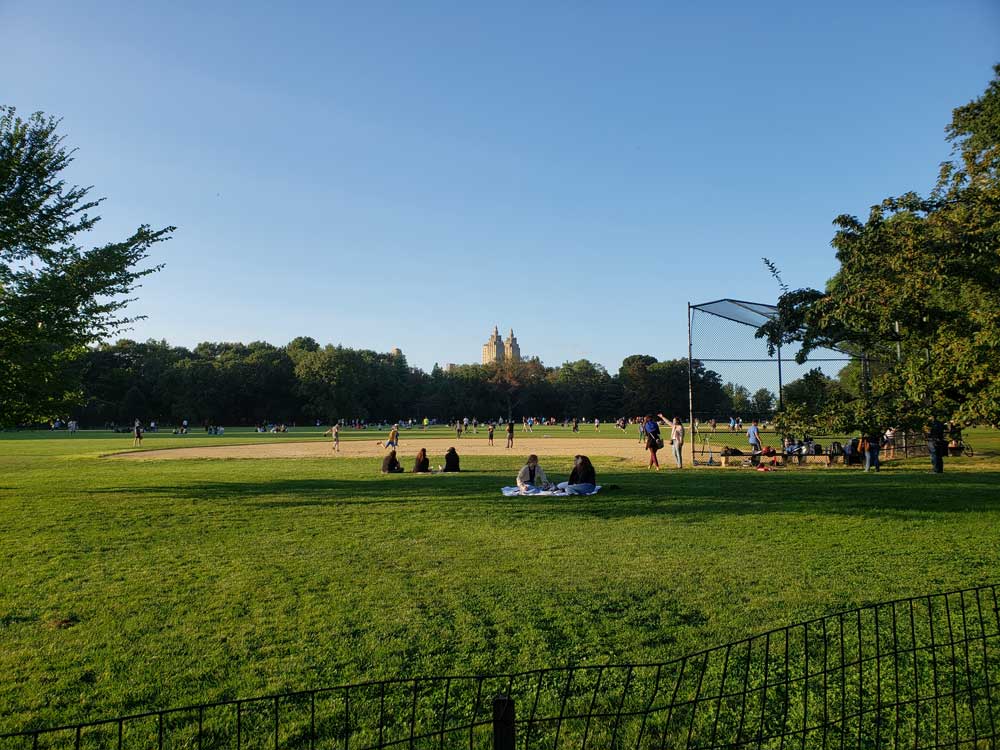
The Great Lawn and Turtle Pond are two connected features of Central Park. The pond abuts Belvedere Castle as well as the Delacorte Theater, and contains a variety of turtles and fish. The lawn is composed of 14 acres of oval-shaped land, which is used not only for sports but also for concerts.

The King Jagiello Monument stands at Turtle Pond's east end, the Delacorte Theater on its west end. The Great Lawn proper, surrounded by an oval-shaped path, covers 14 acres , while the Turtle Pond and the adjacent Arthur Rice Pinetum occupy another 31 acres. The Great Lawn and Turtle Pond take up about 55 acres in total.

The Turtle Pond is located south of the Lawn. Most of the park's turtles live in Turtle Pond, and many of these are former pets that were released into the park.

The Arthur Ross Pinetum, named after philanthropist Arthur Ross, contains 17 species of pine trees across a 4-acre area on the northwestern side of the oval.

Central Park Terrace Hallway

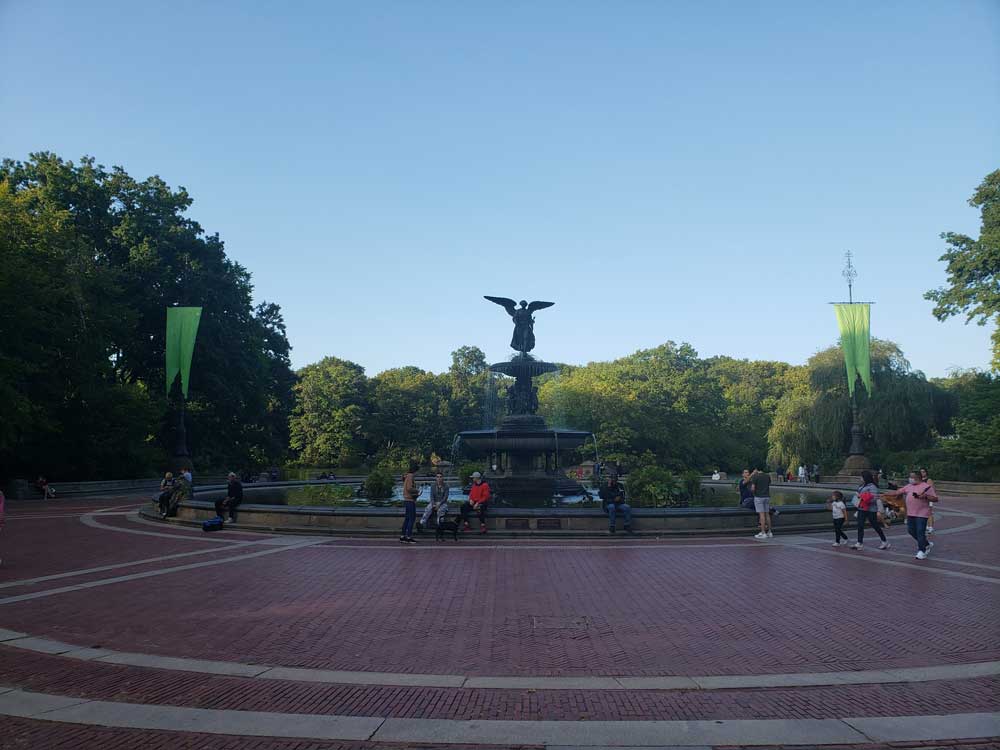
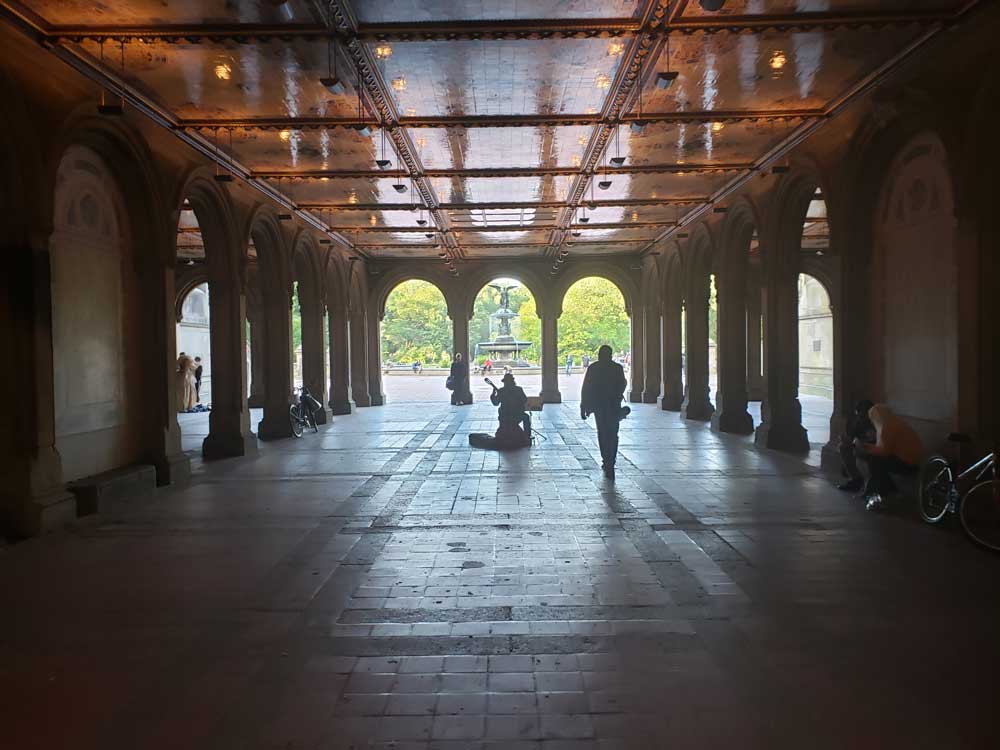
Bethesda Terrace and Fountain are two architectural features overlooking the southern shore of the Lake in New York City's Central Park. The fountain, with its Angel of the Waters statue, is located in the center of the terrace.

Central Park Bethesda Fountain

Bethesda Terrace's two levels are united by two grand staircases and a lesser one that passes under Terrace Drive. They provide passage southward to the Central Park Mall and Naumburg Bandshell at the center of the park. The upper terrace flanks the 72nd Street Cross Drive and the lower terrace provides a podium for viewing the Lake. The mustard-olive colored carved stone is New Brunswick sandstone, with a harder stone for cappings, with granite steps and landings, and herringbone pattern paving of Roman brick laid on edge.

Central Park Cleopatras Needle

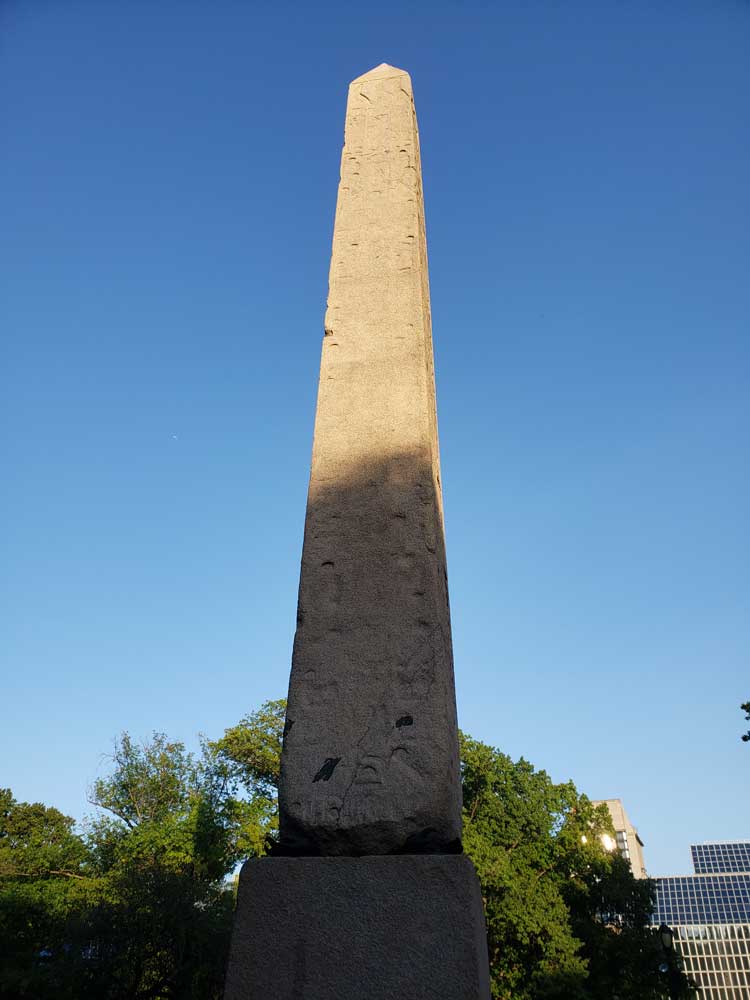
Cleopatra's Needle in New York City is one of three similarly named Egyptian obelisks. It was erected in Central Park, west of the Metropolitan Museum of Art in Manhattan, on January 22, 1881. It was secured in May 1877 by judge Elbert E. Farman, the United States Consul General at Cairo, as a gift from the Khedive for the United States remaining a friendly neutral as the European powers - France and Britain - maneuvered to secure political control of the Egyptian government.

Made of red granite, the obelisk stands about 21 metres (69 ft) high, weighs about 200 tons, and is inscribed with Egyptian hieroglyphs. It was originally erected in the Egyptian city of Heliopolis on the orders of Thutmose III, in 1475 BC. The granite was brought from the quarries of Aswan near the first cataract of the Nile. The inscriptions were added about 200 years later by Ramesses II to commemorate his military victories. The obelisks were moved to Alexandria and set up in the Caesareum - a temple built by Cleopatra in honor of Mark Antony or Julius Caesar - by the Romans in 12 BCE, during the reign of Augustus, but were toppled some time later. This had the fortuitous effect of burying their faces and so preserving most of the hieroglyphs from the effects of weathering.

Central Park The Lake

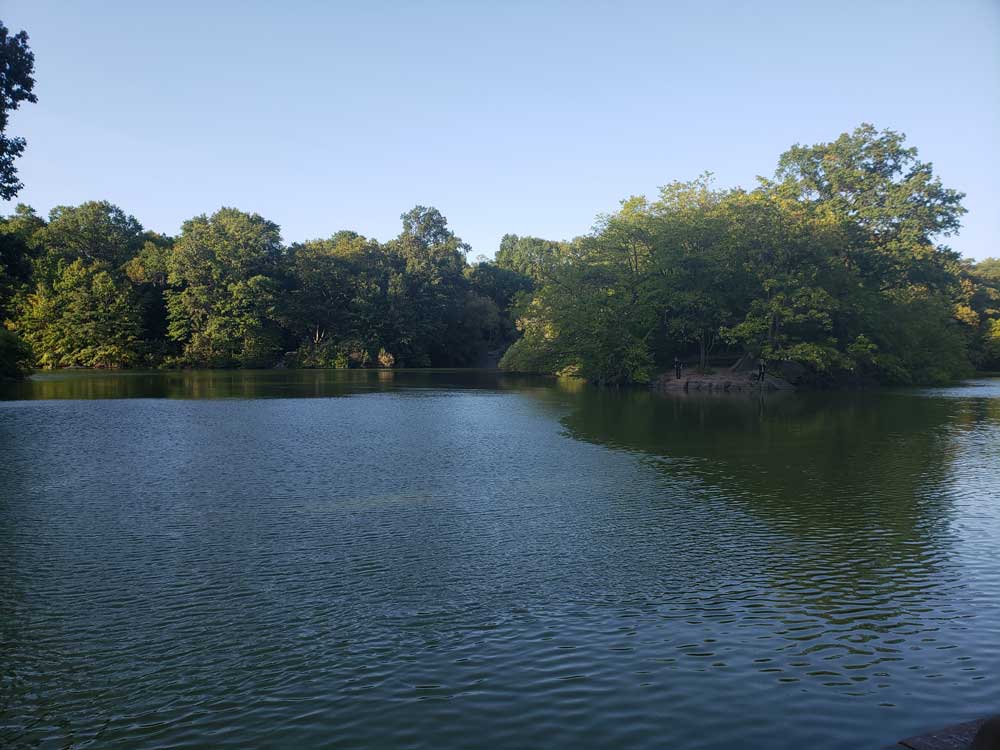
The Ramble and Lake are two geographic features of Central Park in Manhattan, New York City. the features are located on the west side of the park between the 66th and 79th Street transverses. The 38-acre Ramble, located on the north shore of the Lake, is a forested area with highly varied topography and numerous winding walks, designated as a protected nature preserve. It was designed as a "wild garden" away from carriage drives and bridle paths, in which to be wandered, or to be viewed as a "natural" landscape. The Ramble includes several rustic bridges, and formerly contained a small cave. Historically, it has been frequented for both birdwatching and cruising.

The serpentine 20-acre Lake offers dense naturalistic planting, rocky outcrops of glacially scarred Manhattan bedrock, small open glades, and an artificial stream (the Gill) that empties through the Azalea Pond, then down a cascade into the Lake. At the northwestern corner of the Lake, the ground rises toward Vista Rock, crowned by a lookout and folly named Belvedere Castle. The western shore includes the Ladies' Shelter, the southern shore contains a waterfront porch called Bethesda Terrace, and the eastern shore contains the Loeb Boathouse.

Central Park Hamilton Statue

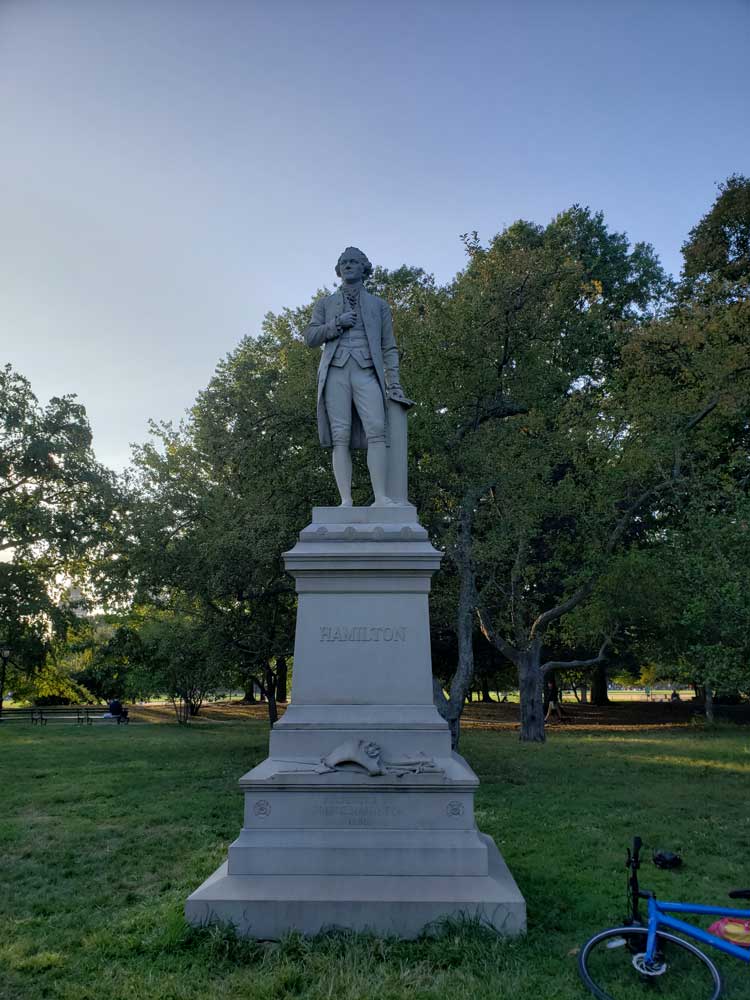
An outdoor granite sculpture of Alexander Hamilton by Carl Conrads. Hamilton's son, John C. Hamilton, commissioned Conrads to sculpt this statue, which was dedicated on November 22, 1880, and donated to the city. Hamilton lived nearby in Manhattan, at Hamilton Grange, when he died in 1804. Hamilton is dressed in Colonial style with a wig, ruffled collar, knickers, and buckle shoes. His right hand is on his chest, while his left hand is holding a rolled document, resting on a stone column. Thirteen stars encircle the top of the pedestal. A sword, scabbard and military hat are near the base of the pedestal.

A number of the sculptures are busts of authors and poets, located on Literary Walk adjacent to the Central Park Mall. Another cluster of sculptures, around the Zoo and Conservancy Water, are statues of characters from children's stories. A third sculpture grouping primarily depicts "subjects in nature" such as animals and hunters. Alice in Wonderland Margaret Delacorte Memorial (1959), a sculpture of Alice, is at Conservatory Water. Angel of the Waters (1873), by Emma Stebbins, is the centerpiece of Bethesda Fountain. Balto (1925), a statue of Balto, the sled dog who became famous during the 1925 serum run to Nome, is near East Drive and East 66th Street.[397] King Jagiello Monument (1939, installed 1945), a bronze monument, is at the east end of Turtle Pond. Women's Rights Pioneers Monument (2020), a monument of Sojourner Truth, Susan B. Anthony, and Elizabeth Cady Stanton, was the city's first statue to depict a female historical figure.

This article uses material from the Wikipedia article "Central Park", "Conservatory Garden", "Sheep Meadow", "Central Park Mall", "Great Lawn and Turtle Pond", "Bethesda Terrace and Fountain", "The Ramble and Lake", "Statue of Alexander Hamilton (Central Park)", "Strawberry Fields (memorial)", "Jacqueline Kennedy Onassis Reservoir", "Cleopatra's Needle (New York City)", "Belvedere Castle", and "Wollman Rink" which is released under the Creative Commons Attribution-Share-Alike License 3.0