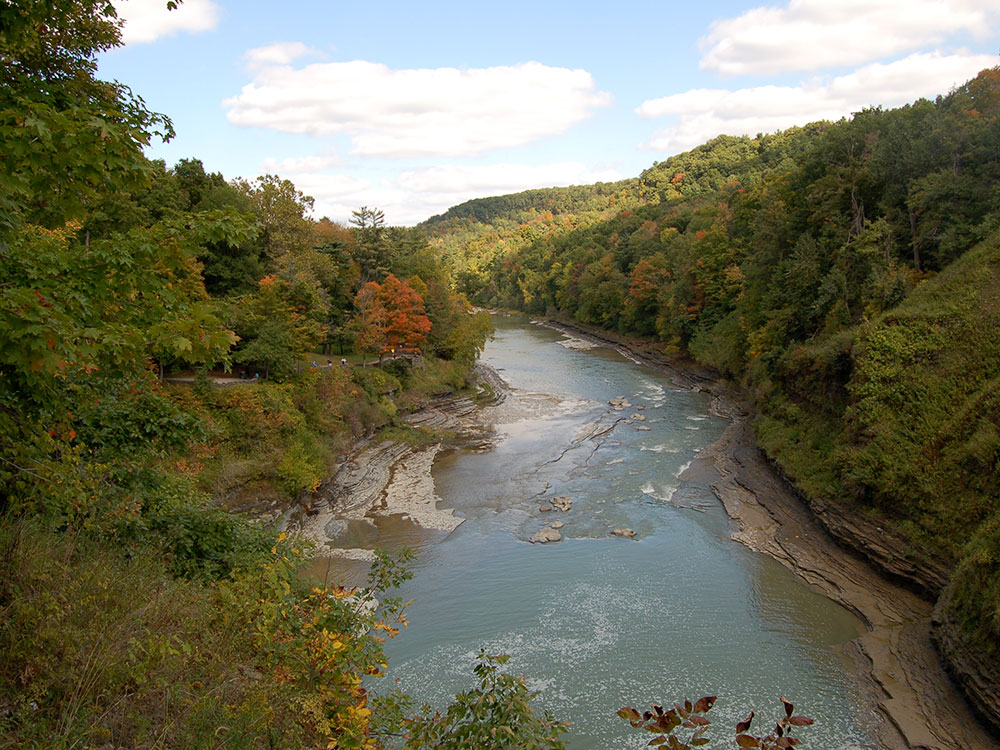
State park located in the northwestern part of New York roughly 17 miles long, following the course of the Genesee River as it flows north through a deep gorge and over several large waterfalls
General Information
Campgrounds and pools open seasonally (late May through Columbus Day weekend)
Glen Iris Inn: open for dining May through October
No fee on weekdays in the off-season
Camping fees vary by site type
How to Get There
From Rochester, NY (approximately 35 miles): Take I-390 S to Exit 4 (Mt. Morris), then take NY-408 S to NY-36 S, following signs to the park's north entrance near Mount Morris. For the main south entrance, continue on NY-36 S to Castile and follow signs to the park entrance on Park Road.
Overview
Letchworth State Park is a 14,427-acre New York State Park located in the northwestern part of the State of New York. The park is roughly 17 miles (27 km) long, following the course of the Genesee River as it flows north through a deep gorge and over several large waterfalls. It is located 35 miles (56 km) southwest of Rochester and 60 miles (97 km) southeast of Buffalo, and spans portions of the Livingston County towns of Leicester, Mount Morris, and Portage, as well as the Wyoming County towns of Castile and Genesee Falls.
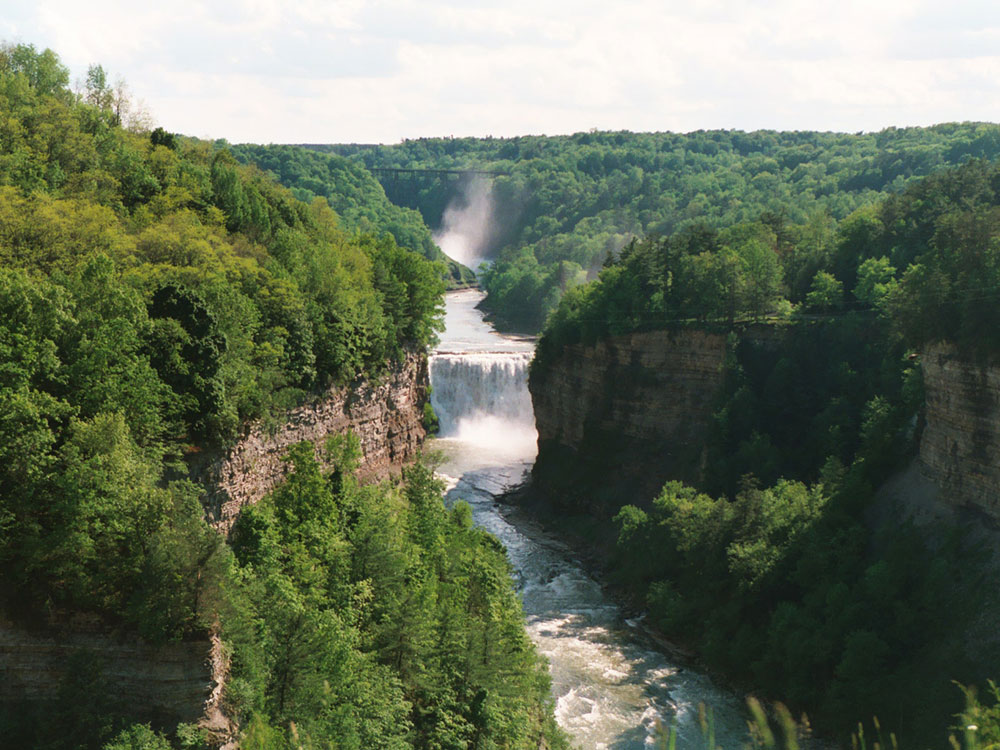
In 1859, industrialist William Pryor Letchworth (1823-1910) began purchasing land near the Middle Falls, and started construction of his Glen Iris Estate. In 1906 he bequeathed the 1,000-acre (4 km2) estate to New York, which soon after became the core of the newly created Letchworth State Park. The park prominently features three large waterfalls - the Upper, Middle, and Lower Falls - on the Genesee River, which flows within a deep gorge that winds through the park. The rock walls of the gorge, which rise up to 550 feet (170 m) in places, prompted the area's reputation as the "Grand Canyon of the East".
Park entrances are located near Mount Morris, Perry, Castile and Portageville. A paved two- or three-lane road follows the west side of the gorge, allowing many scenic viewpoints for the geologic features.
The park includes pavilions, picnic tables, playgrounds, 66 miles (106 km) of hiking trails, two large swimming pools, cabins, campsites for tents, trailer sites with dumping stations, and horse-riding trails. Activities within the park include hiking, biking, fishing, whitewater rafting and kayaking, geocaching, and hunting (wild turkey and deer when in season). During the winter, the park facilitates snowmobiling, cross-country skiing, snow tubing, and horse-drawn sleighs. Hot air ballooning is available at the park, weather permitting.
In 2015, Letchworth State Park won USA Today's Reader's Choice competition as the best state park in the United States. In 2020 the park topped a similar list.
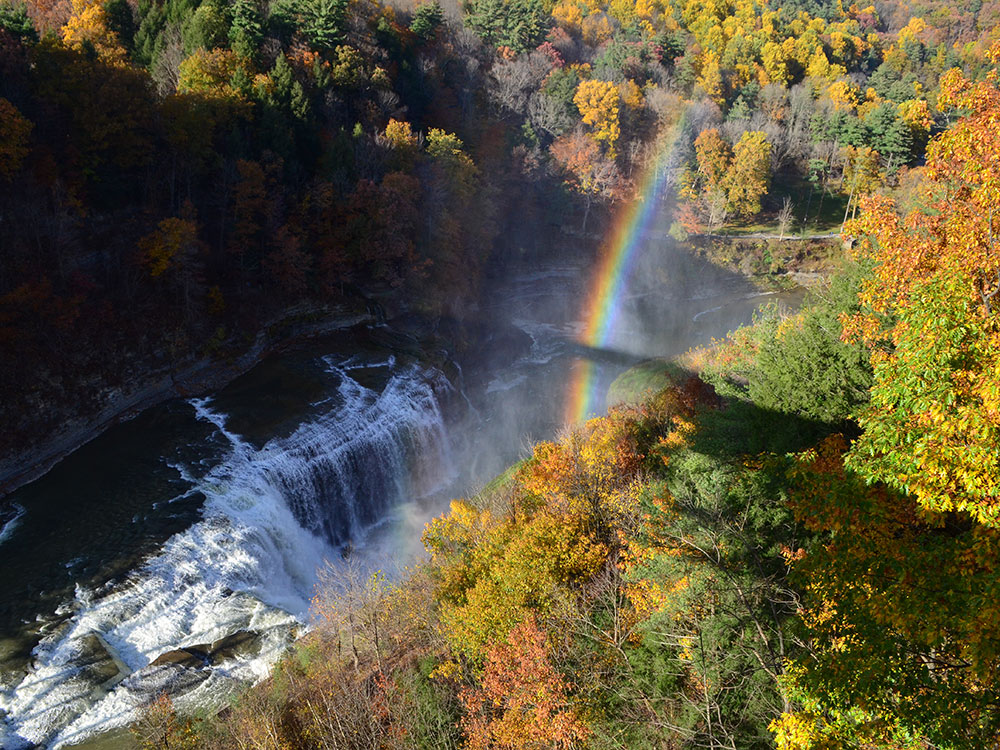
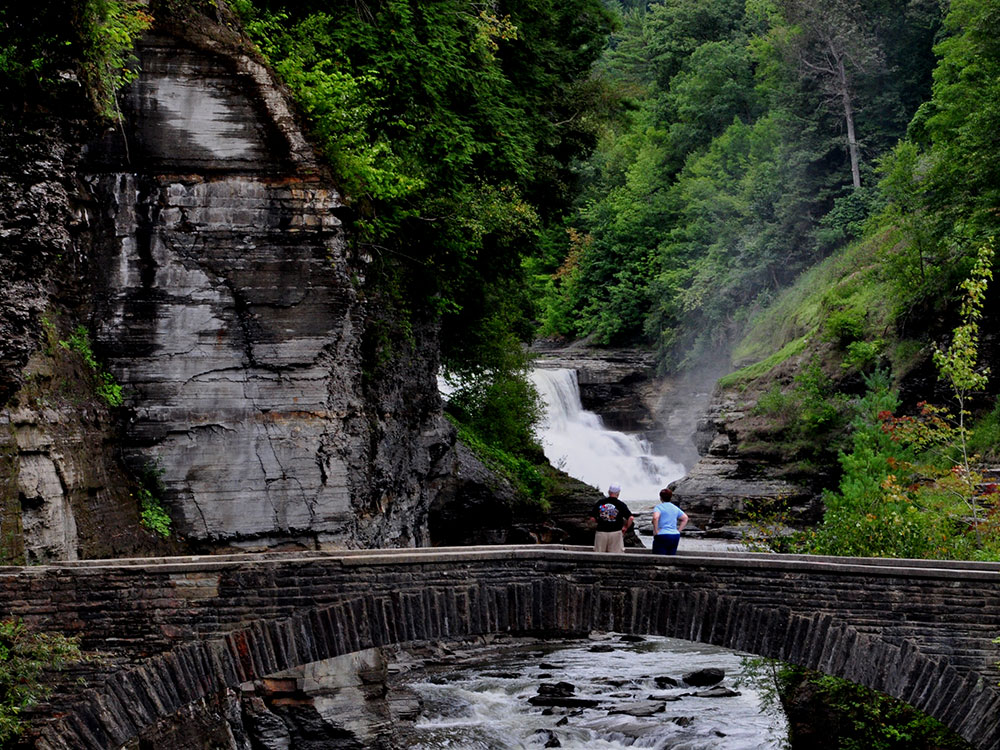
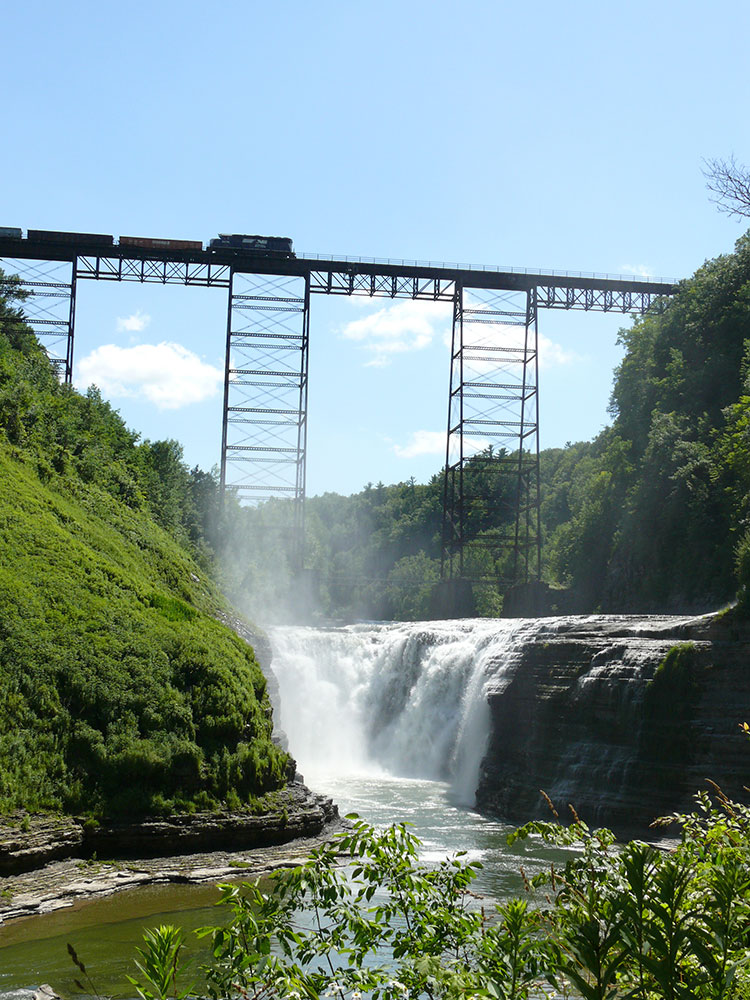
Within the park, there are three large waterfalls on the Genesee River and as many as 50 waterfalls found on tributaries that flow into it; the deep gorge formed by the river, with rock walls rising up to 550 feet (170 m) in places and which narrow to 400 feet (120 m) across above the middle of the three falls, prompted the area's reputation as the "Grand Canyon of the East". The three major waterfalls — called the Upper, Middle, and Lower Falls — are located in Portage Canyon, the southern section of the park. The only trail bridging the Genesee River in the park crosses a stone bridge just below the Lower Falls. The Middle Falls is the highest, and the Upper Falls has an active railroad trestle crossing immediately above it.
The park also contains Inspiration Falls, a ribbon waterfall that is located on a tributary creek a short distance east of the Inspiration Point Overlook, 0.4 miles (640 m) west of the park visitor center. It has a total drop of 350 feet (110 m). While impressive in its height, it is seasonal and often appears as only a water stain on the cliff. The falls faces to the south-southwest and has a crest that is one foot (300 mm) wide.
The bedrock exposed in the gorge is Devonian in age, mostly shales, with some layers of limestone and sandstone. The rock was laid down in an ancient inland sea, and it holds many marine fossils. The landform of the section of the Genesee River valley represented by the park is geologically very young, caused by a diversion of the river from the old valley by the last continental glacier, which forced the river to cut a new section of valley.
The historic, restored Glen Iris Inn, William Pryor Letchworth's former residence adapted for use as a hotel, is located on the top of a cliff overlooking Middle Falls and offers in-season meals and overnight accommodations. It is open to the public for breakfast, lunch and dinner.
The park is the present-day site of the grave of Mary Jemison, a Scots-Irish immigrant pioneer who was captured at the age of 12 from central Pennsylvania by a French and Shawnee raiding party during the French and Indian War. She was soon adopted by a family of Seneca people, and eventually lived in western New York on the Genesee River. She had become thoroughly assimilated and chose to live with the Seneca for the rest of her long life, having a total of seven children by two successive husbands. Her remains were exhumed from the Buffalo Creek Reservation and reinterred on the grounds of a Seneca Council House, relocated to the site by Letchworth and rededicated in 1872.
The park also features the William Pryor Letchworth Museum, which was founded with the collections of the park's founder. The exhibits focus on the natural and cultural history of the Genesee Valley, and include archaeological artifacts of the Seneca nation, and displays on Mary Jemison, early pioneers, the Genesee Valley Canal and William Pryor Letchworth.
The Humphrey Nature Center opened in 2016. Operated year-round by New York State, the 5,000-square-foot (460 m2) sustainable building features classrooms and meeting rooms, a research lab, a butterfly garden, and connections to various trails.
Found at the north end of the park, the construction of the Mount Morris Dam was begun in 1948 by the United States Army Corps of Engineers under the Flood Control Act of 1944. The dam was completed in 1954. The Genesee River became wider and deeper immediately upstream as a result, but areas downstream were spared yearly flooding which destroyed valuable farmland.
The Mount Morris Dam is the largest flood control device of its kind (concrete gravity) east of the Mississippi River. It is 1,028 feet (313 m) in length and rises 230 feet (70 m) from the riverbed. The dam proved its worth during the Flood of 1972, saving thousands of acres of farmland and the city of Rochester from flooding.
The Portage Viaduct is an iron railroad bridge located upstream and within view of the park's Upper Falls. The bridge is 820 feet (250 m) long and 240 feet (73 m) high. Although walking on the structure is considered trespassing, visitors to the park commonly disregard warning signs in order to view the gorge from the bridge, despite the safety concerns associated with walking on an active railroad bridge.
This article uses material from the Wikipedia article "Letchworth State Park", which is released under the Creative Commons Attribution-Share-Alike License 3.0