_004_-_Ballys_Complex-400.jpg)
_004_-_Ballys_Complex.jpg)
Coastal resort city in New Jersey, known for its casinos, boardwalk, and beaches
General Information
Get on I-676/US-30 E from S Penn Square and N Broad St. Follow I-676, NJ-42 S and Atlantic City Expy E to Christopher Columbus Blvd in Atlantic City. Take Arctic Ave to Atlantic Ave.
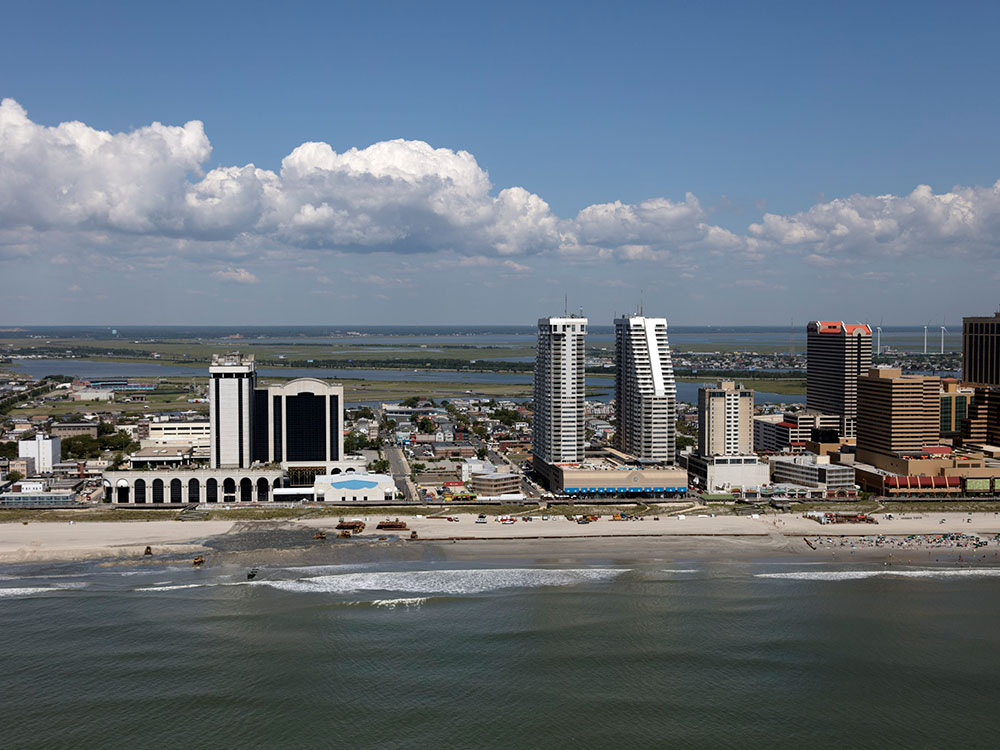
Atlantic City, often known by its initials A.C., is a coastal resort city in New Jersey, known for its casinos, boardwalk, and beaches.
Atlantic City inspired the U.S. version of the board game Monopoly, especially the street names. Since 1921, Atlantic City has been the home of the Miss America pageant. In 1976, New Jersey voters legalized casino gambling in Atlantic City. The first casino opened two years later.
The city is located on 8.1 mi-long (13.0 km) Absecon Island, along with Ventnor City, Margate City and Longport to the southwest. The city is located 60 mi (97 km) southeast of Philadelphia and 125 mi (201 km) south of New York City.
Atlantic City is considered the "Gambling Capital of the East Coast", and currently has nine large casinos.
In the wake of the economic downturn following the Great Recession and the legalization of gambling in adjacent and nearby states (including Delaware, Maryland, New York, and Pennsylvania), four casino closures took place in 2014: the Atlantic Club on January 13; the Showboat on August 31; the Revel, which was Atlantic City's second-newest casino, on September 2; and Trump Plaza, which originally opened in 1984, and was the poorest performing casino in the city, on September 16.
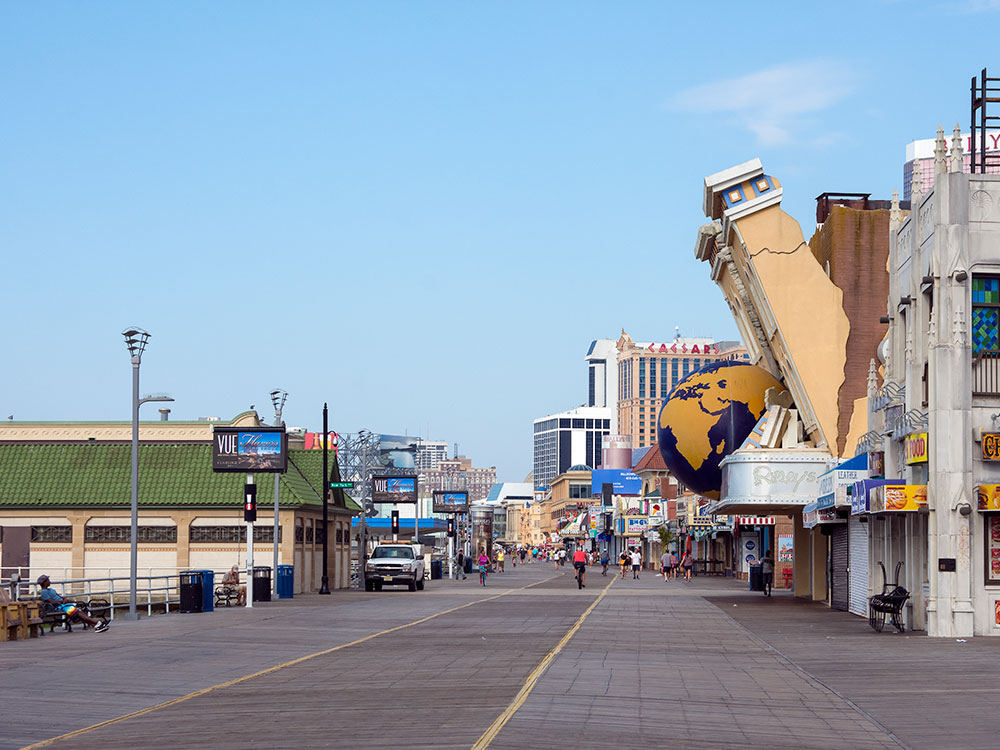
The Atlantic City Boardwalk opened on June 26, 1870,[130] a temporary structure erected for the summer season that was the first boardwalk in the United States.
The Boardwalk starts at Absecon Inlet in the north and runs along the beach south-west to the city limit 4 mi (6.4 km) away then continues 1+1⁄2 mi (2.4 km) into Ventnor City. Casino/hotels front the boardwalk, as well as retail stores, restaurants, and amusements. Notable attractions include the Boardwalk Hall, House of Blues, and the Ripley's Believe It or Not! museum.
The Boardwalk has been home to several piers over the years. The first pier, Ocean Pier, was built in 1882. It eventually fell into disrepair and was demolished. Another famous pier built during that time was Steel Pier, opened in 1898, which once billed itself as "The Showplace of the Nation". It now operates as an amusement pier across from the Hard Rock. Captain John Lake Young opened "Young's Million Dollar Pier" as an arcade hall in 1903, and on the seaward side "erected a marble mansion", fronted by a formal garden, with lighting and landscaping designed by Young's longtime friend Thomas Alva Edison. Young's Million Dollar Pier, Atlantic City's largest amusement pier during its time", was transformed into a shopping mall in the 1980s, known as "Shops on Ocean One". In 2006, the Ocean One mall was bought, renovated and re-branded as "The Pier Shops at Caesars" and in 2015, it was renamed "Playground Pier." Garden Pier, located opposite Revel Atlantic City, once housed a movie theater, and is now home to the Atlantic City Historical Museum.
Atlantic City has many different shopping districts and malls, many of which are located inside or adjacent to the casino resorts. Several smaller themed retail and dining areas in casino hotels include the Borgata Shops and The Shoppes at Water Club inside the Borgata, the Waterfront Shops inside of Harrah's, Spice Road inside the Trump Taj Mahal, while Resorts Casino Hotel has a small collection of stores and restaurants. Major shopping malls are also located in and around Atlantic City.
In Atlantic City, shops include:
Playground Pier, an underwater-themed indoor high end shopping center located on the Million Dollar Pier formerly known as "Shops on Ocean One". The four-story shopping mall contains themed floors.
Tanger Outlets The Walk, an outdoor outlet shopping center spanning several blocks. The only outlet mall in Atlantic County, The Walk opened in 2003 and is undergoing an expansion.
The Quarter at Tropicana, an old Havana-themed indoor shopping center at the Tropicana, which contains over 40 stores, restaurants, and nightclubs.
Atlantic City (sometimes referred to as "Monopoly City") has become well-known over the years for its portrayal in the U.S. version of the popular board game Monopoly, in which properties on the board are named after locations in and near Atlantic City. While the original incarnation of the game did not feature Atlantic City, it was in Indianapolis that Ruth Hoskins learned the game, and took it back to Atlantic City. After she arrived, Hoskins made a new board with Atlantic City street names, and taught it to a group of friends, who ultimately passed in on to Charles Darrow, who made some modifications to the game and claimed it as his own invention. The relative prices of the places on the board reflect to some extent the social status of neighborhoods at the time, with wealthy white streets being worth more, and streets where Black and Asian residents lived being cheaper.
Marvin Gardens, the leading yellow property on the board, is actually a misspelling of the original location name, "Marven Gardens". The misspelling was said to have been introduced by Charles Todd and passed on when his home-made Monopoly board was copied by Charles Darrow and thence Parker Brothers. It was not until 1995 that Parker Brothers acknowledged this mistake and formally apologized to the residents of Marven Gardens for the misspelling, although the spelling error was not corrected.
Some of the actual locations that correspond to board elements have changed since the game's release. Illinois Avenue was renamed Martin Luther King Jr. Blvd. in the 1980s. St. Charles Place no longer exists, as the Showboat Casino Hotel was developed where it once ran.
The "Short Line" is believed to refer to the Shore Fast Line, a streetcar line that served Atlantic City. The B&O Railroad did not serve Atlantic City. A booklet included with the reprinted 1935 edition states that the four railroads that served Atlantic City in the mid-1930s were the Jersey Central, the Seashore Lines, the Reading Railroad, and the Pennsylvania Railroad.
The actual "Electric Company" and "Water Works" serving the city are the Atlantic City Electric Company and the Atlantic City Municipal Utilities Authority, respectively.
Rolling chairs, which were introduced in 1876 and in continuous use since 1887, have been a boardwalk fixture to this day. While powered carts appeared in the 1960s, the original and most common were made of wicker. The wicker canopied chairs-on-wheels are manually pushed the length of the boardwalk by attendants, much like a Rickshaw.
The Absecon Lighthouse is a coastal lighthouse located in the South Inlet section of Atlantic City overlooking Absecon Inlet. It is the tallest lighthouse in the state of New Jersey and is the third tallest masonry lighthouse in the United States. Construction began in 1854, with the light first lit on January 15, 1857. The lighthouse was deactivated in 1933 and although the light still shines every night, it is no longer an active navigational aid. Gardner's Basin, which is home to the Atlantic City Aquarium as well as small shops and restaurants, is located a short distance north of Absecon Light.
While located 2 mi (3.2 km) south of Atlantic City in Margate City, Lucy the Elephant has become almost an icon for the Atlantic City area. Lucy is a six-story elephant-shaped example of novelty architecture, constructed of wood and tin sheeting in 1882 by James V. Lafferty in an effort to sell real estate and attract tourism. Over the years, Lucy had served as a restaurant, business office, cottage, and tavern (the last closed by Prohibition). Lucy had fallen into disrepair by the 1960s and was scheduled for demolition. The structure was moved and refurbished as a result of a "Save Lucy" campaign in 1970 and received designation as a National Historic Landmark in 1976, and is open as a museum.
Atlantic City was the home of the Miss America competition, hosting the event from its inception until 2004, and again from 2013-18. The Miss America competition originated on September 7, 1921, as a two-day beauty contest, and it included state contestants as well as women from various cities around the country. The event that year was called the "Atlantic City Pageant", and the winner of the grand prize, Margaret Gorman, took home the 3-foot Golden Mermaid trophy. Gorman was not called "Miss America" until 1922, when she re-entered the pageant and lost to Mary Campbell. The pageant was initiated to extend the tourist season after the Labor Day weekend. The pageant has been nationally televised since 1954. It peaked in the early 1960s, when it was repeatedly the highest-rated program on American television. It was seen as a symbol of the United States, with Miss America often being referred to as the female equivalent of the President. The pageant's longtime emcee, Bert Parks, hosted the event from 1955 to 1979. At the Atlantic City Convention Center, there is a 400 lb (180 kg) interactive statue of Parks holding a crown. When a visitor puts their head inside the crown, sensors activate a recorded playback of his "There She Is..." line through speakers hidden behind nearby bushes.
Since 2010, Boardwalk Empire, an American television series from cable network HBO set in Atlantic City during the Prohibition era, has cast a new light on the city. Starring Steve Buscemi, the show was adapted from a chapter about historical criminal kingpin Enoch "Nucky" Johnson (who is renamed "Enoch Thompson" in the show) in Nelson Johnson's book, Boardwalk Empire: The Birth, High Times, and Corruption of Atlantic City. The series was filmed in New York City at various locations that captured Atlantic City's period architecture and on a set built to resemble the Atlantic City boardwalk in the 1920s.
Since February 2, 1887, the city of Atlantic City has seen 2,538 (as of September 2018) professional boxing fight programs,[176] the first one being one with a main event fight between Willie Clark, 3-0-3, and debuting Horace Leeds, won by Clark on points over four rounds. During the 1980s, professional boxing activity boomed in Atlantic City, at times rivaling Las Vegas, Nevada, in staging major boxing fights. Fighters who fought in Atlantic City at that era include Marvelous Marvin Hagler, Thomas Hearns, Wilfredo Gomez, Jeff Chandler, Larry Holmes, George Foreman, Mike Tyson and others. Fights included The Brawl For it All, Tyson versus Holmes, Tyson versus Michael Spinks, and Roberto Durán versus Iran Barkley.
Atlantic City is one of five municipalities in the state—and the only one outside of Cape May County—that offer free public access to oceanfront beaches monitored by lifeguards, joining Wildwood, North Wildwood, Wildwood Crest and Upper Township's Strathmere section.
This article uses material from the Wikipedia article "Atlantic City, New Jersey", which is released under the Creative Commons Attribution-Share-Alike License 3.0

_006_-_Dennis_Hotel-1000.jpg)
_006_-_Dennis_Hotel.jpg)
_009_-_Dennis_Hotel-1000.jpg)
_009_-_Dennis_Hotel.jpg)
_010-1000.jpg)
_010.jpg)
_011-1000.jpg)
_011.jpg)
_031_-_Arch_and_Amphitheater-1000.jpg)
_031_-_Arch_and_Amphitheater.jpg)