Institute now part of Johns Hopkins University, with the library focused on research into the 19th century
General Information
How to Get There
Overview
The George Peabody Library, was formerly the Library of the Peabody Institute of music in the City of Baltimore. The Peabody Institute is now part of Johns Hopkins University, and the library has become focused on research into the 19th century. It is located on the Peabody campus at West Mount Vernon Place in the Mount Vernon-Belvedere historic cultural neighborhood north of downtown Baltimore, Maryland. The collections are available for use by the general public, in keeping with the famous Baltimorean merchant/banker/financier/philanthropist George Peabody's goal to create a library "for the free use of all persons who desire to consult it".
Collection
The main collection reflects broad interests but is focused on the 19th century, in keeping with Peabody's desire for it to be "well furnished in every department of knowledge and of the most approved literature". The library's 300,000 volume collection is particularly strong in religion, British art, architecture, topography and history; American history, biography, and literature; Romance languages and literature; history of science; and geography, exploration and travel. Some of the collections highlights include first editions by Poe, Hawthorne, Melville, and H. L. Mencken, Diderot's 28-volume Encyclopédie, early editions of Don Quixote, Maryland and Baltimore maps, natural history folios, a first edition of Darwin's Origin of the Species, and fore-edge books.
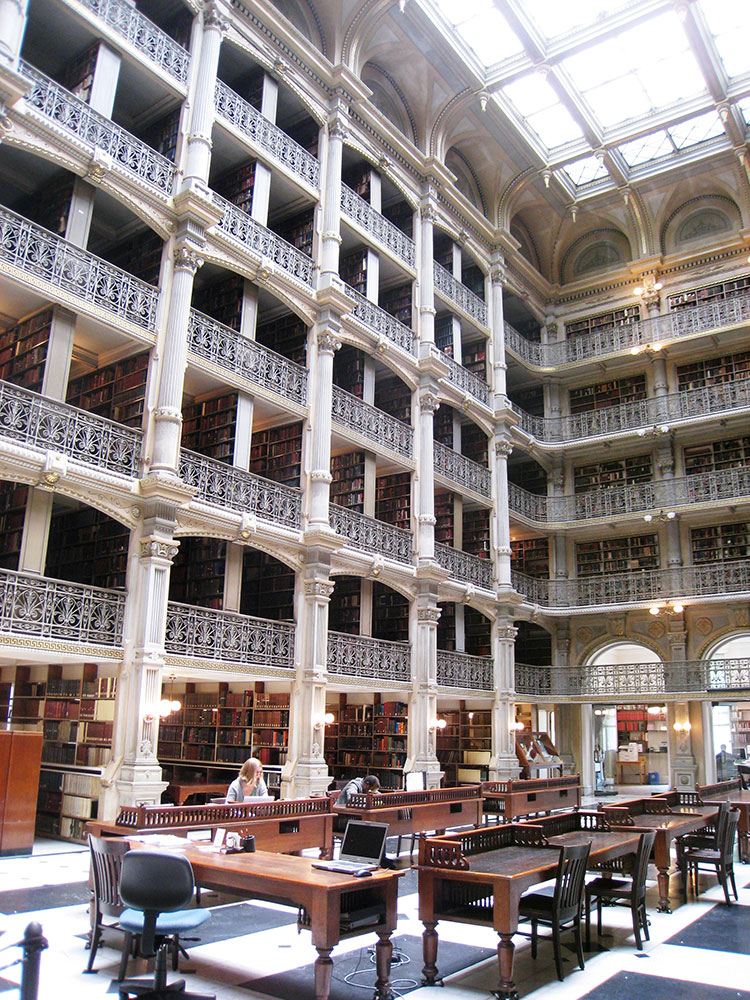
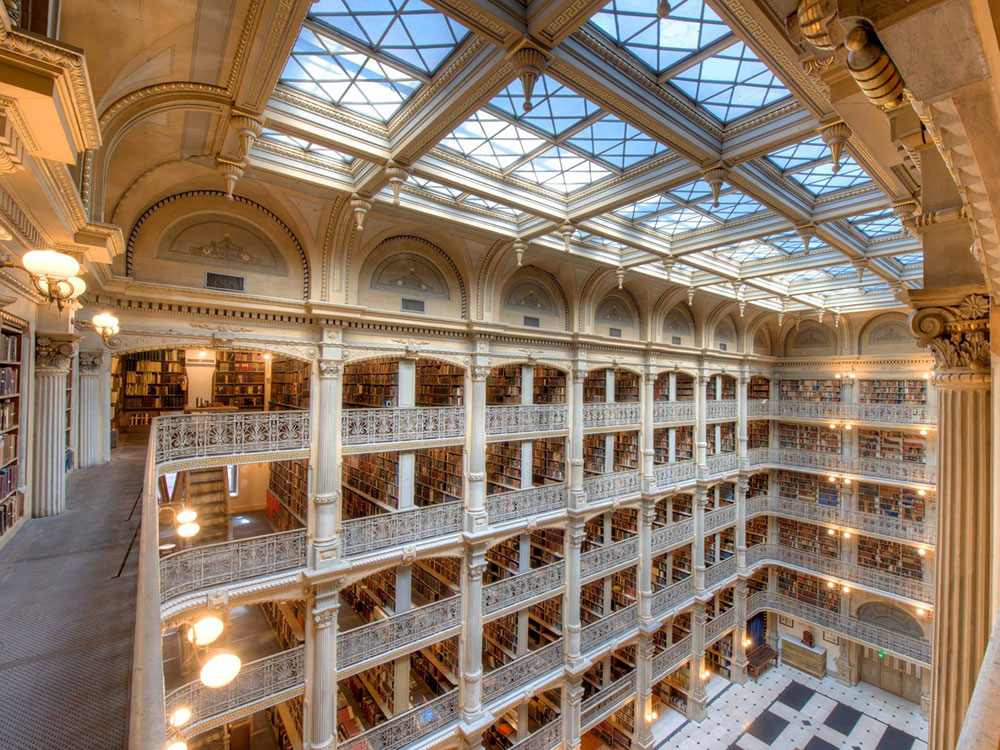
The library interior is often regarded as one of the most beautiful libraries in the world. Completed in 1878, it was designed by Baltimore architect Edmund G. Lind in collaboration with the first Peabody provost, Nathaniel H. Morison, that described it as a "cathedral of books". The neo-Greco interior features an atrium that, over an alternating black and white slab marble floor, soars 61 feet high to a latticed skylight of frosted heavy glass, surrounded by five tiers of ornamental black cast-iron balconies (produced locally by the Bartlett-Hayward Company) and gold-scalloped columns containing closely packed book stacks.
This article uses material from the Wikipedia article "George Peabody Library", which is released under the Creative Commons Attribution-Share-Alike License 3.0