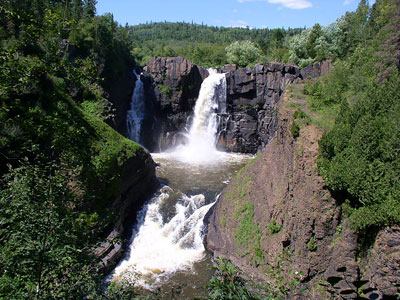

State park at the northeastern tip of Minnesota, on the Canada-United States border contains a 120-foot (37 m) waterfall, the tallest in the state
General Information
How to Get There
From Duluth, MN (150 mi): Take MN-61 E (North Shore Scenic Drive) northeast from Duluth all the way to the Canadian border, approximately 150 miles, where the state park entrance is on the right at 9393 E Highway 61.
Overview
Grand Portage State Park is a state park at the northeastern tip of Minnesota, on the Canada–United States border. It contains a 120-foot (37 m) waterfall, the tallest in the state (though it is on the border with Canada and thus partially in Ontario), on the Pigeon River. The High Falls and other waterfalls and rapids upstream necessitated a historically important portage on a fur trade route between the Great Lakes and inland Canada. This 8.5-mile (13.7 km) path as well as the sites of historic forts at either end are preserved in nearby Grand Portage National Monument.
The state park, held by the surrounding Grand Portage Indian Reservation and leased to the state of Minnesota for $1 a year, is the only U.S. state park jointly managed by a state and a Native American band. It is also the only Minnesota state park not owned by the state.
Things to Do
Visit Minnesota's Tallest Waterfall
Grand Portage State Park is home to High Falls, the tallest waterfall in Minnesota. Located along the Pigeon River on the Canadian border, the falls plunge approximately 120 feet through a dramatic gorge of ancient volcanic and metamorphic rock. The park is one of the premier natural attractions on Minnesota's North Shore and offers visitors spectacular scenery, cultural history, and easy access to one of the state's most iconic landmarks.
Experience the North Woods Wilderness
The park is situated within the rugged landscape of northeastern Minnesota, surrounded by boreal forests, rivers, and rocky ridges. Visitors can experience pristine wilderness environments while exploring habitats that support moose, black bears, wolves, bald eagles, and numerous migratory bird species.
Learn About Ojibwe Heritage
Grand Portage State Park is located within the Grand Portage Band of Lake Superior Chippewa Reservation. Interpretive displays highlight the cultural significance of the region and the long history of Indigenous peoples who have lived, traveled, and traded throughout the Lake Superior watershed.
Enjoy Photography and Scenic Overlooks
The park's overlooks provide outstanding views of High Falls and the Pigeon River gorge. The area is especially popular during autumn when colorful foliage contrasts with the dark rock walls and rushing water. Winter also attracts visitors who enjoy viewing the frozen waterfall and snow-covered forest landscape.
Explore Nearby North Shore Attractions
Many visitors combine a trip to Grand Portage State Park with nearby attractions including Grand Portage National Monument, Judge C.R. Magney State Park, the Superior Hiking Trail, and other scenic destinations along Minnesota's North Shore.
Top Trails
High Falls Trail
Length: Approximately 1 mile round trip
Elevation Gain: Minimal
Difficulty: Easy
This fully accessible paved trail leads to several viewing platforms overlooking High Falls. The route provides outstanding views of Minnesota's tallest waterfall and the impressive Pigeon River gorge while remaining suitable for visitors of all ages and abilities.
Middle Falls Trail
Length: Approximately 5 miles round trip
Elevation Gain: Moderate
Difficulty: Moderate
This less-traveled trail follows the Pigeon River to Middle Falls, offering scenic forest views, river overlooks, and a quieter wilderness experience than the main waterfall area.
Border Route Trail Connections
Length: Variable distances available
Elevation Gain: Moderate to Strenuous
Difficulty: Strenuous
Nearby sections of the Border Route Trail provide experienced hikers with access to spectacular ridge-top views, remote forests, and panoramic vistas overlooking the Boundary Waters region and Lake Superior watershed.
Pigeon River Overlook Walks
Length: Variable short walks
Elevation Gain: Minimal
Difficulty: Easy
Additional viewing areas throughout the park provide opportunities to observe the river gorge, wildlife, and the international border shared by Minnesota and Ontario while enjoying the natural beauty of the region.
Sources: Minnesota Department of Natural Resources official Grand Portage State Park information, including details on High Falls, the Pigeon River, hiking trails, accessibility features, wildlife viewing, and visitor amenities. https://www.dnr.state.mn.us/state_parks/park.html?id=spk00273
Additional information verified through Minnesota DNR visitor resources and Grand Portage area recreation information covering the High Falls Trail, Middle Falls Trail, Border Route Trail access, Ojibwe heritage, and North Shore recreation opportunities.
A mixed hardwood forest covers most of the park, chiefly paper birch and quaking aspen with occasional white spruce, eastern white pine, balsam fir, northern white cedar, poplar, and black ash. A more boreal forest appears on ridges and slopes, with black spruce joining the previously listed conifers intermixed with additional birch and aspen. Bottomlands near the river support black and green ash as well as white cedar, white spruce, and yellow birch.
Mammalian species of this park include white-tailed deer, moose, Canadian lynx, black bear, red fox, porcupine, pine marten, river otter, beaver, snowshoe hare, skunk, and red squirrel with the occasional coyote and timber wolf. Waterfowl and raptors such as osprey frequent the Pigeon River, which also attracts walleye, northern pike, and rainbow smelt for their spring spawning.
The High Falls is at the end of a gentle 0.5-mile (0.8 km) paved trail and boardwalk. Three wooden decks provide different angles to view the falls. A further 3.5 miles (5.6 km) of hiking trail leads to the 30-foot (9 m) Middle Falls and provides distant views of Lake Superior and Isle Royale from hilltops. A 0.2-mile (0.3 km) path leads from the park office through the picnic area to a historic marker commemorating the Webster-Ashburton Treaty. In winter all of the trails are open for snowshoeing.
Grand Portage State Park is developed for day-use only. The closest camping is in Ontario's adjacent Pigeon River Provincial Park or in the unincorporated community of Grand Portage, Minnesota.
The park emphasizes interpretation of Ojibwe cultural heritage, as a counterpoint to fur trade and natural history interpretation at nearby parks. Many park employees have been members of the Grand Portage Band.
The state park is located at the northern terminus of scenic Minnesota Highway 61.
Grand Portage State Park follows two miles (3.2 km) of the Pigeon River, which marks the Canada - United States border. The U.S. Customs border checkpoint is visible from the park entrance and in fact sits within the park's authorized boundaries.
Since the High Falls of the Pigeon River is shared with Ontario, the 70-foot (21 m) High Falls on the Baptism River in Tettegouche State Park is often touted as "the highest waterfall entirely within Minnesota."
This article uses material from the Wikipedia article "Grand Portage State Park", which is released under the Creative Commons Attribution-Share-Alike License 3.0
-1000.jpg)
.jpg)
-1000.jpg)
.jpg)