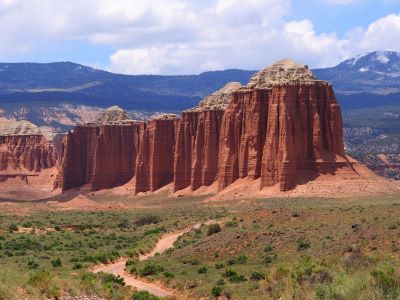

A massive wall of buff-pink Entrada Sandstone monoliths rising above the desert floor in the remote Cathedral Valley district of Capitol Reef National Park.
General Information
- Type:
- Roadside rock formation along the Cathedral Valley Loop
- High Clearance Vehicle Required:
- Yes; four-wheel drive may be needed, and roads can be impassable when wet
- Difficulty:
- Easy (viewed from the road; short walks optional)
- Hours:
- Open 24 hours year-round, road conditions permitting
- Fees:
- No fee is charged for the Cathedral Valley District
- Pet Policy:
- Pets allowed on leash on roads and in parking areas; not allowed on trails or cross-country
- Closest cities with hotels:
- Torrey, Caineville, and Hanksville
- Seasons:
- Spring and fall are best; summer highs can reach the upper 90s and winter storms can close the roads
- Location:
- Cathedral Valley, Capitol Reef National Park, UT
- Website:
- nps.gov/care/planyourvisit/cathedralvalley.htm
How to Get There
From Capitol Reef National Park Visitor Center: Drive east on UT-24 toward Caineville, turn north onto the unpaved Cathedral Road (Caineville Wash Road), and follow it north into Cathedral Valley. Alternatively, drive the full Cathedral Valley Loop clockwise by starting on the Hartnet Road, 11.7 miles east of the visitor center, which requires fording the Fremont River.
Overview
The Walls of Jericho are a row of towering, sheer-sided monoliths in the remote Cathedral Valley district of Capitol Reef National Park. Named for the biblical walls that famously came tumbling down, the formations rise like the ramparts of an ancient fortress above the open desert floor, joining nearby landmarks such as the Temples of the Sun and Moon among Cathedral Valley's most striking sights. Like the other monoliths of the valley, they are made of buff-pink Entrada Sandstone, deposited about 160 million years ago on Jurassic tidal flats. The fine-grained rock crumbles easily, so the formations are constantly being reshaped by erosion. Visitors come for the solitude, the dramatic scenery, and the photography, especially in the warm light of early morning and late afternoon. No fee or permit is required to visit Cathedral Valley, although a free backcountry permit is required for camping outside the primitive Cathedral Valley Campground.
Reaching the Walls of Jericho requires a long drive on unpaved roads. The National Park Service notes that vehicles with high ground clearance, even without four-wheel drive, can usually negotiate the Cathedral Valley roads without difficulty, but spring and summer rains and winter snows can leave them muddy, washed out, and impassable to even the best high-clearance four-wheel-drive vehicles, so check road conditions at the visitor center before setting out. The full Cathedral Valley Loop is 57.6 miles long, and travel in the area is light, so carry plenty of water, food, fuel, a shovel, and emergency supplies; there is no potable water in Cathedral Valley and cell phone reception is usually poor or nonexistent. The formations are best viewed from the road and nearby pullouts, and visitors can take short walks to explore, staying on established routes to protect the fragile desert soils. Many visitors combine the Walls of Jericho with the Temples of the Sun and Moon, Glass Mountain, and the Upper Cathedral Valley overlooks on a full day of exploring the loop.
History
The Walls of Jericho are a row of Entrada Sandstone monoliths in Cathedral Valley, an area named in 1945 by Charles Kelly and Frank Beckwith for its church-like formations. They take their name from the biblical walls of Jericho, which fell at the sound of trumpets.
Things to Do
Photograph the Walls
The walls glow warm orange in early morning and late afternoon light.
Drive the Cathedral Valley Loop
The unpaved loop passes the walls and other monoliths.
Visit the Temples of the Sun and Moon
The famous temples are in the lower valley.
Prepare for Remote Travel
Bring water, a spare tire and a high-clearance vehicle; there are no services.
This article uses material from the National Park Service page "Cathedral Valley - Capitol Reef National Park", which describes the geology, road conditions, and visitor information for the Cathedral Valley District.