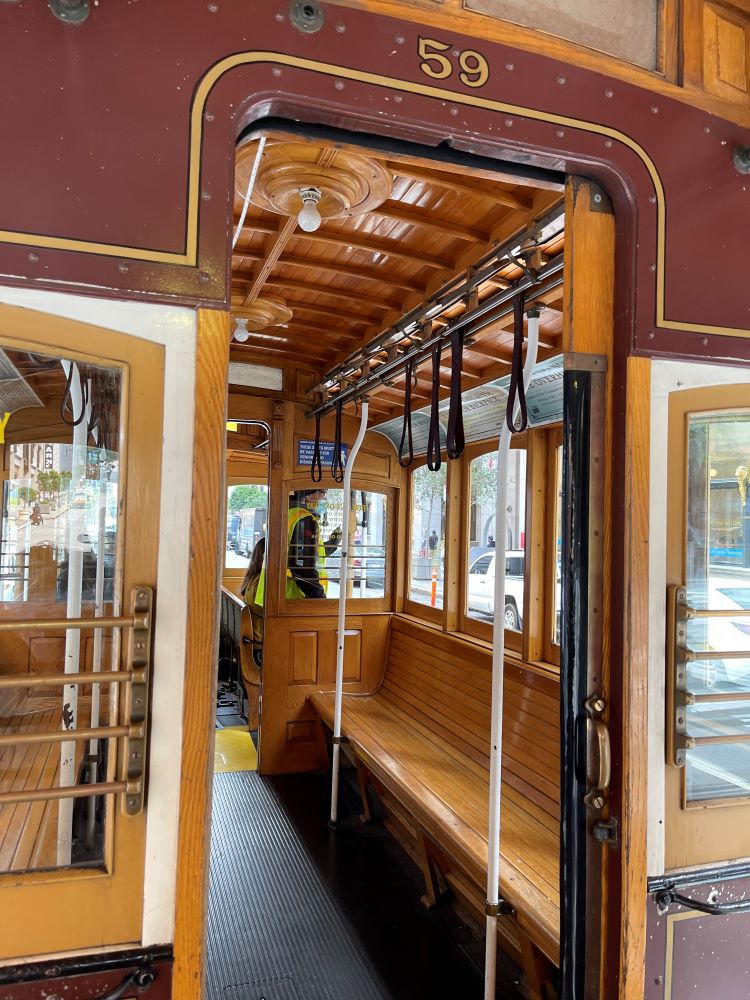
San Francisco Cable Car System

Grinnell Point and Swiftcurrent Lake from the Many Glacier Hotel
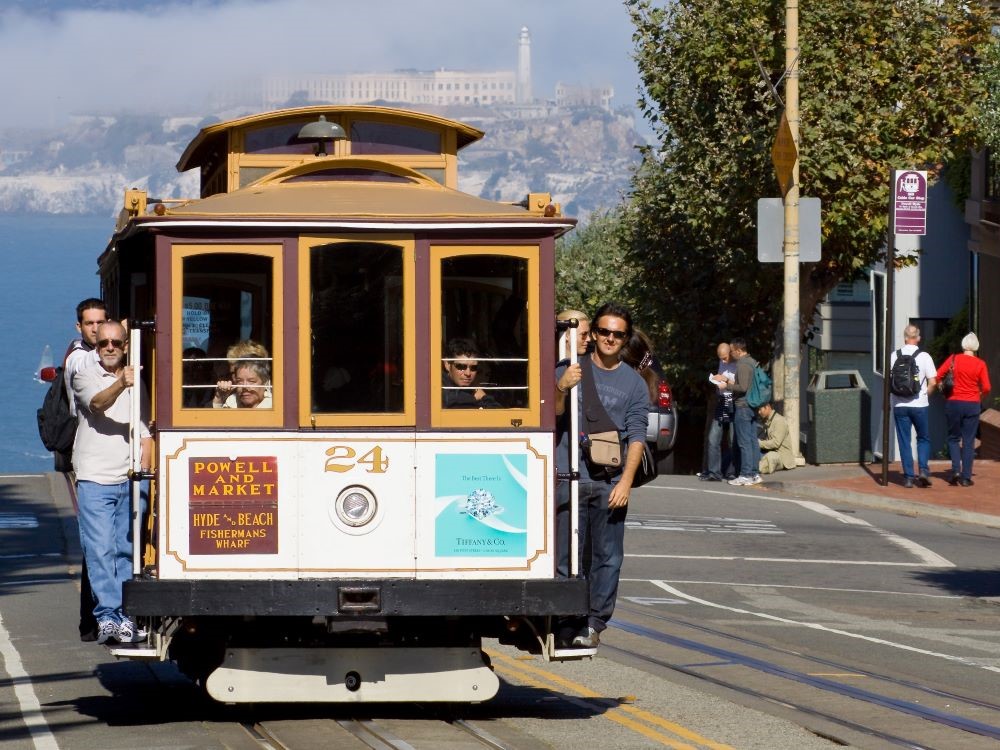
Jeff P from Berkeley, CA, USA, CC BY 2.0, via Wikimedia Commons; Image Size Adjusted

World's last manually operated cable car system and an icon of San Francisco, the cable car system forms part of the city's intermodal urban transport network

General Information
Hours:
Open daily 7am to 10:30pm
Fees:
Single Ride: $8.00 To board cable cars at Powell & Market, Bay & Taylor and Hyde & Beach Streets, you must purchase your fare in advance (applies 8 a.m. to 5 p.m. daily)
1-Day Visitor Passport: $13.00
3-Day Visitor Passport: $31.00
7-Day Visitor Passport: $41.00
Pet Policy:
Pets NOT allowed
Closest cities with hotels:
San Francisco
Seasons:
Seasons: All year
Location:
Website:
Rating:
5.0

Take 11th St and Mission St to S Van Ness Ave. Turn right onto S Van Ness Ave. Continue on Filbert St to destination.

The San Francisco cable car system is the world's last manually operated cable car system. An icon of San Francisco, the cable car system forms part of the intermodal urban transport network operated by the San Francisco Municipal Railway. Of the 23 lines established between 1873 and 1890, only three remain (one of which combines parts of two earlier lines): two routes from downtown near Union Square to Fisherman's Wharf, and a third route along California Street. While the cable cars are used to a certain extent by commuters, the vast majority of their seven million annual passengers are tourists, and as a result, the wait to get on can often reach two hours or more. They are among the most significant tourist attractions in the city, along with Alcatraz Island, the Golden Gate Bridge, and Fisherman's Wharf.

The cable cars are separate from San Francisco's heritage streetcars, which operate on Market Street and the Embarcadero, as well as from the more modern Muni Metro light rail system.

The cable cars are pulled by a cable running below the street, held by a grip that extends from the car through a slit in the street surface, between the rails. Each cable is 1.25 inches (3.2 cm) in diameter, running at a constant speed of 9.5 miles per hour (15.3 km/h), and driven by a 510 horsepower (380 kW) electric motor located in the central power house, via a set of self-adjusting sheaves. Each cable has six steel strands, with each strand containing 19 wires, wrapped around a sisal rope core (to allow easier gripping). The cables are coated with a tar-like material which serves as a sacrificial lubricant - much like a pencil eraser erodes away rather than the paper. To start and stop the movement of the car, the gripman closes and opens the grip around the cable (similar to the clutch of a conventional car). The grip's jaws exert a pressure of up to 30,000 pounds per square inch (210,000 kPa) on the cable. Due to wear and tear, a grip's dies have to be replaced after three days of usage.

The cable cars are pulled by a cable running below the street, held by a grip that extends from the car through a slit in the street surface, between the rails. Each cable is 1.25 inches (3.2 cm) in diameter, running at a constant speed of 9.5 miles per hour (15.3 km/h), and driven by a 510 horsepower (380 kW) electric motor located in the central power house, via a set of self-adjusting sheaves. Each cable has six steel strands, with each strand containing 19 wires, wrapped around a sisal rope core (to allow easier gripping). The cables are coated with a tar-like material which serves as a sacrificial lubricant - much like a pencil eraser erodes away rather than the paper. To start and stop the movement of the car, the gripman closes and opens the grip around the cable (similar to the clutch of a conventional car). The grip's jaws exert a pressure of up to 30,000 pounds per square inch (210,000 kPa) on the cable. Due to wear and tear, a grip's dies have to be replaced after three days of usage.

There are four separate cables: one 16,000-foot (4,900 m) length and one 10,300-foot (3,100 m) length for the Hyde and Mason segments, a 9,300-foot (2,800 m) length for their common Powell section, and one 21,000-foot (6,400 m) length for the California Street line.

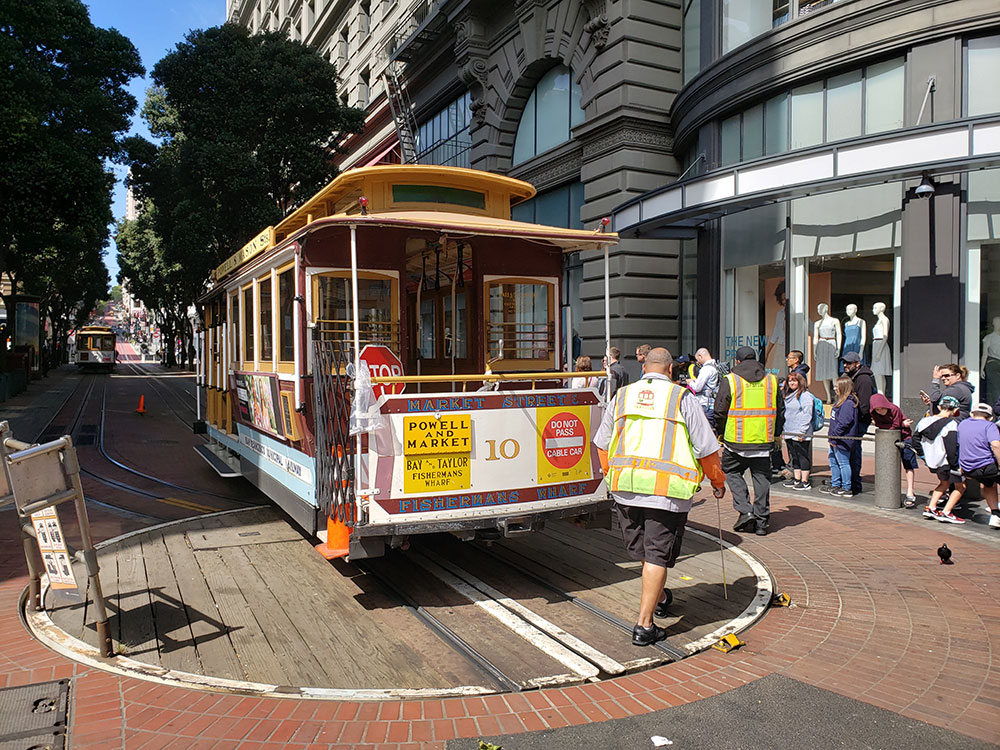
There are 27 cars in rotation when the system is operating. They come in two kinds: Single-ended cars serve the Powell-Hyde and Powell-Mason lines. These cars have an open-sided front section, with outward-facing seats flanking the gripman and a collection of levers that actuate the grip and various brakes. The rear half of the car is enclosed, with seats facing inward and entrances at each end and the car has a small platform at the rear. These cars are 27 feet 6 inches (8.4 m) long and 8 feet (2.4 m) wide and weigh 15,500 pounds (7,000 kg). They have a passenger capacity of 60, 29 of them seated. These cars must be rotated to reverse direction at each end of the line, an operation performed on turntables.

Double-ended cars serve the California Street line. These cars are somewhat longer, having open-sided grip sections at both ends and an enclosed section in the middle. These cars are 30 feet 3 inches (9.2 m) long and 8 feet (2.4 m) wide and weigh 16,800 pounds (7,600 kg). They can hold 68 passengers, 34 of them seated. The California Street line lacks turning capabilities at each end, resulting in the necessity of the double-ended cars.

There are 28 single-ended cars available for operation on the Powell lines and 12 double-ended cars on the California Street line. The cable cars are occasionally replaced with new or restored cars, with the old cars being moved to storage for later restoration. There are two cable cars in storage in the cable car museum / power house inside the car barn: car numbers 19 and 42, which were used on the Sacramento-Clay and O'Farrell, Jones and Hyde Street lines, respectively.

The museum's entrance is at Washington and Mason. It contains several examples of old cable cars, together with smaller exhibits and a shop. Two galleries allow the visitor to overlook the main power house, and also to descend below the junction of Washington and Mason Streets and see the large cavern where the haulage cables are routed out to the street via huge sheaves.

The car is driven by the grip, whose job requires strength, coordination, and balance. The grip must smoothly grip and release the cable, know the points at which the grip must be released to coast over intersecting lines or places where the cable does not follow the tracks, and maintain clearance from other traffic. The conductor collects fares, manages crowding, and controls the rear-wheel brakes on some hills.

This article uses material from the Wikipedia article "San Francisco cable car system", which is released under the Creative Commons Attribution-Share-Alike License 3.0
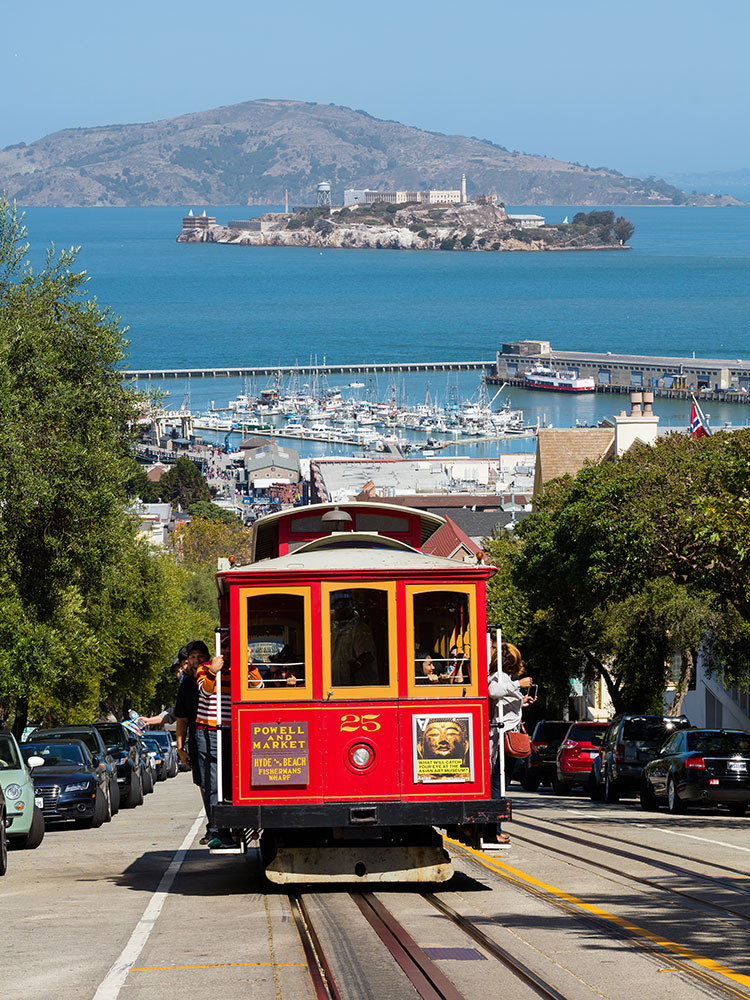
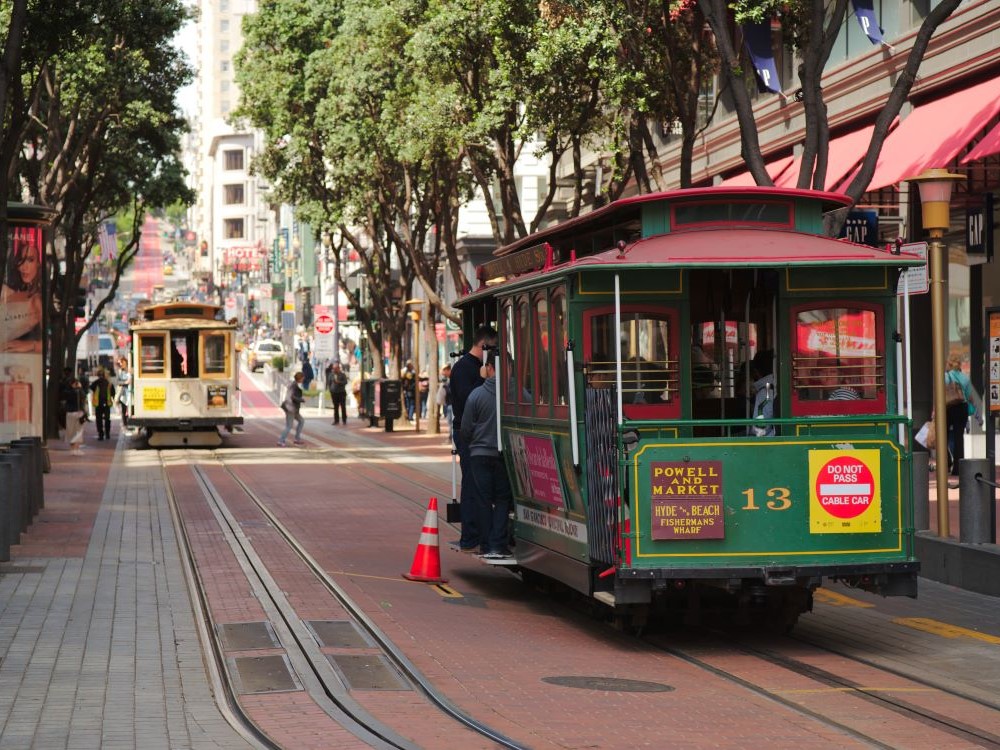
Thomas Wolf, www.foto-tw.de, CC BY-SA 3.0, via Wikimedia Commons ; Image Size Adjusted
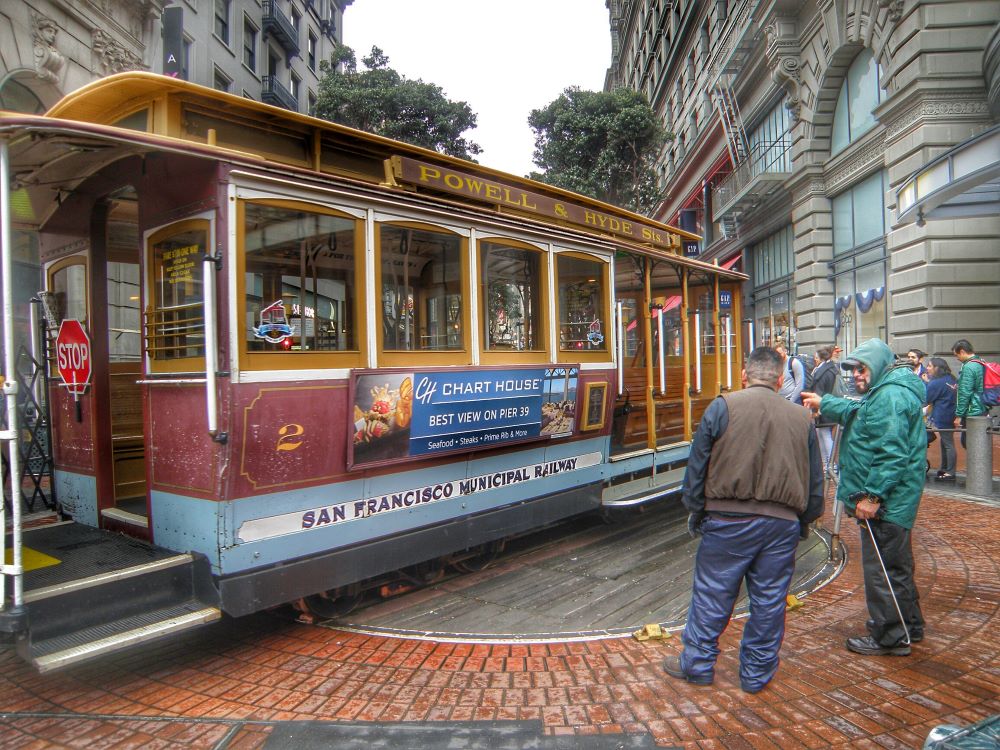
Christian Mehlführer, User:Chmehl, CC BY 3.0, via Wikimedia Commons ; Image Size Adjusted