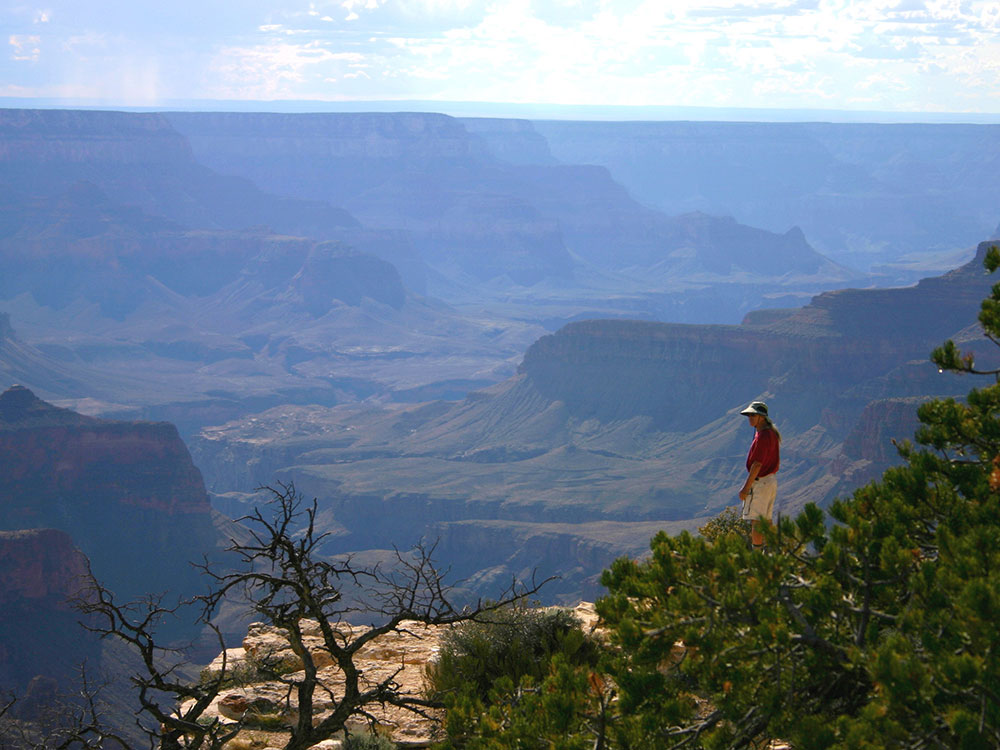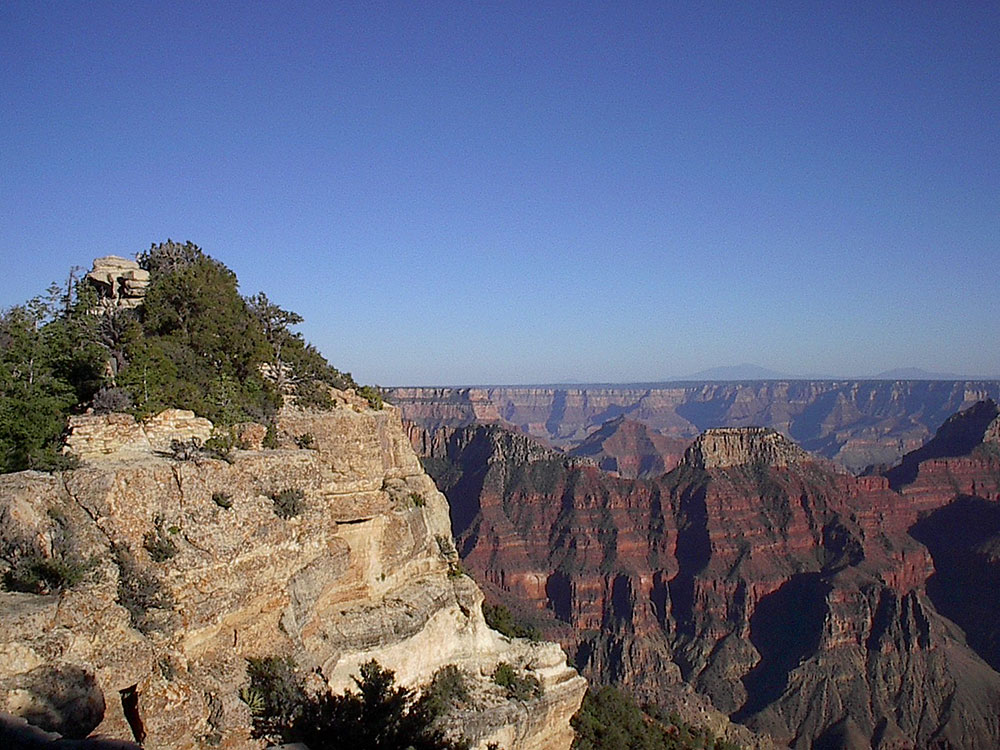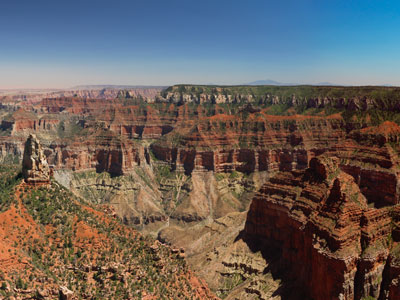

Northern less visited area of park includes a visitor center, the Grand Canyon Lodge, and a number of hiking trails, including the Bright Angel Point Trail and Transept Trail.
General Information
- Pet Policy:
- On the North Rim, leashed pets are allowed only on the Bridle Trail and the Arizona Trail north of the Bridle Trail
Pets are not allowed on other trails, below the rim, or in park lodging (service animals excepted) - Closest Cities with Hotels
- Kanab, UT, 79 miles
Page, AZ, 123 miles - Seasons:
- Full visitor services typically May 15 to October 15
Open for day use after October 15 until snow closes State Route 67 (usually by December 1)
Road closed to vehicles during the winter - Location:
- North Rim, AZ 86052
- Website:
- nps.gov/grca
How to Get There
From Page(123 miles): Head northeast on S Navajo Dr toward S Lake Powell Blvd. Turn right at the 1st cross street onto S Lake Powell Blvd. Turn left onto US-89 S. At the traffic circle, take the 2nd exit onto US-89. Turn right onto US-89A N. Turn left onto AZ-67 S.
Overview
The North Rim is the Grand Canyon’s quieter, cooler and more remote side. Sitting more than 8,000 feet above sea level on the forested Kaibab Plateau, roughly 1,000 feet higher than the South Rim, it is surrounded by ponderosa pine, spruce, fir and aspen forests and broad mountain meadows. Although the two rims are only about 10 miles apart as the raven flies, the drive between them is more than 200 miles, and only about one in ten Grand Canyon visitors makes the trip north.
People come to the North Rim for its solitude, its cooler summer temperatures and a different perspective on the canyon. Views here look south across the vast side canyons and temples of the inner canyon, with the South Rim on the distant horizon. Visitors come to watch sunrise and sunset from the rim’s high points, hike forested rim trails, descend the North Kaibab Trail into the canyon, spot wildlife such as the tassel-eared Kaibab squirrel found nowhere else in the world, and enjoy a slower-paced national park experience without the crowds of the South Rim.
Sightseeing and Scenic Drives
The main sightseeing hub is Bright Angel Point, a short paved walk near the end of the entrance road that follows a narrow ridge between Roaring Springs Canyon and Transept Canyon. From there, the paved Cape Royal Road and its spur to Point Imperial make up the North Rim’s primary scenic drive, winding about 23 miles through forest and meadows to a series of overlooks and pull-offs. Point Imperial, at 8,803 feet, is the highest point on the Grand Canyon’s rim and overlooks the Painted Desert and the eastern end of the canyon. Along the Cape Royal Road, stops include Vista Encantada, Roosevelt Point and Walhalla Overlook, ending at Cape Royal, where a short paved path leads to Angels Window, a natural arch with a view of the Colorado River below. Farther west, the remote Tuweep (Toroweap Overlook) offers a sheer 3,000-foot drop to the river but is reached only by long, unpaved roads off Route 389 west of Fredonia.
Hiking
The North Rim offers trails for a range of abilities. Easy options include the paved Bright Angel Point Trail and the Cape Royal Trail, while the Transept Trail follows the rim through the forest between Grand Canyon Lodge and the North Rim Campground. Moderate hikes include the Cliff Springs Trail to a shaded spring beneath a rock overhang, the Cape Final Trail to one of the rim’s most expansive viewpoints, and longer rim hikes such as the Widforss Trail, Uncle Jim Trail and Ken Patrick Trail. The North Kaibab Trail is the only maintained trail into the canyon from the North Rim, descending about 14 miles and 5,800 feet past Supai Tunnel, Roaring Springs and Ribbon Falls to Phantom Ranch and the Colorado River. Day hikers often turn around at Coconino Overlook, Supai Tunnel or Roaring Springs, and the trail is also the northern half of the famous Rim-to-Rim hike. Hiking to the river and back in one day is not recommended, and overnight trips below the rim require a backcountry permit.
Other Activities
Beyond sightseeing and hiking, the North Rim is known for its mule rides, which offer guided trips along the rim and partway down the North Kaibab Trail. Ranger programs, including talks, walks and evening programs, are offered during the summer season. Grand Canyon is an International Dark Sky Park, and the North Rim’s high elevation and remote location make it one of the best places in the park for stargazing. Wildlife viewing is also popular, with mule deer, wild turkeys, Kaibab squirrels and occasionally bison seen in the meadows along the entrance road. Backpacking, Rim-to-Rim treks and photography of sunrise and sunset from Point Imperial and Cape Royal round out the most popular activities.
Getting to the North Rim
The North Rim is located in far northern Arizona in a region known as the Arizona Strip, isolated from the rest of the state by the canyon itself. The only paved access is State Route 67, which runs 44 miles south from Jacob Lake on U.S. 89A to the rim. Most visitors arrive by car as part of a larger Southwest road trip, often combined with Zion and Bryce Canyon National Parks in Utah, Lake Powell, or the South Rim. Drive times are about 1.5 hours from Kanab, Utah, 2.5 hours from Page, 3 hours from Zion National Park, 4.5 hours from Las Vegas and about 4 to 4.5 hours from the South Rim. The nearest major airport is Las Vegas, with smaller regional airports in St. George, Utah and Page, Arizona. Fuel and services are very limited near the park, so fill up in Kanab, Fredonia or Jacob Lake before heading south on Route 67.
Seasons
Because of its high elevation, the North Rim has a short visitor season. Full visitor services typically operate from May 15 through October 15, and the park remains open for day use until the first heavy snows close State Route 67, usually by early December. The road stays closed all winter, when the plateau receives heavy snowfall, and the rim can only be reached by experienced skiers or snowshoers with a backcountry permit for overnight stays. Summer brings pleasant daytime temperatures in the 70s and low 80s °F, cool nights, wildflowers in the meadows, and afternoon monsoon thunderstorms in July and August. Fall is one of the most beautiful times to visit, when the aspen groves along Route 67 and the Cape Royal Road turn gold, usually from late September to early October.
Camping and Lodging
Inside the park, the historic Grand Canyon Lodge, built in 1928 on the edge of Bright Angel Point, was the North Rim’s only in-park lodging, but the main lodge building was destroyed by the 2025 Dragon Bravo Fire. Check the National Park Service website for the current status of lodging and services. The North Rim Campground, near the lodge area, offers tent and RV sites by reservation, and backcountry campgrounds below the rim, such as Cottonwood Campground on the North Kaibab Trail, require a permit. Just outside the park in the Kaibab National Forest, Kaibab Lodge and DeMotte Campground sit about 5 miles north of the park entrance, and Jacob Lake Inn and the Jacob Lake Campground are about an hour from the rim. Within one to two hours, Kanab, Utah is the most popular base for North Rim visitors, with a wide selection of hotels, motels and restaurants, while the lodges at Marble Canyon and Lees Ferry and the larger town of Page are good options for travelers coming from the east.
Visitor Centers
The North Rim Visitor Center, located next to Grand Canyon Lodge near Bright Angel Point, served as the main source of park information, maps, exhibits, ranger programs and backcountry information, but it was among the buildings lost in the 2025 Dragon Bravo Fire, so check with the park for current information services. On the way to the rim, the Kaibab Plateau Visitor Center at Jacob Lake, operated by the Kaibab National Forest, offers information on the North Rim, the surrounding national forest and road conditions on Route 67.
Shuttles
Unlike the South Rim, the North Rim does not have a park shuttle system, and visitors drive their own vehicles to the overlooks and trailheads. During the summer season, a hiker shuttle has been offered from the lodge area to the North Kaibab Trailhead, which helps with limited trailhead parking. For hikers completing the Rim-to-Rim hike, the private Trans-Canyon Shuttle runs seasonally between the North and South Rims, about a 4.5-hour drive. See the Grand Canyon Shuttle System page for more information on shuttles throughout the park.
This article uses material from the Wikipedia articles "Grand Canyon National Park", "North Rim, Arizona", "Grand Canyon Lodge" and "Dragon Bravo Fire", which are released under the Creative Commons Attribution-Share-Alike License 3.0, and information from the National Park Service "Visiting the North Rim" page.
Featured GC North Rim Locations and Trails
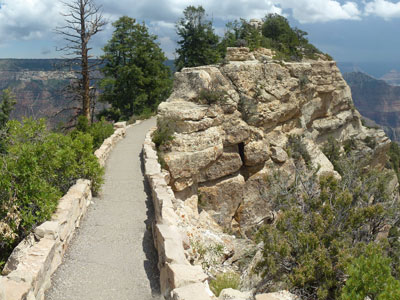
0.5 mile roundtrip, 150 feet elevation gain, Easy
Short paved trail along a narrow ridge leading to a dramatic North Rim overlook with sweeping views across the canyon.
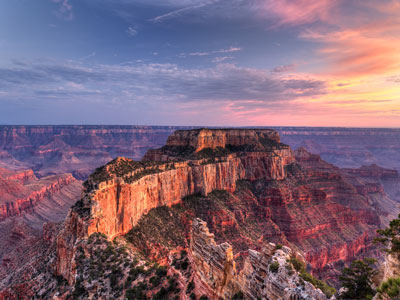
Jeff P from Berkeley, CA, USA, CC BY 2.0, via Wikimedia Commons; Image Size Adjusted

0.6 mile roundtrip, 50 feet elevation gain, Easy
A scenic overlook at the end of a paved rim trail offering expansive canyon views, natural rock features, and distant river vistas.
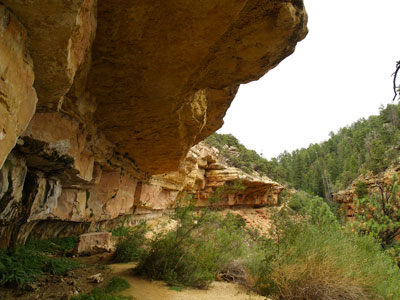
1 mile roundtrip, 300 feet elevation gain, Moderate
A moderate forested trail leading to a secluded canyon spring with dramatic rock overhangs and cooler, shaded surroundings.
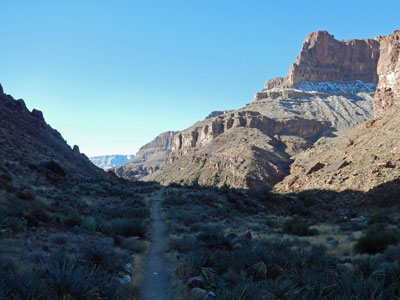
28 miles roundtrip, 5,761 feet elevation gain, Very Strenuous
14-mile (23 km) trail starting on the North Rim, with features including Roaring Springs, Ribbon Falls (140 ft), The Box (a slot canyon), and Phantom Ranch.