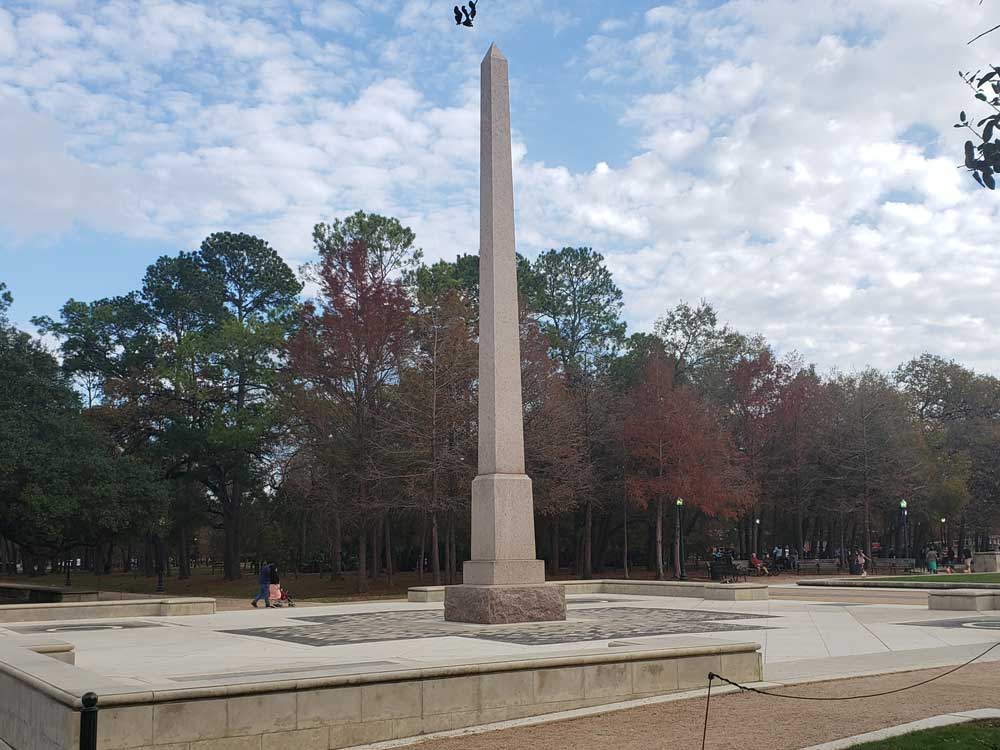
Tall granite obelisk erected in 1936 to honor the Texas pioneers of the early nineteenth century.
General Information
- Hours:
- Open daily, 6am to 11pm
- Fees:
- Free
- Pets
- Pets allowed
- Seasons:
- All Year
How to Get There
From the InterContinental Houston Medical Center (0.8 mi): Head south on Main St, turn left onto Hermann Dr, and continue into Hermann Park to Molly Ann Smith Plaza near McGovern Lake, where the obelisk stands.
Overview
Rising 50 feet above the tranquil Molly Ann Smith Plaza in Houston's Hermann Park, the Pioneer Memorial Obelisk commands the southern edge of the Mary Gibbs and Jesse H. Jones Reflection Pool with quiet, timeless authority. Crafted from Vermont granite quarried by the Barre Granite Works, its pale stone catches the Texas sunlight and casts long reflections across the still water of McGovern Lake. Visitors who linger at its base will discover inscriptions narrating the story of early pioneer settlement in Texas — a compact chronicle etched into stone as enduring as the monument itself. One of the largest obelisks in the United States, it serves as both a landmark and a meditation on the generations whose perseverance shaped this region.
The obelisk was unveiled in 1936 by the San Jacinto Centennial Association to mark the 100th anniversary of Texas Independence, a year when the state turned inward to honor its founding struggles. Its creator, Frank A. Teich, was a German-born sculptor who immigrated to the United States in 1878 and went on to work on landmarks across Texas, including the State Capitol in Austin. Within Hermann Park itself, his work can also be seen in the Dick Dowling statue and the stone arch beneath the Sam Houston Monument, making the obelisk a standout among his contributions to this beloved greenspace. Relocated to its present site during a major park revitalization completed in 2003, the monument today draws visitors, historians, and photographers drawn to its austere beauty and the heritage it quietly proclaims.
History
Hermann Park was created in 1914, when George H. Hermann, a Houston businessman and philanthropist, donated the land to the city, and landscape architect George Kessler laid out its early design. The 50-foot granite obelisk was built in 1936 for the Texas Centennial, honoring the pioneers who settled Texas, and it anchors the south end of the long reflection pool. The surrounding Molly Ann Smith Plaza was later landscaped as a gathering place.
Things to Do
See the Obelisk
View the granite obelisk and its inscriptions.
Walk the Reflection Pool
The 740-foot reflection pool stretches north from the obelisk.
Photograph the View
The obelisk reflected in the pool is a classic Houston photo.
Visit the Museum of Natural Science
The museum is just across the plaza.
This article uses material from the Wikipedia article and official sources for the Pioneer Memorial Obelisk and the Hermann Park Conservancy, released under the Creative Commons Attribution-Share-Alike License 3.0.