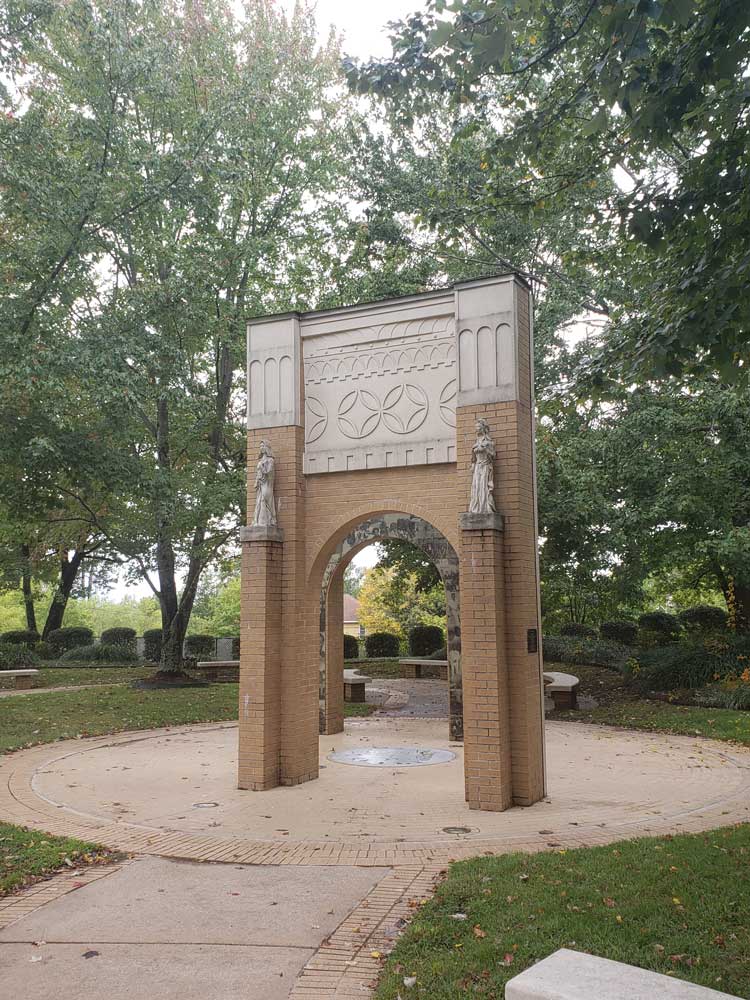
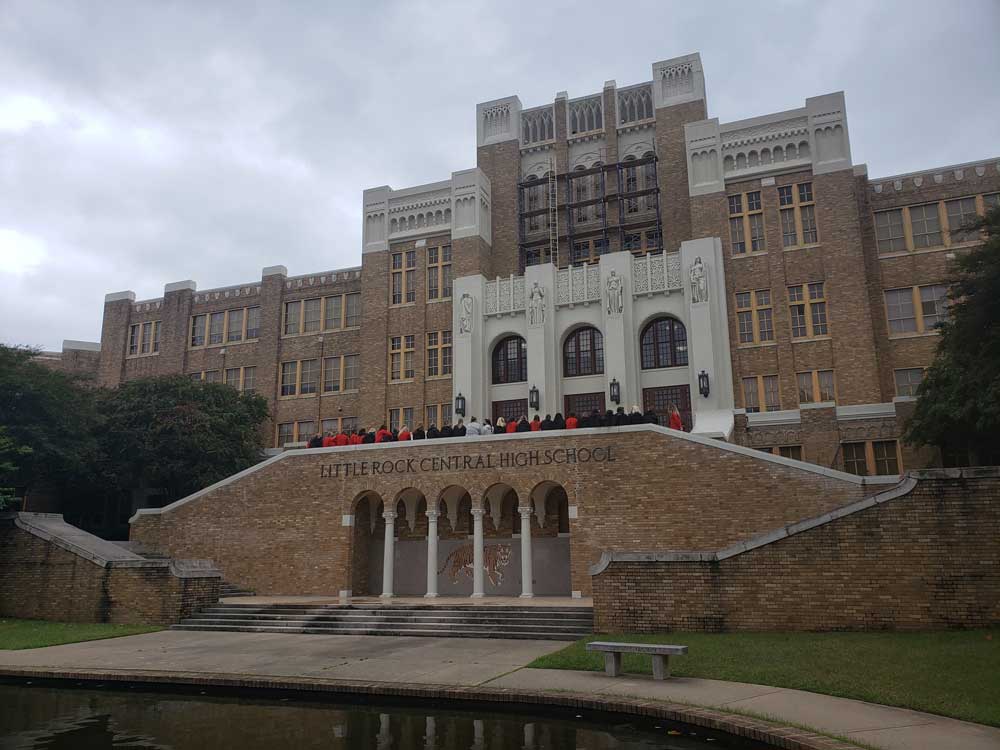
Site of forced desegregation in 1957 after the U.S. Supreme Court ruled that segregation of public schools was unconstitutional three years earlier
General Information
Closed Thanksgiving Day, Christmas Day, and New Year's Day
Outdoor grounds and commemorative areas may be accessed daily
How to Get There
From Little Rock (2 mi): Take I-630 west to Exit 2B for Dr. Martin Luther King Jr. Drive, head south, turn right onto W. Daisy L. Gatson Bates Drive, and continue about 0.5 miles.
Little Rock Central High School (LRCHS) is an accredited comprehensive public high school in Little Rock, Arkansas. The school was the site of forced desegregation in 1957 after the U.S. Supreme Court ruled that segregation of public schools was unconstitutional three years earlier. This was during the period of heightened activism in the civil rights movement.
Central is located at the intersection of Park Street and Daisy L. Gatson Bates Drive (formerly 14th Street). Bates was an African-American journalist and state NAACP president who played a key role in bringing about, through the 1957 crisis, the integration of the school.
Built in 1927 at a cost of $1.5 million, Little Rock Senior High School was designed in the Gothic Revival style; it was hailed as the most expensive, most beautiful, and largest high school in the nation. Statues of four figures over the front entrance represent ambition, personality, opportunity, and preparation. Its opening earned national publicity, with nearly 20,000 people attending the dedication ceremony. In 1953 it was renamed as Little Rock Central High School.
At the time in Arkansas and other states across the South, public school educational facilities were legally racially segregated. In 1954 the US Supreme Court ruled in Brown v. Board of Education that such segregation in public schools was unconstitutional, and encouraged the states to integrate their schools. Related historic events in the 1950s changed education at Central High School and throughout the United States.
LRCHS was the focal point of the Little Rock Integration Crisis of 1957. Nine Black students, known as the Little Rock Nine, were denied entrance to the school in defiance of the 1954 U.S. Supreme Court ruling ordering integration of public schools. This provoked a showdown between the Governor Orval Faubus and President Dwight D. Eisenhower that gained international attention.
On the morning of September 23, 1957, the nine Black high school students faced an angry mob of over 1,000 Whites in front of Central High School who were protesting the integration project. As the students were escorted inside by the Little Rock police, violence escalated, and they were removed from the school. The next day, Eisenhower ordered the 1,200-man 327th Airborne Battle Group of the U.S. Army's 101st Airborne Division from Fort Campbell, Kentucky, to escort the nine students into the school. By the same order, he federalized the entire 10,000-man Arkansas National Guard, in order to remove them from the control of Governor Faubus. At nearby Camp Robinson, a hastily organized Task Force 153rd Infantry drew guardsmen from units all over the state. Most of the Arkansas Guard was quickly demobilized, but the ad hoc Task Force 153rd Infantry assumed control at Thanksgiving when the 327th withdrew, and patrolled inside and outside the school for the remainder of the school year. As Melba Pattillo Beals, one of the nine students, wrote in her diary, "After three full days inside Central [High School], I know that integration is a much bigger word than I thought."
This event, watched by the nation and world, was the site of the first important test for the implementation of the U.S. Supreme Court's Brown v. Board of Education decision of 1954. Many areas of the South pledged to resist this ruling. Arkansas' governor Orval Faubus questioned the authority of the federal court system and the validity of desegregation. The crisis at Little Rock's Central High School was the first fundamental test of the national resolve to enforce black civil rights in the face of massive resistance during the years following the Brown decision. As to whether Eisenhower's specific actions to enforce integration violated the Posse Comitatus Act, the Supreme Court, in Cooper v. Aaron (1958), indirectly affirmed the legality of his conduct. It was never expressly reviewed.
In 1958, federal Judge Jesse Smith Henley of the United States District Court for the Eastern District of Arkansas, stating that integration had "broken down under the pressure of public opinion," suspended operation of the federal integration order until the 1960-61 school term. The school board said that it had faced large fees and could not afford to hire security guards to keep the peace in school.
LRCHS was listed on the National Register of Historic Places on August 19, 1977, and was designated as a National Historic Landmark on May 20, 1982. The school continues to be used as an educational facility.
This article uses material from the Wikipedia article "Little Rock Central High School", which is released under the Creative Commons Attribution-Share-Alike License 3.0