Historic city renowned for its pivotal role in the American civil rights movement, featuring landmarks, museums, and cultural sites that commemorate the struggle for voting rights and equality.
General Information
Selma Welcome Center: Monday to Friday, 8:30 a.m. – 4:30 p.m.
Closed major holidays; hours vary by site
How to Get There
From Montgomery, AL (50 mi): Take US-80 W directly to Selma. The route passes through Lowndes County and leads into downtown Selma near the Edmund Pettus Bridge.
Overview
Selma, Alabama, is a small city on the Alabama River in the Black Belt region of the state, and it is famous as the site of the 1965 voting rights marches that helped lead to the Voting Rights Act. On March 7, 1965, known as "Bloody Sunday," state troopers attacked civil rights marchers on the Edmund Pettus Bridge, and the images shocked the nation. Two weeks later, thousands marched the 54 miles from Selma to Montgomery under federal protection.
Visitors come to Selma to walk across the Edmund Pettus Bridge, to visit the National Voting Rights Museum and Institute, and to see Brown Chapel AME Church, the starting point of the marches. They also come to follow the Selma to Montgomery National Historic Trail, to see antebellum homes and the Old Live Oak Cemetery, and to attend the annual Bridge Crossing Jubilee in March.
History
Selma was founded in 1820 on a bluff above the Alabama River and became a prosperous cotton port, and during the Civil War it was the site of an important Confederate arsenal and naval foundry. The Battle of Selma in April 1865 resulted in the destruction of much of the city by Union troops. In the twentieth century, Selma's Black residents were largely prevented from registering to vote, and local activists, with the Student Nonviolent Coordinating Committee and Dr. Martin Luther King Jr.'s Southern Christian Leadership Conference, organized a campaign in 1965. The events of Bloody Sunday and the subsequent march led to the passage of the Voting Rights Act in August 1965.
Sightseeing and Popular Landmarks
The Edmund Pettus Bridge, a steel arch bridge over the Alabama River, is a National Historic Landmark and the most important site in Selma, and Brown Chapel AME Church, from which the marches began, is nearby. The National Voting Rights Museum and Institute is at the foot of the bridge and has exhibits and the footprints of marchers. The Old Live Oak Cemetery, Sturdivant Hall, and the Selma Interpretive Center, which is on the trail, are other sights, as are the Historic Water Avenue and the Martin Luther King Jr. Street Historic District.
Culture and Museums
The National Voting Rights Museum and Institute tells the story of the struggle for voting rights, and the Lowndes County Interpretive Center, in a nearby county, covers the march and the Lowndes County Freedom Organization. The Selma Interpretive Center, part of the National Park Service, has exhibits on the Selma to Montgomery march. The Slavery and Civil War Museum and the Joe Smitherman Historic Building are also in the city, and the Bridge Crossing Jubilee is held each March.
Parks
Selma has a small number of parks and green spaces. Memorial Stadium and Bloch Park are local recreation areas, and the Alabama River offers fishing and boating, and Old Cahawba Archaeological Park, about 15 miles away, is the site of Alabama's first state capital, now a ghost town with ruins and trails. The Black Belt region is known for its prairie landscape and its catfish ponds.
Seasons and Weather
Selma has a humid subtropical climate. Summers are hot and humid, with highs in the 90s°F, and winters are mild, with highs in the 50s°F and almost no snow. March is a popular time to visit because of the Jubilee, and spring and fall are the most comfortable seasons. Thunderstorms are common in spring and summer.
This article uses material from Wikipedia as well as information from official tourism and institutional sources. Key references include Selma Dallas County Tourism, National Park Service Selma to Montgomery National Historic Trail, National Voting Rights Museum and Institute, Alabama Tourism Department, and National Weather Service Birmingham. Wikipedia material is from the articles "Selma, Alabama" and "Selma to Montgomery marches", and is available under the Creative Commons Attribution-Share-Alike License 3.0.
Featured Locations
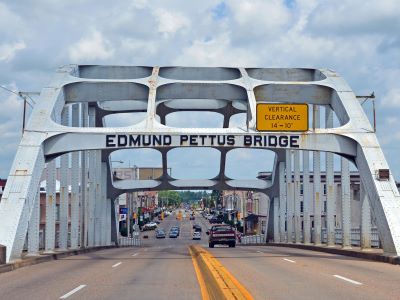
Dough4872, CC BY-SA 4.0, via Wikimedia Commons; Image Size Adjusted
Edmund Pettus Bridge
Iconic steel-arched bridge symbolizing the struggle for civil rights and the historic 1965 Selma to Montgomery marches.


