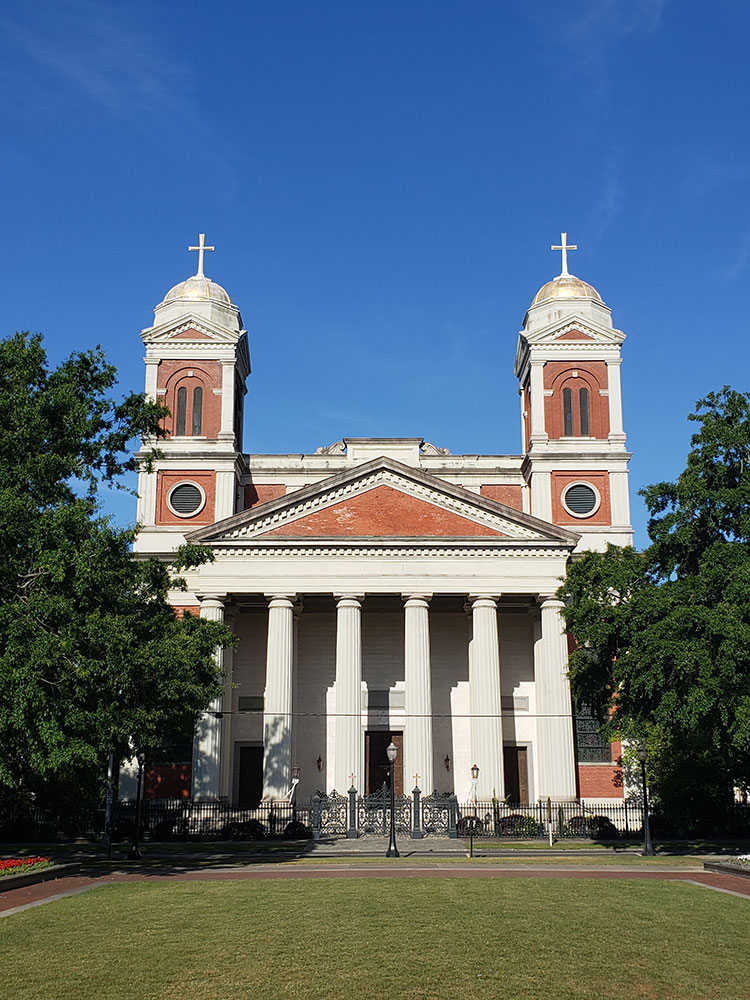
Cathedral in Mobile, Alabama, on the National Register of Historic Places as a contributing property to the Church Street East Historic District and Lower Dauphin Street Historic District.
General Information
- Hours:
-
Cathedral open daily for worship and visitors
Saturday Masses: 8:00am and 4:30pm Vigil
Sunday Masses: 8:00am and 10:30am
Monday–Friday Mass: 12:10pm - Fees:
-
Free admission
Donations welcome - Pet Policy:
- Pets are not permitted inside the cathedral.
- Closest cities with hotels:
- Mobile, Alabama
- Seasons:
- All year
- Location:
- 307 Conti Street, Mobile, AL 36602
- Website:
- mobilecathedral.org
How to Get There
From Mobile (1 mi): Travel through downtown Mobile toward Conti Street and continue to the Cathedral Basilica of the Immaculate Conception at 307 Conti Street, located a few blocks north of the waterfront in the historic district.
Overview
The Cathedral Basilica of the Immaculate Conception (French: Cathédrale de l'Immaculée-Conception de Mobile) is a cathedral serving Roman Catholics in Mobile, Alabama. It is the seat of the Archbishop of the Roman Catholic Archdiocese of Mobile. The cathedral is named for Mary, mother of Jesus, under her title, Our Lady of the Immaculate Conception. It is listed on the National Register of Historic Places as a contributing property to the Church Street East Historic District and Lower Dauphin Street Historic District.
History
Mobile's Cathedral Parish was established on July 20, 1703, by Jean-Baptiste de la Croix de Chevrières de Saint-Vallier, Bishop of Quebec. Bishop de Saint-Vallier named Father Roulleaux de La Vente, first pastor of the parish church, which was located at the French settlement of Mobile at the citadel of Fort Louis de la Louisiane. The parish is the first established on the Gulf Coast.
When the Mobile settlement was relocated to its present site in 1711, a new parish church was built and was known as Notre Dame de la Mobile (Our Lady of Mobile). In 1781, during the Spanish occupation of Mobile, the parish took its current name, Immaculate Conception.
Mobile was elevated to a diocese in 1829, and Frenchman, Michael Portier, was named its first bishop. Bishop Portier’s first “cathedral” was a small wooden structure located in the Old Spanish Burying Ground, site of the present cathedral. Portier soon set out to construct a "real" cathedral.
Construction
The cathedral, designed in 1833, by Claude Beroujon, a former seminarian turned architect, is laid out in a Roman basilica design. Construction began in 1835, but the Panic of 1837, caused a shortage of funds and delayed progress. The cathedral was consecrated for public worship in 1850, by Bishop Portier, though Beroujon's design was not yet fully realized. The portico and towers were to come later.
The classical portico, with eight massive columns of the Roman Doric order, was added in the 1870s, under the direction of Bishop John Quinlan. The two towers were completed in 1884, during the watch of Bishop Jeremiah O'Sullivan.
Stained glass windows
One of the cathedral's finest attributes is its stained glass windows. The windows were made in Munich, Germany by Franz Mayer & Co., and installed beginning in 1890. The last window was installed in 1910, during the time of Bishop Edward Patrick Allen.
The twelve main windows, six on the south wall and six on the north wall, are approximately 8 feet (2.4 m) wide and 23 feet (7.0 m) tall. Each window depicts an event involving Mary in the life of her son, Jesus. The subjects of the south wall windows are Our Lady of the Immaculate Conception, the Presentation of Mary at the Temple, the Annunciation, the Visitation, the Nativity of Jesus, and the Holy Family. The themes of the north wall are the Finding of the Child Jesus at the Temple, the Marriage Feast of Cana, the Crucifixion of Jesus, Pentecost, the Assumption of Mary into Heaven, and the Coronation of Mary, Queen of Heaven.
Two large windows flank the portico, one under each of the two towers. The Baptism of Jesus in the River Jordan, by John the Baptist is the subject of the window in the Reconciliation Room, under the north tower. The window under the south tower, in the stairway to the choir loft, appropriately depicts St. Cecilia, patron saint of musicians.
Smaller windows are found in each of the eight doors in the foyer, behind the cathedral's main doors, at the church's front entrance. These depict, from left to right, St. Augustine of Hippo, Our Lady of Mount Carmel, the Presentation of Mary at the Temple, St. Louis IX, King of France, St. Patrick, Our Lady of the Immaculate Conception, St. Agnes of Rome, Virgin & Martyr , and the Most Sacred Heart of Jesus. Above the four middle doors is the Holy Spirit window.History
Mobile's first Catholic parish was founded in 1703, making it one of the oldest on the Gulf Coast. Construction of the cathedral began in 1835 and it was consecrated in 1850, with its towers added in the 1880s. Pope John XXIII named it a minor basilica in 1962.
Things to Do
See the Stained Glass
German stained glass windows fill the cathedral.
Admire the Architecture
The Greek Revival cathedral has a grand portico and twin towers.
Attend Mass
The cathedral holds regular Mass.
Explore Downtown Mobile
The cathedral is near Bienville Square and Dauphin Street.
This article uses material from the Wikipedia articles "Cathedral Basilica of the Immaculate Conception (Mobile, Alabama)", which are released under the Creative Commons Attribution-Share-Alike License 3.0