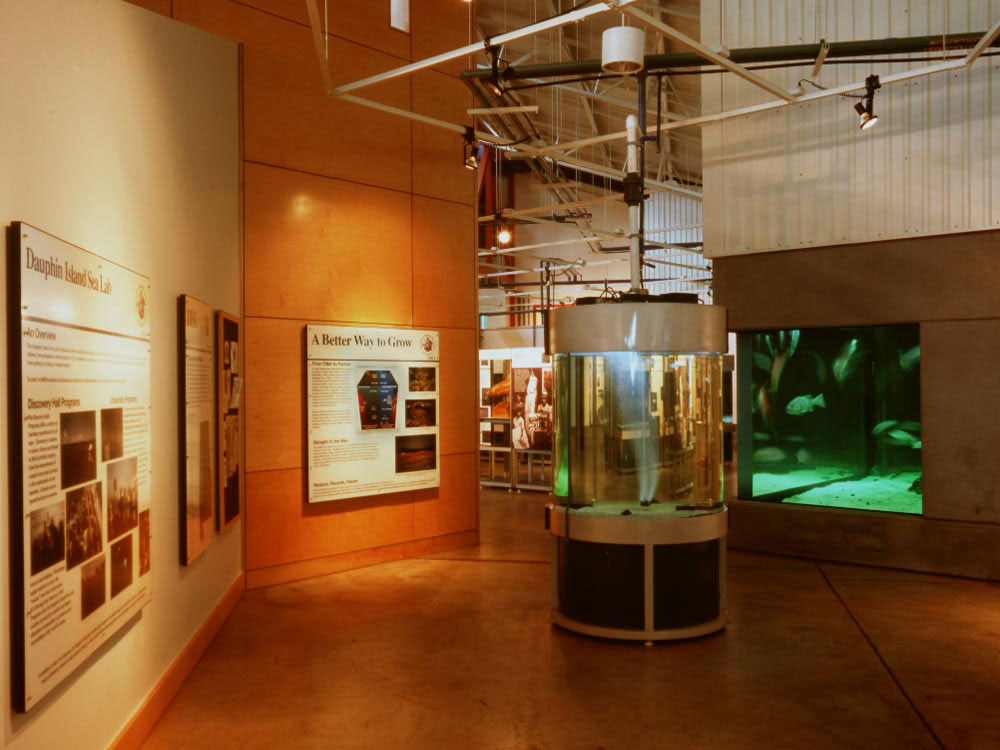
Alabama's primary marine education and research center with a public aquarium specializing in estuarine organisms.
General Information
- Hours:
-
Daily: 9:00am to 5:00pm
Last ticket sold at 4:00pm
Closed Easter Sunday, Thanksgiving Day, Christmas Eve, Christmas Day, New Year's Eve, and New Year's Day - Fees:
-
Adults: $14
Children (5–18): $6
Seniors (60+): $12
Children under 5: Free
Military and AAA discounts available - Pet Policy:
- Pets are not allowed.
- Closest cities with hotels:
- Dauphin Island, Alabama
- Seasons:
- All year
- Location:
- 102 Bienville Blvd, Dauphin Island, AL 36528
- Website:
- disl.edu/aquarium
How to Get There
From Dauphin Island (2 mi): Follow Bienville Boulevard east across Dauphin Island toward Fort Gaines, and the Alabama Aquarium at the Dauphin Island Sea Lab will be on the left at 102 Bienville Boulevard.
Overview
The Dauphin Island Sea Lab (DISL) is Alabama's primary marine education and research center. DISL is the home site of the Marine Environmental Sciences Consortium and was founded by an act of the Alabama State Legislature in 1971. It also has a public aquarium specializing in estuarine organisms, the George F. Crozier Estuarium.
The facilities are located on the East end of Dauphin Island, and occupy grounds formerly owned by the US Air Force for the 693rd Radar Squadron. It is located across the street from historic Fort Gaines.
Estuarium
The George F. Crozier Estuarium is part of the Discovery Hall educational program at the Dauphin Island Sea Lab. It includes a 10,000 square foot Exhibit Hall and a Living Marsh Boardwalk. The Exhibit Hall features four exhibits highlighting aquatic life that could be found in the Mobile-Tensaw River Delta, Mobile Bay, the Barrier Islands and the Northern Gulf of Mexico.
The Mobile-Tensaw River Delta exhibit recreates Alabama's largest wetland, the Mobile-Tensaw River Delta and features multi-species displays featuring the American alligator, turtles and gar.
The Mobile Bay exhibit features a replica of the legs of the Middle Bay Lighthouse and houses native species found in the brackish water of Mobile Bay, including stone crabs, horseshoe crabs, blue crabs, oysters, spadefish, and flounder.
The Barrier Islands exhibit features saltwater species commonly found on and around Alabama's barrier islands, including shrimp, blue crabs and hermit crabs.
The Northern Gulf of Mexico exhibit includes displays of the different marine communities of the Northern Gulf of Mexico and features octopus, lobsters, eels, seahorses, red snapper, sharks and jellyfish.
Rays of the Bay is the latest exhibit added to the Estuarium. Opened in March 2013, the 6,400 US gallons (24,000 l) touch tank houses six sets of four species of rays and skates indigenous to the Northern Gulf of Mexico and Mobile Bay. The species include the Southern stingray, Cownose ray and Atlantic stingray.
History
The Alabama legislature created the Dauphin Island Sea Lab in 1971 as the state's marine science research and education center, shared by more than 20 colleges and universities. The Estuarium, its public aquarium, opened in 1998 to show visitors the habitats of Mobile Bay, the fourth-largest estuary in the United States, from the Mobile-Tensaw Delta to the Gulf of Mexico.
Things to Do
Explore the Aquarium Exhibits
Tanks show the fish, sea turtles and other wildlife of Mobile Bay and the Gulf.
Touch Marine Life
The touch pool lets visitors handle crabs, snails and other creatures.
Walk the Living Marsh Boardwalk
The outdoor boardwalk crosses a salt marsh behind the Estuarium.
Watch the Sea Lab at Work
Researchers study the bay's waters and wildlife at the Sea Lab campus.
Visit Fort Gaines
The Civil War fort is just down the road on Dauphin Island.
This article uses material from the Wikipedia articles "Dauphin Island Sea Lab", which are released under the Creative Commons Attribution-Share-Alike License 3.0