
Capital city of Connecticut, founded in 1635 and is among the oldest cities in the United States and is home to the country's oldest public art museum (Wadsworth Atheneum), the oldest publicly funded park (Bushnell Park), the oldest continuously published newspaper (the Hartford Courant), and the second-oldest secondary school (Hartford Public High School).
Places to See in New Haven, CT

ZhengZhou, CC BY-SA 4.0, via Wikimedia Commons; Image Size Adjusted

Frank Pepe Pizzeria Napoletana / Pepe's
Legendary coal‑fired pizzeria founded in 1925, famous for its crisp, charred New Haven–style “apizza,” including the iconic white clam pie that helped define American pizza culture.
Dmadeo, CC BY-SA 3.0, via Wikimedia Commons; Image Size Adjusted

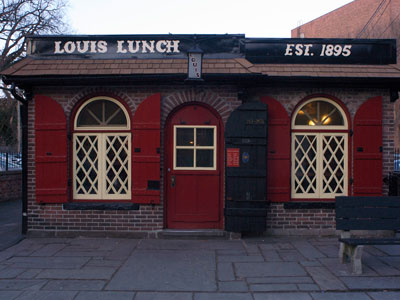
Louis' Lunch
Tiny, historic lunch counter famously recognized as the birthplace of the hamburger sandwich, serving simple, broiler‑cooked burgers on white toast using methods unchanged since 1895.
Farragutful, CC BY-SA 4.0, via Wikimedia Commons; Image Size Adjusted

Emilie Foyer, CC BY-SA 3.0, via Wikimedia Commons; Image Size Adjusted

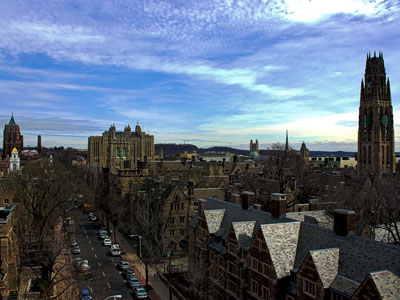
Yale University
World‑renowned Ivy League university founded in 1701, known for its Gothic architecture, residential college system, museums, libraries, and a central role in the cultural life of New Haven.
Overview
New Haven is a port city on Long Island Sound in southern Connecticut, and it is best known as the home of Yale University, one of the oldest and most prestigious universities in the United States. It is also the "Pizza Capital of America" to many fans, thanks to its coal-fired "apizza" at Frank Pepe's, Sally's, and Modern, and it has a claim to the first hamburger sandwich, served at Louis' Lunch. The city has a historic central green, lively theaters, and some of the best museums in New England.
Visitors come to New Haven for the Yale campus, the Beinecke Rare Book & Manuscript Library with its Gutenberg Bible, and the Yale University Art Gallery and Peabody Museum. They also come for the New Haven Green, for Frank Pepe Pizzeria Napoletana and Louis' Lunch, and for the theaters, such as the Yale Repertory Theatre and the Shubert.
History
New Haven was founded in 1638 by Puritans led by the Reverend John Davenport and the merchant Theophilus Eaton, who laid out the city in a grid of nine squares around a central green, an early example of town planning. It was a separate colony until it merged with Connecticut in 1664, and then shared the role of state capital with Hartford until 1875. Yale, founded in 1701 in Branford and moved to New Haven in 1716, became the city's defining institution. In the nineteenth century the city was a center of manufacturing, with Eli Whitney's gun factory, and in 1839 the Amistad case, in which enslaved Africans who had taken over a Spanish ship were tried and freed, was heard here.
Sightseeing and Popular Landmarks
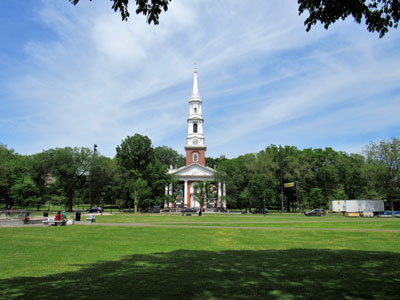
The New Haven Green, a 16-acre common with three historic churches, is the center of the city, and Yale University's Gothic and Georgian campus is next to it. The Sterling Law Building and Sterling Memorial Library are Collegiate Gothic landmarks, and the Beinecke Library is a modern building with translucent marble walls that house its rare books. East Rock Park has a war memorial tower with views of the city, and Lighthouse Point Park has a lighthouse and a beach.
Culture and Museums
The Yale University Art Gallery, the oldest university art museum in the Western Hemisphere, and the Yale Center for British Art, a building designed by Louis Kahn, are free to visit. The Yale Peabody Museum of Natural History, with its dinosaur skeletons, and the Beinecke Library, with its Gutenberg Bible and Audubon's Birds of America, are other major museums. The city's theaters include the Yale Repertory Theatre, the Long Wharf Theatre, and the Shubert, and the New Haven Symphony Orchestra is one of the oldest in the country.
Parks
The New Haven Green hosts concerts and festivals, and East Rock Park, designed in the nineteenth century, has trails, a summit road, and a memorial. West Rock Ridge State Park has hiking, and Lighthouse Point Park has a beach and a historic carousel. The Yale Farm, the Farmington Canal Heritage Trail, and the Long Wharf waterfront offer other places to walk and relax.
Seasons and Weather
New Haven has a humid continental climate moderated by Long Island Sound. Summers are warm and humid, with highs in the low 80s°F, and winters are cold, with highs in the 30s°F and about 30 inches of snow. Spring and fall are the most pleasant seasons, and coastal storms and nor'easters can bring heavy rain and snow.
This article uses material from Wikipedia as well as information from official tourism and institutional sources. Key references include Visit New Haven, Yale University, Yale University Art Gallery, Beinecke Rare Book & Manuscript Library, Connecticut Office of Tourism, and National Weather Service Upton. Wikipedia material is from the articles "New Haven, Connecticut" and "Yale University", and is available under the Creative Commons Attribution-Share-Alike License 3.0.