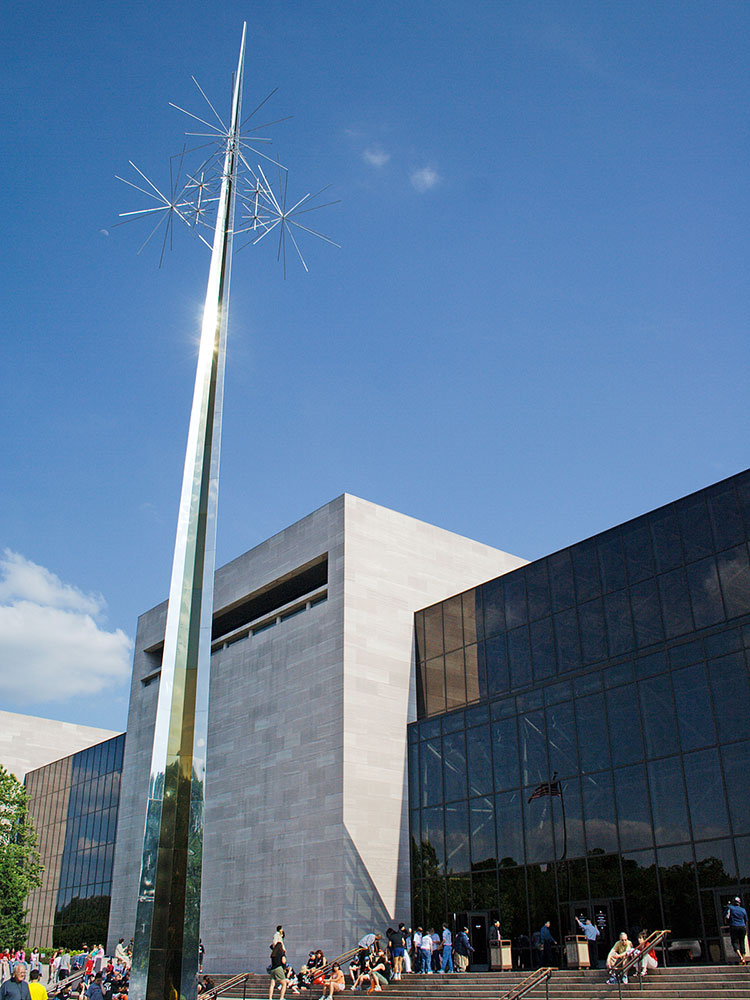

A world-renowned museum showcasing extensive collections of fossils, minerals, gemstones, cultural artifacts, human origins exhibits, wildlife specimens, and scientific discoveries spanning Earth's history.
General Information
- Hours:
- Daily: 10:00am to 5:30pm
Closed December 25
Last entry is typically permitted until closing time - Fees:
-
Free admission
Some special exhibitions may require separate paid tickets - Pet Policy:
- Pets are not allowed inside the museum
- Closest cities with hotels:
- Washington, DC
- Seasons:
- All year; spring and fall generally offer the most comfortable weather for exploring nearby National Mall attractions
- Location:
- 10th Street and Constitution Avenue NW, Washington, DC 20560
- Website:
- naturalhistory.si.edu
How to Get There
From Arlington, VA (5 mi): Take I-395 or US-50 into Washington, DC, continue toward the National Mall, and proceed to 10th Street NW and Constitution Avenue NW where the museum is located.
Overview
The National Museum of Natural History, opened in 1910 on the National Mall, is one of the most visited museums in the world, with more than 146 million specimens and artifacts. People come to see dinosaur skeletons, the Hope Diamond, a giant ocean hall, live insects, and a large African elephant that greets visitors in the rotunda, all in a museum that is also a leading research institution. Admission is free, and the exhibits are spread across several floors, so most visitors pick a few halls rather than see everything in a single visit.
David H. Koch Hall of Fossils - Deep Time
Deep Time traces 3.7 billion years of life on Earth, from the earliest microbes through the age of dinosaurs and the ice age to the present. Fossil skeletons of dinosaurs such as Tyrannosaurus rex, Triceratops, and Diplodocus are shown alongside marine reptiles, giant sloths, and mammoths, and the exhibit connects past extinctions and climate change to the modern world.
Janet Annenberg Hooker Hall of Geology, Gems, and Minerals
This hall presents the National Gem and Mineral Collection, including crystals, meteorites, and some of the world's most famous gemstones, along with exhibits on volcanoes, earthquakes, plate tectonics, and the formation of rocks. The gem gallery is described below.
Sant Ocean Hall
The Sant Ocean Hall explores the diversity of marine life and the ocean's role in the planet's systems. A life-size model of a North Atlantic right whale hangs overhead, and displays include a giant squid specimen, a living coral reef, and exhibits on ocean exploration and the effects of human activity.
Kenneth E. Behring Family Hall of Mammals
More than 270 taxidermy mammals are shown in lifelike habitat scenes, from African savannas to the Arctic, along with fossil mammals showing how the group evolved over 65 million years. The hall covers adaptations, survival, and the effects of climate change on mammals.
David H. Koch Hall of Human Origins
The Hall of Human Origins follows the story of human evolution over six million years through fossil skulls, tools, and reconstructions of early human ancestors. Interactive displays explore how climate and environment shaped our species.
Bone Hall
The Bone Hall, a long-running favorite with families, displays skeletons of mammals, birds, reptiles, and other vertebrates side by side so visitors can compare how bone structure varies across species, including humans, gorillas, and whales.
Ancient Egypt
This exhibit explores life and death in ancient Egypt with mummies, coffins, funerary objects, and artifacts from burials. It explains mummification and the beliefs about the afterlife that shaped Egyptian culture.
O. Orkin Insect Zoo and Butterfly Pavilion
The Insect Zoo houses live tarantulas, ants, bees, and other arthropods, with staff-led feeding demonstrations at set times. The adjoining Butterfly Pavilion is a tropical greenhouse where visitors walk among free-flying butterflies; it requires a separate timed ticket.
World-Renowned Objects
Several items in the collection are known worldwide. Among them are:
- Hope Diamond: a 45.52-carat deep blue diamond that is among the most famous gems in the world, with a long history of royal and private owners before it was donated by Harry Winston in 1958
- Star of Asia: a large star sapphire in the gem collection
- Fenykovi elephant: a large African bush elephant mount standing in the rotunda, one of the largest on display anywhere
- Tyrannosaurus rex: the "Nation's T. rex" skeleton, on long-term loan from the U.S. Army Corps of Engineers, featured in Deep Time
- Giant squid: a rare preserved specimen in the Sant Ocean Hall
This article uses material from the Wikipedia article "National Museum of Natural History" and the museum's official website, naturalhistory.si.edu. The Wikipedia material is released under the Creative Commons Attribution-Share-Alike License 3.0.