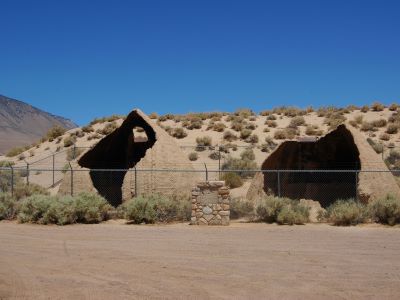

Two 1870s beehive charcoal kilns near the shore of Owens Lake that once fueled the silver smelters of the Cerro Gordo mines.
General Information
- Hours:
- Open daily; daylight hours recommended
- Fees:
- No entrance or parking fees
- Pet Policy:
- Pets allowed on a leash
- Closest cities with hotels:
- Lone Pine, CA (about 20 mi)
- Seasons:
- Fall through spring; summer days can be extremely hot
- Location:
- Cottonwood Charcoal Kilns, off US-395 near Cartago, CA
- Website:
- en.wikipedia.org
How to Get There
From Lone Pine (about 20 mi): Take US-395 south along the western edge of Owens Lake. A short dirt road leads east from the highway to the kilns, north of the small community of Cartago.
Overview
The Cottonwood Charcoal Kilns are a pair of large beehive-shaped kilns on the western edge of Owens Lake, south of Lone Pine in the Owens Valley. Built of stone and brick in the 1870s, they turned wood from the nearby Sierra Nevada into charcoal for the silver smelters of the Cerro Gordo mines in the Inyo Mountains across the lake. Today the kilns stand alone on the open desert floor, with the Sierra Nevada rising behind them, and they are a short, easy stop for travelers on US-395.
History
Silver was discovered at Cerro Gordo, high in the Inyo Mountains east of Owens Lake, in the 1860s, and by the 1870s its smelters needed huge amounts of charcoal, while the surrounding desert had almost no trees. In 1876 Colonel Sherman Stevens built a sawmill high on Cottonwood Creek in the Sierra Nevada and a flume to carry logs down the mountain to these kilns, where the wood was slowly burned into charcoal. The charcoal was then hauled across Owens Lake by steamboat to the far shore and carried up to the smelters. When Cerro Gordo's ore began to run out in the late 1870s, the kilns were abandoned. Owens Lake itself later dried up after the Los Angeles Aqueduct began diverting the Owens River in 1913.
Things to Do
See the Kilns
Walk around the two massive kilns and look through their openings at the brick interiors. The structures are fragile, so do not climb on them.
Take in the Views
The kilns stand on the open desert with the Sierra Nevada rising sharply behind them and the dry bed of Owens Lake stretching to the east.
Watch Birds on Owens Lake
Shallow-water areas on the lake bed now attract migrating shorebirds, and the Owens Lake Bird Festival is held each spring.
Explore More of US-395
The Olancha Sculpture Garden and Fossil Falls are to the south, and Lone Pine and the Alabama Hills are to the north.
This article uses material from the Wikipedia article "Cottonwood Charcoal Kilns", which is released under the Creative Commons Attribution-Share-Alike License 3.0.