Huntington Library

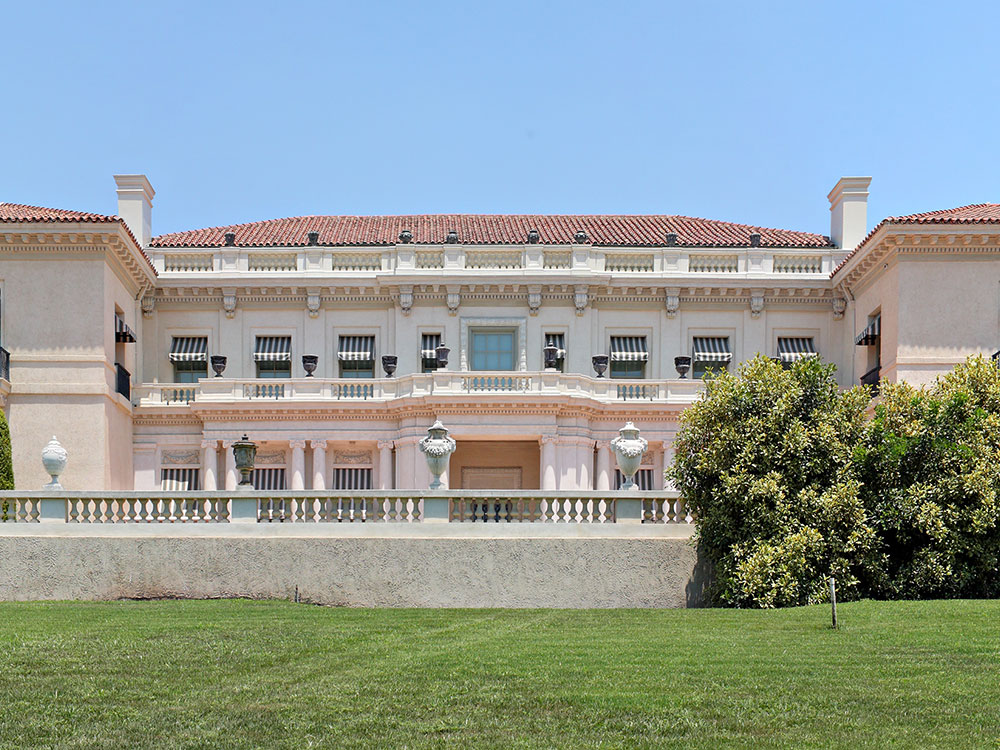
Huntington Library building exterior in San Marino, Los Angeles area

Guerinf, CC BY-SA 4.0, via Wikimedia Commons; Image Size Adjusted

Collections-based educational and research institution houses an extensive art collection with a focus on 18th- and 19th-century European art and 17th- to mid-20th-century American art.

General Information

Hours:
Wednesday to Monday: 10am to 5pm
Closed Tuesday
Check-in closes at 4:15pm
Fees:
Adults: $29 (weekdays) / $34 (weekends & peak)
Seniors (65+): $24–$28
Students (12–18): $24–$28
Children (4–11): $13–$15
Children under 4: Free
Pet Policy:
Pets are not allowed
Closest cities with hotels:
Pasadena (5 mi), Los Angeles (10 mi)
Seasons:
Open year-round; best in spring for blooming gardens and fall for mild weather
Location:
1151 Oxford Rd, San Marino, CA 91108
Website:
huntington.org

From Pasadena (5 mi): Take CA-110 S toward Los Angeles, exit at Orange Grove Blvd, head east, then turn right onto Allen Ave and continue to Oxford Rd to reach the entrance of The Huntington.

The Huntington Library, Art Museum and Botanical Gardens, known as The Huntington, is a collections-based educational and research institution established by Henry E. Huntington (1850-1927) and Arabella Huntington (c.1851-1924) and located in San Marino, California. In addition to the library, the institution houses an extensive art collection with a focus on 18th- and 19th-century European art and 17th- to mid-20th-century American art. The property also includes approximately 120 acres (49 ha) of specialized botanical landscaped gardens, most notably the "Japanese Garden", the "Desert Garden", and the "Chinese Garden" (Liu Fang Yuan).

Formerly the residence of Henry E. Huntington (1850-1927) and his wife, Arabella Huntington (1850-1924), the Huntington Art Gallery opened in 1928.

With an endowment of more than $400 million (and half a billion dollars raised between 2001 and 2013), the Huntington is among the wealthiest cultural institutions in the United States.

The library building was designed in 1920 by the southern California architect Myron Hunt in the Mediterranean Revival style. Hunt's previous commissions for Mr. and Mrs. Huntington included the Huntington's residence in San Marino in 1909, and the Huntington Hotel in 1914. The library contains a substantial collection of rare books and manuscripts, concentrated in the fields of British and American history, literature, art, and the history of science. Spanning from the 11th century to the present, the library's holdings contain 7 million manuscript items, over 400,000 rare books, and over a million photographs, prints, and other ephemera. Highlights include one of eleven vellum copies of the Gutenberg Bible known to exist, the Ellesmere manuscript of Chaucer (ca. 1410), and letters and manuscripts by George Washington, Thomas Jefferson, Benjamin Franklin, and Abraham Lincoln. It is the only library in the world with the first two quartos of Hamlet; it holds the manuscript of Benjamin Franklin's autobiography, Isaac Newton's personal copy of his Philosophiae Naturalis Principia Mathematica with annotations in Newton's own hand, the first seven drafts of Henry David Thoreau's Walden, John James Audubon's Birds of America, and first editions and manuscripts from authors such as Charles Bukowski, Jack London, Alexander Pope, William Blake, Mark Twain, and William Wordsworth.

The Library's Main Exhibition Hall showcases some of the most outstanding rare books and manuscripts in the collection, while the West Hall of the Library hosts rotating exhibitions. The Dibner Hall of the History of Science is a permanent exhibition on the history of science with a focus on astronomy, natural history, medicine, and light.

With the 2006 acquisition of the Burndy Library, a collection of nearly 60,000 items, the Huntington became one of the top institutions in the world for the study of the history of science and technology.

The Huntington's collections are displayed in permanent installations housed in the Huntington Art Gallery and Virginia Steele Scott Gallery of American Art. Special temporary exhibitions are mounted in the MaryLou and George Boone Gallery, with smaller, focused exhibitions displayed in the Works on Paper Room in the Huntington Art Gallery and the Susan and Stephen Chandler Wing of the Scott Galleries. In addition the gallery also hosts different exhibitions of photography throughout the year including those about different social and political subjects.

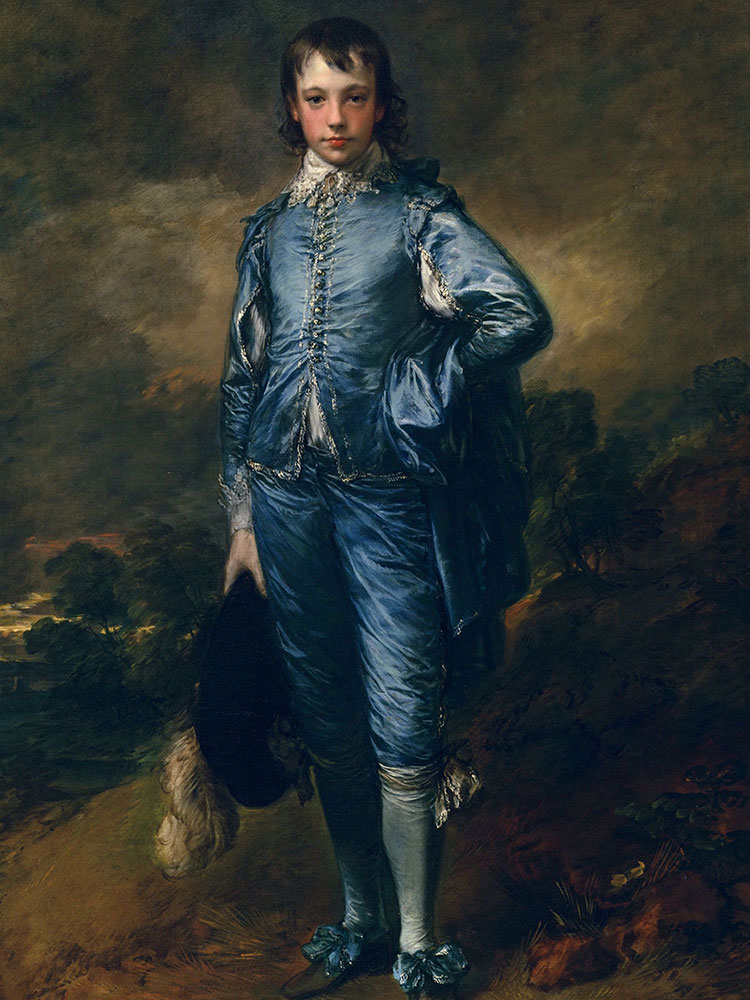
The European collection, consisting largely of 18th- and 19th-century British & French paintings, sculptures and decorative arts, is housed in The Huntington Art Gallery, the original Huntington residence. The permanent installation also includes selections from the Arabella D. Huntington Memorial Art Collection, which contains Italian and Northern Renaissance paintings and a spectacular collection of 18th-century French tapestries, porcelain, and furniture. Some of the best known works in the European collection include The Blue Boy by Thomas Gainsborough, Pinkie by Thomas Lawrence, and Madonna and Child by Rogier van der Weyden.

Complementing the European collections is the Huntington's American art holdings, a collection of paintings, prints, drawings, sculptures, and photographs dating from the 17th to the mid-20th century. The institution did not begin collecting American art until 1979, when it received a gift of 50 paintings from the Virginia Steele Scott Foundation. Consequently, The Virginia Steele Scott Gallery of American Art was established in 1984. In 2009, the Virginia Steele Scott Galleries were expanded, refurbished, and reinstalled. The new showcase, a $1.6 million project designed to give the Huntington's growing American art collection more space and visibility, combines the original, 1984 American gallery with the Lois and Robert F. Erburu Gallery, a modern classical addition designed by Los Angeles architect Frederick Fisher. Highlights among the American art collections include Breakfast in Bed by Mary Cassatt, The Long Leg by Edward Hopper, Small Crushed Campbell's Soup Can (Beef Noodle) by Andy Warhol, and Global Loft (Spread) by Robert Rauschenberg. As of 2014, the collection numbers some 12,000 works, ninety percent of them drawings, photographs and prints.

In 2014, the library acquired the Millard Sheets mural Southern California landscape (1934), the dining room wall painting originally painted for homeowners Fred H. and Bessie Ranke in the Hollywood Hills of Los Angeles.

The Huntington's botanical gardens cover 120 acres (49 ha) and showcase plants from around the world. Huntington worked to make them thrive in the generous California climate. Today his many projects of horticulture live on, providing opportunities for botanical research and for enjoyment. The gardens are divided into more than a dozen themes, including the Australian Garden, Camellia Collection, Children's Garden, Desert Garden, Herb Garden, Japanese Garden, Lily Ponds, North Vista, Palm Garden, Rose Garden, the Shakespeare Garden, Subtropical and Jungle Garden, and the Chinese Garden (Liu Fang Yuan 流芳園 or the Garden of Flowing Fragrance).

The Rose Hills Foundation Conservatory for Botanical Science has a large tropical plant collection, as well as a carnivorous plants wing.

The Camellia Collection, recognized as an International Camellia Garden of Excellence, includes nearly eighty different camellia species and some 1,200 cultivated varieties, many of them rare and historic. The Rose Garden contains approximately 1,200 cultivars (4,000 individual plants) arranged historically to trace the development of roses from ancient to modern times.

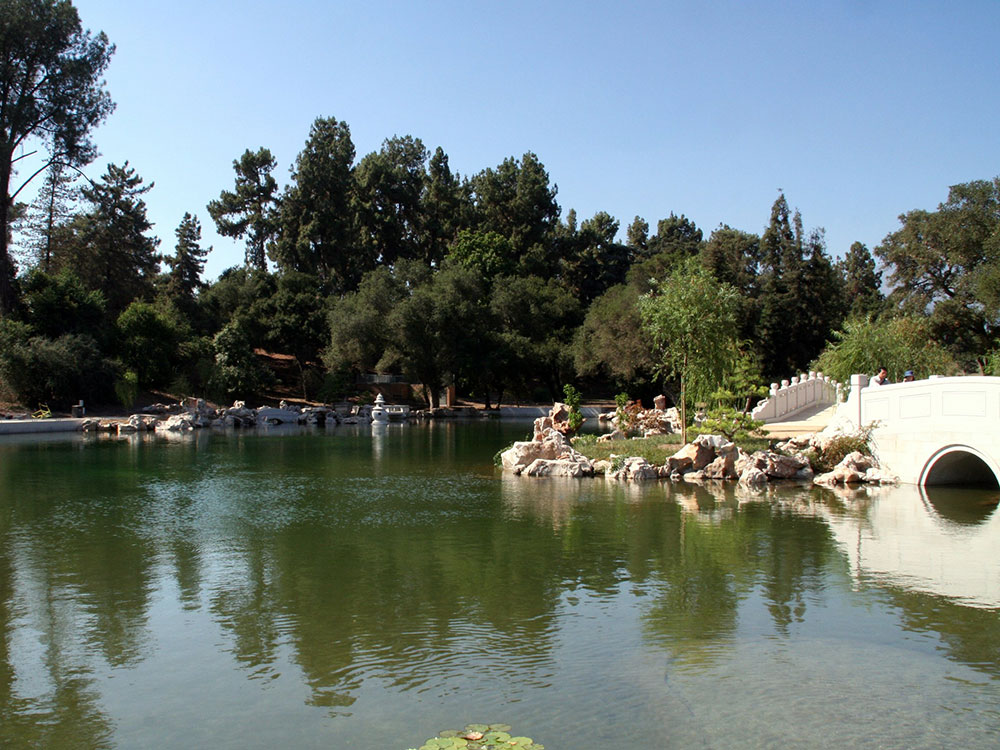
A Chinese garden, the largest outside of China, was dedicated on February 26, 2008 after artisans from Suzhou, China spent some six months at Huntington to construct the first phase of the newest facility. On 12 acres (4.9 ha) at the northwest corner of the Huntington, the garden features man-made lakes ("Pond of Reflected Greenery" and "Lake of Reflected Fragrance") with pavilions connected by bridges. Unique Chinese names are assigned to many of the facilities in the garden, such as the tea house, known as the "Hall of the Jade Camellia". Other pavilions are the "Love for the Lotus Pavilion", "Terrace of the Jade Mirror", and "Pavilion of the Three Friends".

The second phase, which includes the "Clear and Transcendent Pavilion (Qing Yue Tai 清越臺)", "Lingering Clouds Peak (Liu Yun Xiu 留雲岫)" (with a waterfall), "Waveless Boat (Bu Bo Xiao Ting 不波小艇)", "Crossing through Fragrance" bridge and the "Cloud Steps" bridge, opened on March 8, 2014. There were other pavilions, including the "Flowery Brush Studio", and structures completed under phase two. A place to display its large collections of penjing and bonsai has completed.

The Desert Garden, one of the world's largest and oldest outdoor collections of cacti and other succulents, contains plants from extreme environments, many of which were acquired by Henry E. Huntington and William Hertrich (the garden curator). One of the Huntington's most botanically important gardens, the Desert Garden, brings together a plant group largely unknown and unappreciated in the beginning of the 1900s. Containing a broad category of xerophytes (aridity-adapted plants), the Desert Garden grew to preeminence and remains today among the world's finest, with more than 5,000 species.

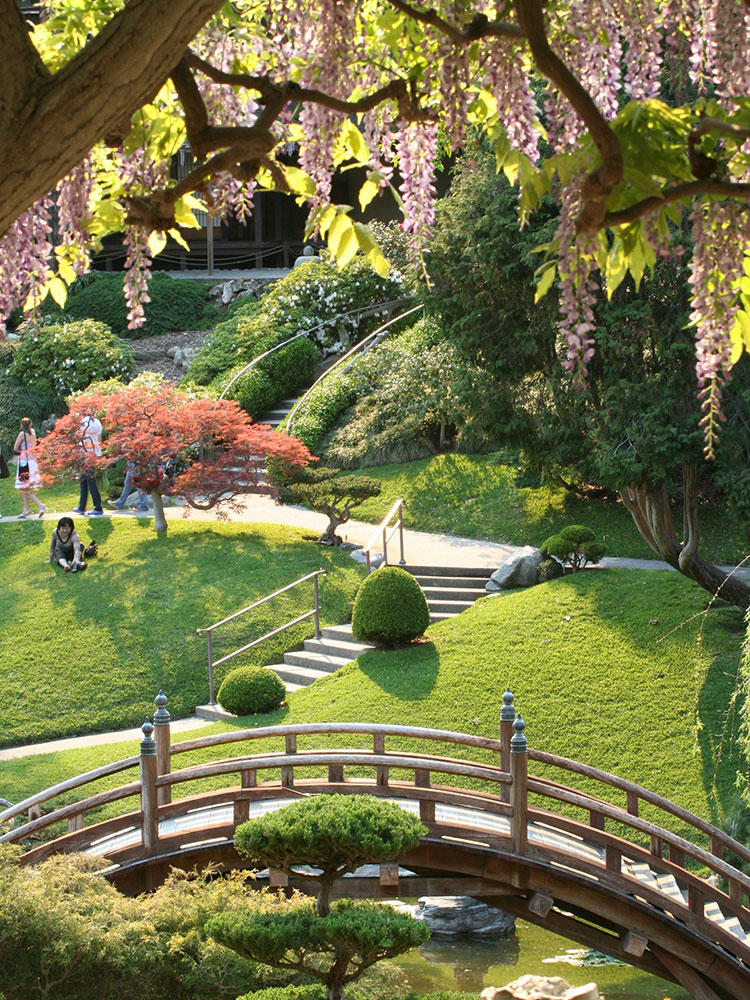
In 1911, art dealer George Turner Marsh (who also created the Japanese Tea Garden at the Golden Gate Park) sold his commercial Japanese tea garden to Henry E. Huntington to create the foundations of what is known today as the Japanese Garden. The garden was completed in 1912 and opened to the public in 1928. According to historian Kendall Brown, the garden consists of three gardens: the original stroll garden with koi-filled ponds and a drum or moon bridge, the raked-gravel dry garden added in 1968, and the traditionally landscaped tea garden.

In addition, the gardens feature a large bell, the authentic ceremonial teahouse Seifu-an (the Arbor of Pure Breeze), a fully furnished Japanese house, the Zen Garden, and the bonsai collections with hundreds of trees. The Bonsai Courts at the Huntington is the home of the Golden State Bonsai Federation Southern Collection. Another ancient Japanese art form can be found at the Harry Hirao Suiseki Court, where visitors can touch the suiseki or viewing stones.

  • Australian Garden
  • Camellia Garden
  • Children's Garden
  • Conservatory
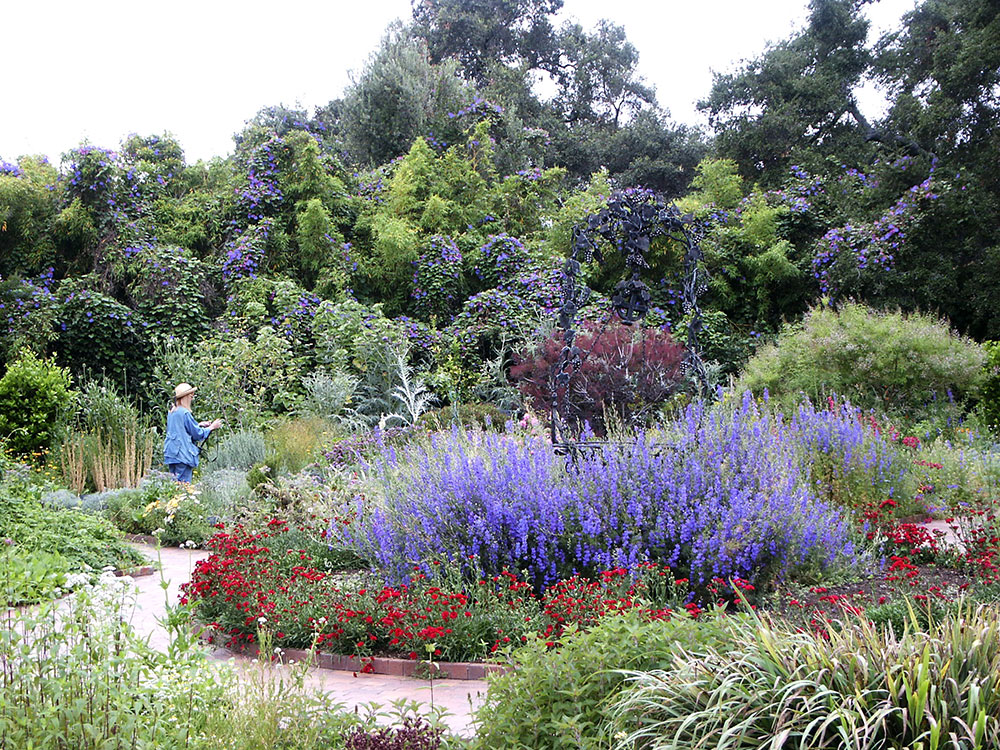
  • Herb Garden
  • Jungle Garden
  • Lily Ponds
  • Palm Garden
  • Ranch Garden
  • Rose Garden
  • Shakespeare Garden
  • Subtropical Garden

This article uses material from the Wikipedia article "Huntington Library", which is released under the Creative Commons Attribution-Share-Alike License 3.0
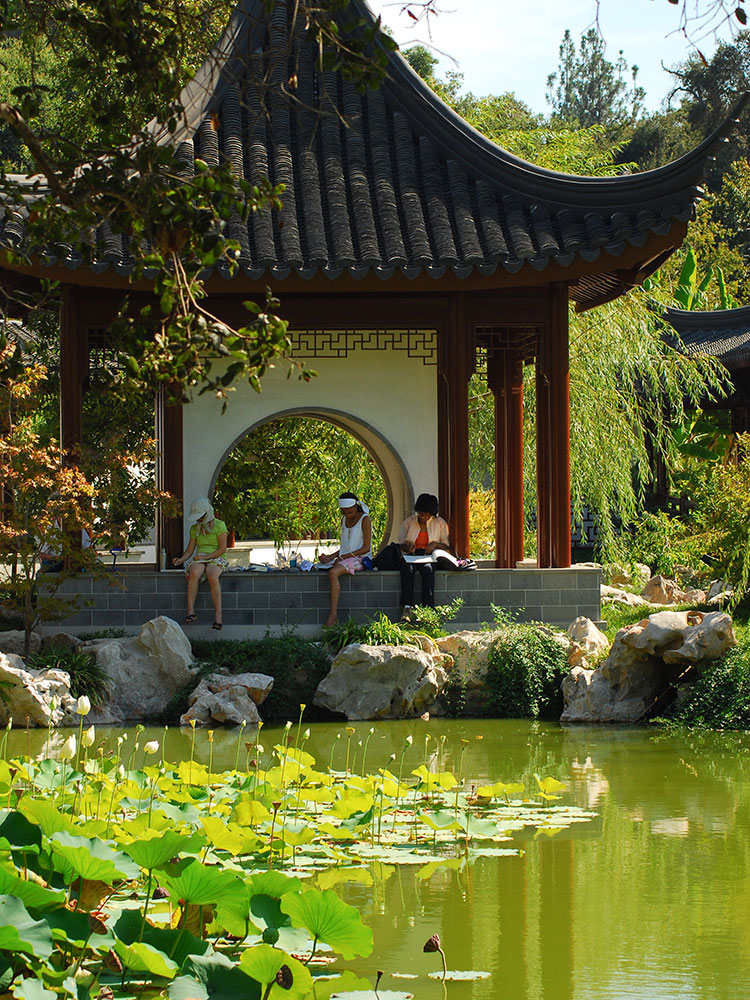
Chinese Garden at the Huntington Library in San Marino, California
Eric Chan from Hollywood, United States, CC BY 2.0, via Wikimedia Commons ; Image Size Adjusted
Spring blooms in the Herb Garden at the Huntington Library, San Marino
Pamla J. Eisenberg from USA, CC BY-SA 2.0, via Wikimedia Commons; Image Size Adjusted
Art gallery inside the Huntington Library in San Marino, California
Mfield, Matthew Field, http://www.photography.mattfield.com, CC BY-SA 3.0, via Wikimedia Commons ; Image Size Adjusted
Japanese Garden at the Huntington Library in San Marino, California
Plane777 at English Wikipedia, Public domain, via Wikimedia Commons ; Image Size Adjusted
Chinese garden pagoda and pond at the Huntington Library, San Marino
Plane777 at English Wikipedia, Public domain, via Wikimedia Commons ; Image Size Adjusted
Huntington Library building facade in San Marino, California
Guerinf, CC BY-SA 4.0, via Wikimedia Commons; Image Size Adjusted
The Blue Boy painting by Thomas Gainsborough at the Huntington Library
Thomas Gainsborough, Public domain, via Wikimedia Commons ; Image Size Adjusted