Getty Museum

Exterior view of the Getty Center museum in Los Angeles, California

Museum well known for its architecture, gardens, and views overlooking Los Angeles, featuring pre-20th-century European paintings, drawings, sculpture, and decorative arts; and photographs from the 1830s through present day from all over the world

General Information
Hours:
Open Tuesday to Friday 10am to 5pm
Closed Mondays
Holiday Closures
Closed annually on New Year's Day, Independence Day, Thanksgiving Day, and Christmas Day
Fees:
Free Admission
Admission is free, though temporarily requires a timed-entry reservation.
Parking
There is no street parking available near the Getty Center.
Parking reservations are not required or accepted.
Parking Fee
Parking is $20 per car or motorcycle; $15 after 3 pm.
For evening events and on Saturdays, parking is $10 after 6 pm.
Pet Policy:
No pets allowed
Closest cities with hotels:
Los Angeles
Seasons:
All year
Location:
350 South Grand Avenue, Los Angeles 90071
Website:
Rating:
5.0
Los Angeles, CA Weather Forecast

Get on CA-110 from W 1st St. Take I-10 W and I-405 N to N Sepulveda Blvd. Take exit 57B from I-405 N. Continue on N Sepulveda Blvd. Drive to Getty Center Dr.

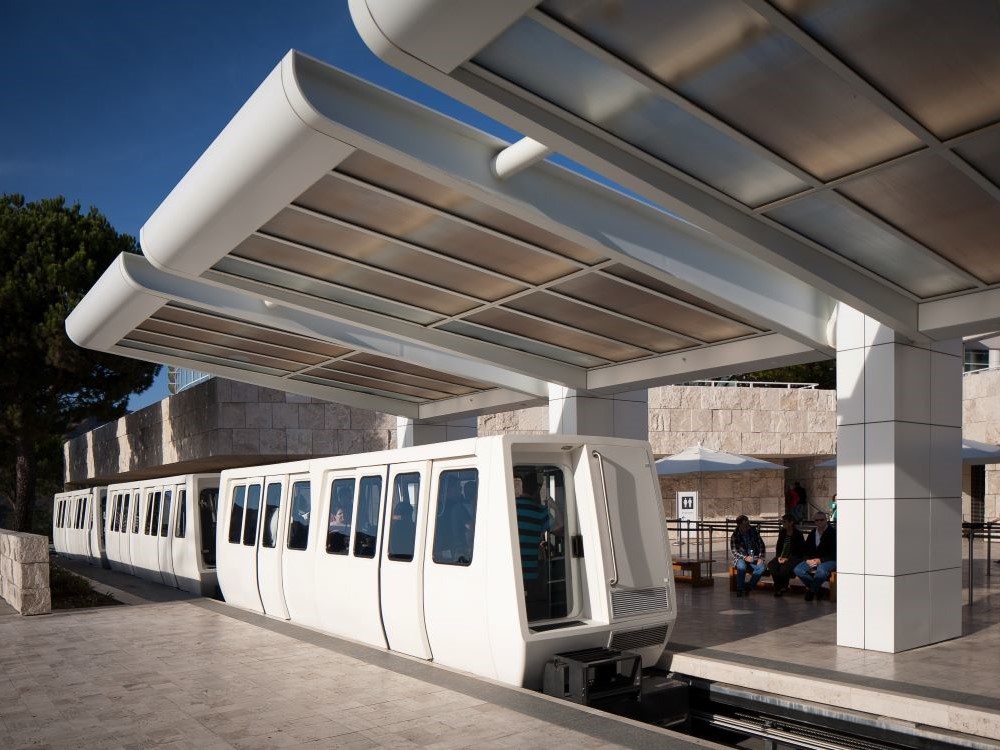
The Getty Center, in Los Angeles, is a campus of the Getty Museum and other programs of the Getty Trust. The $1.3 billion Center opened to the public on December 16, 1997 and is well known for its architecture, gardens, and views overlooking Los Angeles. The Center sits atop a hill connected to a visitors' parking garage at the bottom of the hill by a three-car, cable-pulled hovertrain people mover.

Located in the Brentwood neighborhood of Los Angeles, the Center is one of two locations of the J. Paul Getty Museum and draws 1.8 million visitors annually. (The other location is the Getty Villa in the Pacific Palisades neighborhood of Los Angeles, California.) The Center branch of the Museum features pre-20th-century European paintings, drawings, illuminated manuscripts, sculpture, and decorative arts; and photographs from the 1830s through present day from all over the world. In addition, the Museum's collection at the Center includes outdoor sculpture displayed on terraces and in gardens and the large Central Garden designed by Robert Irwin. Among the artworks on display is the Vincent van Gogh painting Irises.

Designed by architect Richard Meier, the campus also houses the Getty Research Institute (GRI), the Getty Conservation Institute, the Getty Foundation, and the J. Paul Getty Trust. The Center's design included special provisions to address concerns regarding earthquakes and fires.

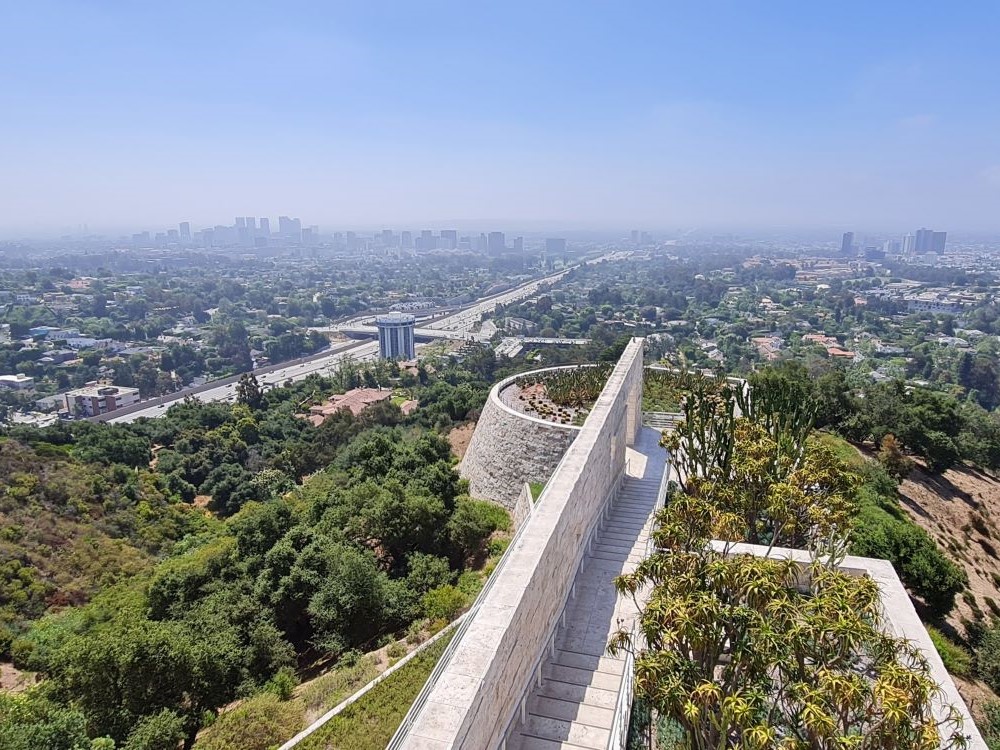
Originally, the Getty Museum started in J. Paul Getty's house located in Pacific Palisades in 1954. He expanded the house with a museum wing. In the 1970s, Getty built a replica of an Italian villa on his home's land to better house his collection, which opened in 1974. After Getty's death in 1976, the entire property was turned over to the Getty Trust for museum purposes. However, the collection outgrew the site, which has since been renamed the Getty Villa, and management sought a location more accessible to Los Angeles. The purchase of the land upon which the center is located, a campus of 24 acres (9.7 ha) on a 110-acre (45 ha) site in the Santa Monica Mountains above Interstate 405, surrounded by 600 acres (240 ha) kept in a natural state, was announced in 1983. The top of the hill is 900 feet (270 m) above sea level, high enough that on a clear day it is possible to see not only the Los Angeles skyline but also the San Bernardino Mountains, and San Gabriel Mountains to the east as well as the Pacific Ocean to the west. In 1984, Richard Meier was chosen to be the architect of the center.

The center ultimately opened to the public on December 16, 1997. After the center opened, the villa closed for extensive renovations and reopened on January 28, 2006, to focus on the arts and cultures of ancient Greece, Rome, and Etruria. Currently, the museum displays collections at both the Getty Center and the Getty Villa in Pacific Palisades.

The Museum has a seven-story deep underground parking garage with over 1,200 parking spaces. Its roof has an outdoor sculpture garden. An automated three-car, cable-pulled hovertrain people mover, the "Getty Center Tram", takes passengers between the parking garage at the bottom of the hill and the Museum at the top of the hill.

Visitors typically arrive at a tram station in the arrival plaza located between the administrative buildings and the Museum entrance. A large set of steps leads to the main doors of the rotunda building. The rotunda building houses information desks, two orientation theatres and Museum shops. It also holds a grand staircase that starts a path toward the paintings located on the second floor of each art pavilion. The rotunda opens to the south to a terrace that links all five of the Museum pavilions. A separate building to the west of the arrival plaza and stairs holds a cafeteria and restaurant. Next to the restaurant is a stone arch, which separates the Museum from the GRI. Stairs from the terrace connecting the GRI and the restaurant lead down to the central garden.

The Getty Center, in Los Angeles, California, is a campus of the Getty Museum and other programs of the Getty Trust. The $1.3 billion Center opened to the public on December 16, 1997 and is well known for its architecture, gardens, and views overlooking Los Angeles. The Center sits atop a hill connected to a visitors' parking garage at the bottom of the hill by a three-car, cable-pulled hovertrain people mover. The Getty Center also has a 7-story underground parking garage for visitors use as they visit the Center.

The Museum building consists of a three-level base building that is closed to the public and provides staff workspace and storage areas. Five public, two-story towers on the base are called the North, East, South, West and the Exhibitions Pavilions. The Exhibitions Pavilion acts as the temporary residence for traveling art collections and the Foundation's artwork for which the permanent pavilions have no room. The permanent collection is displayed throughout the other four pavilions chronologically: the north houses the oldest art while the west houses the newest. The first-floor galleries in each pavilion house light-sensitive art, such as illuminated manuscripts, furniture, or photography. Computer-controlled skylights on the second-floor galleries allow paintings to be displayed in natural light. The second floors are connected by a series of glass-enclosed bridges and open terraces, both of which offer views of the surrounding hillsides and central plaza. Sculpture is also on display at various points outside the buildings, including on various terraces and balconies. The lower level (the highest of the floors in the base) includes a public cafeteria, the terrace cafe, and the photography galleries.

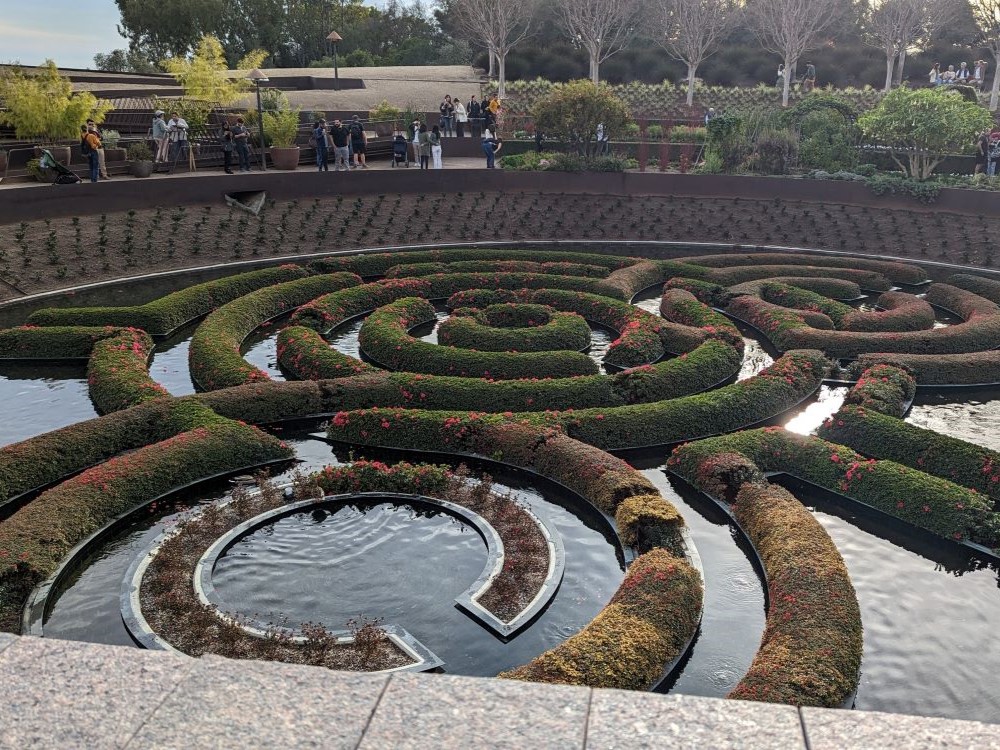
The 134,000-square-foot Central Garden at the Getty Center is the work of artist Robert Irwin. Planning for the garden began in 1992, construction started in 1996, and the garden was completed in December 1997.

Irwin was quoted as saying that the Central Garden "is a sculpture in the form of a garden, which aims to be art." Water plays a major role in the garden. A fountain near the restaurant flows toward the garden and appears to fall into a grotto on the north garden wall. The resulting stream then flows down the hillside into the azalea pool. The designers placed rocks and boulders of varying size in the stream bed to vary the sounds from the flowing water. A tree-lined stream descends to a plaza, while the walkway criss-crosses the stream, which continues through the plaza, and goes over a stone waterfall into a round pool. A maze of azaleas floats in the pool, around which is a series of specialty gardens. More than 500 varieties of plant material are used for the Central Garden, but the selection is "always changing, never twice the same". After the original design, an outdoor sculpture garden, called the "Lower Terrace Garden" was added in 2007 on the west side of the central garden just below the scholar's wing of the GRI building.

The Getty Research Institute (GRI) is "dedicated to furthering knowledge and advancing understanding of the visual arts." Among other holdings, GRI's research library contains over 900,000 volumes of books, periodicals, and auction catalogs; special collections; and two million photographs of art and architecture. GRI's other activities include exhibitions, publications, and a residential scholars program. At the Getty Center, GRI is located to the west of the Museum.The round building encircles a landscaped garden and is located to the west of the central garden. The main entrance of GRI is connected by a terrace to the main arrival court of the Museum, with outdoor sculptures placed along the route. GRI has one art gallery on its entrance level that is open to the public.

Meier also designed three other buildings located next to the north promontory and offset at a 22.5 degree angle from the main axis of the Museum pavilions. The north-most building is an auditorium. Next to it is the North Building, with the East Building sitting between the North Building and the rotunda. The main entrance to the East Building is flanked by two round silos that hold its elevators. A bridge over a sunken courtyard links the main entrance of the East Building to the main walkway that connects the auditorium and North Buildings to the rotunda. These buildings house the Getty Conservation Institute (GCI), the J. Paul Getty Trust and the Getty Foundation. These buildings are generally closed to the public except for special events held in the auditorium. They are linked to the Museum both by landscaped terraces and by an enclosed glass walkway that leads from the main rotunda.

This article uses material from the Wikipedia article "Getty Center", which is released under the Creative Commons Attribution-Share-Alike License 3.0
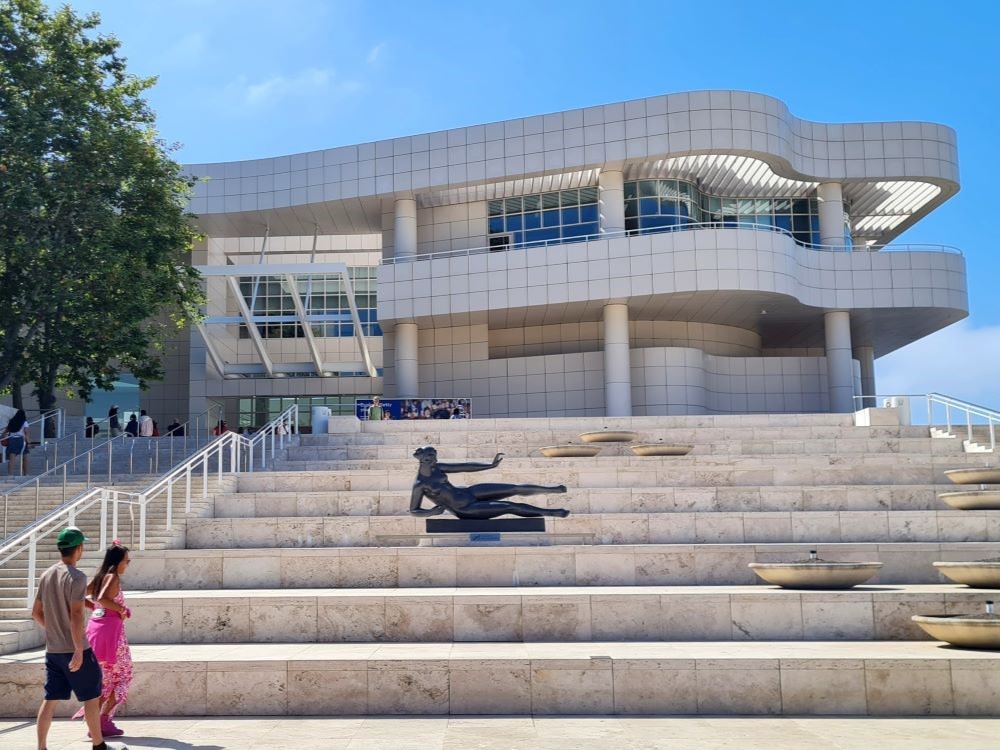
Stairway at the Getty Center museum in Los Angeles
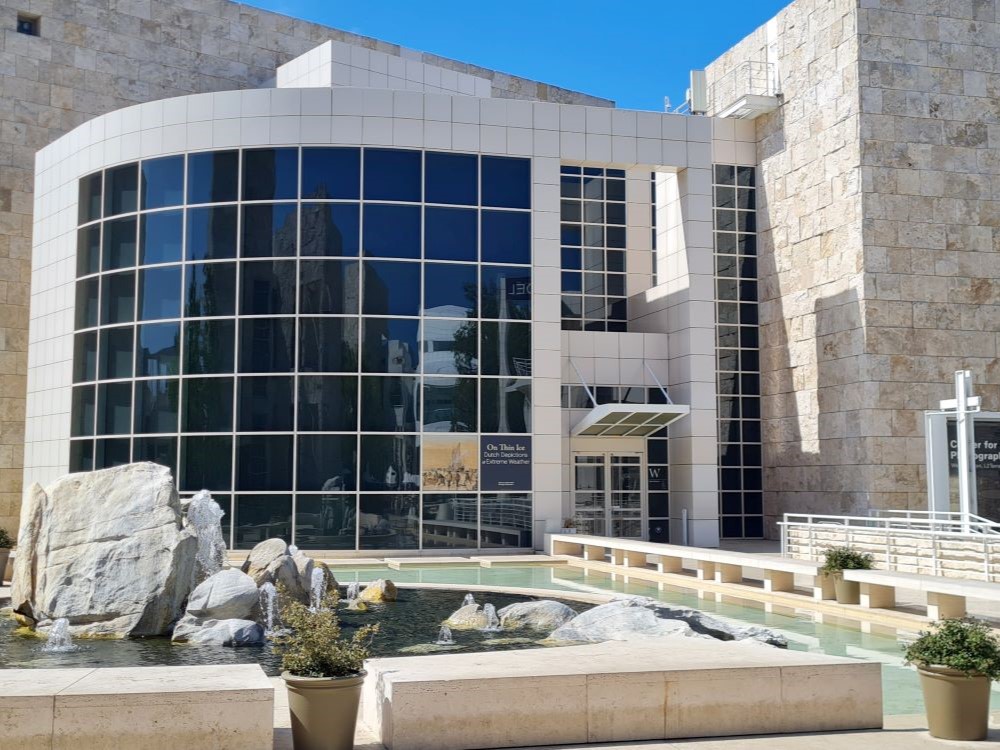
Getty Center museum galleries and courtyard in Los Angeles
Manicured hedges and garden at the Getty Center, Los Angeles
Cactus garden at the Getty Center in Los Angeles, California
Los Angeles city skyline viewed from the Getty Center