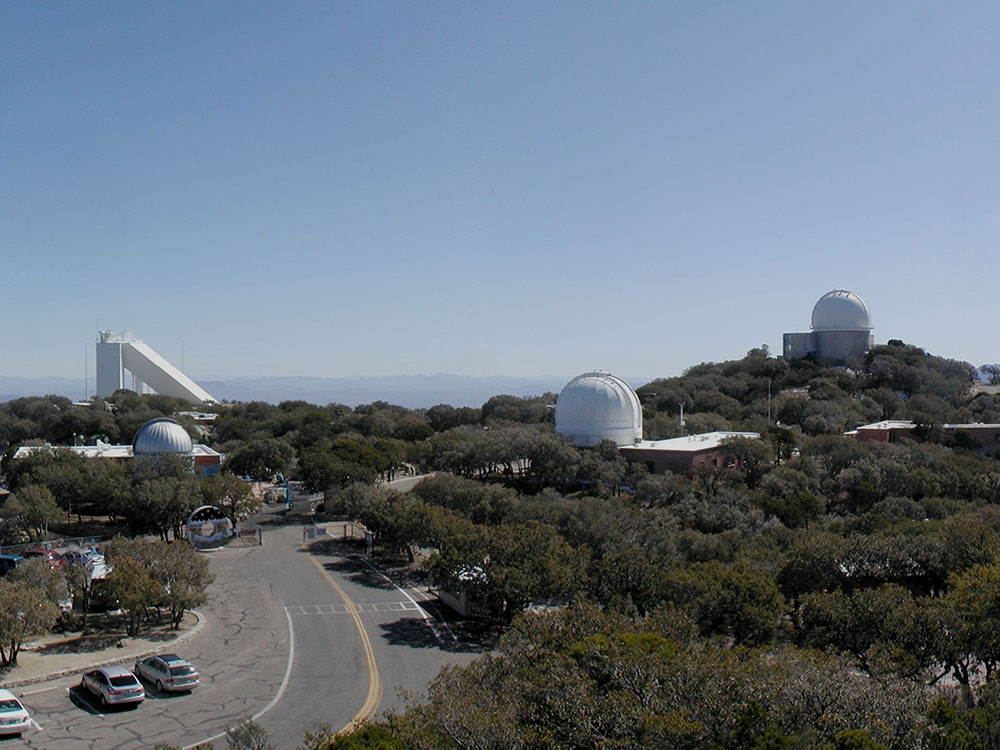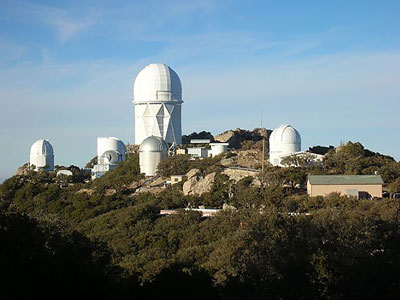

Mountain-top research facility housing one of the world’s largest collections of optical and radio telescopes, offering public tours and stargazing programs.
General Information
- Hours:
-
Visitor Center: Daily 9:00am to 4:00pm
Daytime Tours: 10:00am, 11:30am, and 1:30pm
Night Programs: Begin before sunset; advance reservations required - Fees:
-
Daytime Tour: $19.95 (regular), $15.95 (discounted)
Discounts for seniors (62+), students, military, and groups of 8+
Night Programs: Starting at $50 per person depending on program - Pet Policy:
- Pets are not allowed in buildings; permitted on leashes in outdoor areas only
- Closest cities with hotels:
- Tucson, AZ (56 mi)
- Seasons:
- Late spring through early summer for best visibility; open year-round
- Location:
- Kitt Peak National Observatory
- Website
- kpno.noirlab.edu
How to Get There
From Tucson, AZ (56 mi): Take AZ-86 W (Ajo Way) for 39 miles, turn left onto AZ-386 S, and follow the winding road 12 miles to the summit and Visitor Center.
Overview
Kitt Peak National Observatory sits atop Kitt Peak in the Quinlan Mountains on the Tohono O’odham Nation, about 55 miles west-southwest of Tucson. Founded in 1958, it is one of the largest gatherings of astronomical instruments in the northern hemisphere, with more than twenty optical and two radio telescopes, and it welcomes the public for tours and observing programs.
Visitor Programs
- Daytime tours: the history of the observatory and a visit to a major research telescope.
- Nightly Observing Program: arrive in late afternoon, watch the sunset and view the sky through binoculars and telescopes.
- Overnight Telescope Observing Program: a one-on-one, full night of observing with the visitor center’s telescopes.
Kitt Peak’s telescopes have made notable discoveries, including methane ice on Pluto (1976) and the Kuiper belt object Varuna (2000), and it hosted the first telescope used to search for near-Earth asteroids. It is now overseen by NOIRLab.
History
In 1958 the Tohono O'odham Nation agreed to lease the mountain to the National Science Foundation for an observatory. The mountain, Iolkam Du'ag, is sacred to the Tohono O'odham, and the observatory has grown into one of the largest collections of telescopes in the world.
Things to Do
Take a Daytime Tour
Tours visit some of the large telescopes.
Join the Nightly Observing Program
Reserve a spot to look through a telescope at night.
Visit the Visitor Center
The visitor center has exhibits and a gift shop.
Enjoy the Drive
The road up the mountain has views of the Sonoran Desert.
This article uses material from the Wikipedia article "Kitt Peak National Observatory", which is released under the Creative Commons Attribution-Share-Alike License 3.0