
Historic waterfront settlement featuring preserved battlefield landscapes, 18th‑century architecture, museum exhibits, and a working port that mark a decisive moment in the American Revolution.
General Information
Hours for exterior grounds generally extend from sunrise to sunset
Some attractions and museums may have seasonal schedules
Museum admission and battlefield passes: Fees vary by site
National Park Service passes accepted at battlefield areas
How to Get There
From Williamsburg (13 mi): Take Colonial Parkway east toward Yorktown, continue straight through the parkway entrance, then follow signs to the historic district and waterfront.
Overview
Yorktown is a small colonial town on the York River in eastern Virginia, and it is best known as the site of the decisive victory of the American Revolution, where in October 1781 British General Lord Cornwallis surrendered to General George Washington and the French allies. The siege of Yorktown effectively ended the fighting and led to American independence. Together with Jamestown and Williamsburg, it is part of the Historic Triangle, and the Colonial Parkway connects the three.
Visitors come to Yorktown for the American Revolution Museum at Yorktown, for the Yorktown Battlefield, a unit of the Colonial National Historical Park, and for the Yorktown Victory Monument. They also come for the riverfront at Riverwalk Landing, the Yorktown Beach, and the historic buildings of the Main Street village, such as the Nelson House and the Moore House.
History
Yorktown was founded in 1691 as a port on the York River and became a busy tobacco port in the eighteenth century. In September 1781, General George Washington and the Comte de Rochambeau marched their American and French forces south to Virginia, while a French fleet under Admiral de Grasse blocked the Chesapeake Bay, trapping Cornwallis's army at Yorktown. After a three-week siege, Cornwallis surrendered on October 19, 1781, and the British band is said to have played "The World Turned Upside Down." The town was also the site of a major siege during the Peninsula Campaign of the Civil War in 1862, and the battlefield became part of the national park in 1930.
Sightseeing and Popular Landmarks
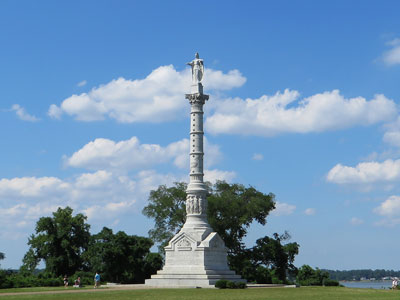
The Yorktown Battlefield has well-preserved earthworks and redoubts, as well as the Moore House, where the surrender terms were negotiated, and Surrender Field, where the British laid down their arms. The 98-foot Yorktown Victory Monument, authorized by Congress in 1781, commemorates the victory, and the Nelson House is a historic mansion, still showing a cannonball scar from the siege. Grace Church, built in 1697, and Riverwalk Landing on the waterfront are other sights.
Culture and Museums
The American Revolution Museum at Yorktown has galleries on the causes and course of the Revolution, and an outdoor living history area with a Continental Army encampment and a Revolution-era farm. The Yorktown Battlefield Visitor Center, run by the National Park Service, has a museum with Washington's field tent and a film on the siege. Yorktown Day on October 19 each year celebrates the victory with a parade and ceremonies.
Parks
The Yorktown Battlefield and the Colonial Parkway are part of Colonial National Historical Park, and the Parkway is a scenic road for driving and biking. Yorktown Beach and the York River offer swimming and fishing, and the Yorktown Riverwalk is a waterfront promenade with shops and restaurants. York River State Park and Newport News Park are nearby for hiking and camping.
Seasons and Weather
Yorktown has a humid subtropical climate. Summers are hot and humid, with highs in the upper 80s°F, and winters are mild, with highs in the 50s°F. Spring and fall are the most pleasant seasons for touring the outdoor sites, and hurricane season runs from June to November.
What to See
- Yorktown Battlefield and National Cemetery, part of Colonial National Historical Park, with earthworks dug by the American and French besiegers
- Yorktown Victory Monument, from 1884, just outside town
- Main Street, with nine pre-Revolutionary buildings such as the Nelson House and Somerwell House and Grace Episcopal Church
- Riverwalk and Water Street: restaurants, shops, a pier, and a beach on the York River
This article uses material from Wikipedia as well as information from official tourism and institutional sources. Key references include Visit Yorktown, American Revolution Museum at Yorktown, National Park Service Yorktown Battlefield, Virginia Tourism, and National Weather Service Wakefield. Wikipedia material is from the articles "Yorktown, Virginia" and "Siege of Yorktown", and is available under the Creative Commons Attribution-Share-Alike License 3.0.


