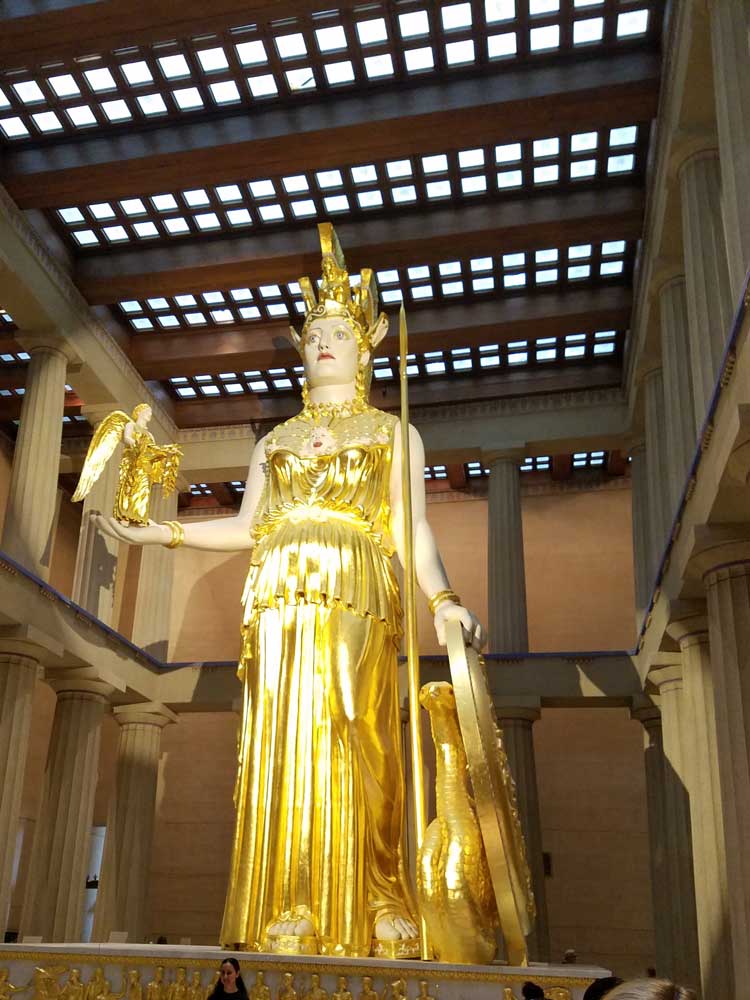
Full-scale replica of the original Parthenon in Athens, and built in 1897 as part of the Tennessee Centennial Exposition, and now functions as an art museum
General Information
Friday–Saturday: 9:00am to 4:30pm
Sunday: 12:30pm to 4:30pm
Hours may vary during special events, holidays, or maintenance closures.
Seniors (62+): Reduced admission available
Children and youth: Reduced admission available
Military, SNAP, and WIC discounts available with qualifying identification
How to Get There
From Nashville (3 mi): Take West End Avenue west from downtown Nashville, continue into Centennial Park, and follow signs to the Parthenon at 2500 West End Ave, the world's only full-scale replica of the ancient Greek Parthenon.
The Parthenon in Centennial Park, in Nashville, is a full-scale replica of the original Parthenon in Athens. It was designed by architect William Crawford Smith and built in 1897 as part of the Tennessee Centennial Exposition.
Today the Parthenon, which functions as an art museum, stands as the centerpiece of Centennial Park, a large public park just west of downtown Nashville. Alan LeQuire's 1990 re-creation of the Athena Parthenos statue in the naos (the east room of the main hall) is the focus of the Parthenon just as it was in ancient Greece. Since the building is complete and its decorations were polychromed (painted in colors) as close to the presumed original as possible, this replica of the original Parthenon in Athens serves as a monument to what is considered the pinnacle of classical architecture. The plaster replicas of the Parthenon Marbles found in the Treasury Room (the west room of the main hall) are direct casts of the original sculptures which adorned the pediments of the Athenian Parthenon, dating back to 438 BC. The surviving originals are housed in the British Museum in London and at the Acropolis Museum in Athens.
As an art museum, the Parthenon's permanent collection on the lower level is a group of 63 paintings by 19th and 20th century American artists, donated by James M. Cowan. Additional gallery spaces provide a venue for a variety of temporary shows and exhibits. The main level contains a replica, completed in 1990, of the Athena Parthenos statue that was in the original Parthenon in Athens.
The statue of Athena Parthenos is a reconstruction, to careful scholarly standards, of the long-lost original: she is cuirassed and helmeted, carries a shield on her left arm and a small 6-foot-high statue of Nike (Victory) in her right palm, and stands 42 feet high, gilt with more than 8 pounds of gold leaf; an equally colossal serpent rears its head between her and her shield.
In the summertime, local theater productions use the building as a backdrop for classic Greek plays such as Euripides' Medea and Sophocles' Antigone, performing (usually for free) on the steps of the Parthenon. Other performances, such as Mary Zimmerman's Metamorphoses, have been done inside, at the foot of Athena's statue.
The Parthenon got a full makeover in 2002 with a much needed cleaning and restoration of the exterior. The exterior lighting was upgraded to allow the columns of the building to be illuminated with different colors than the facade, allowing a uniquely versatile display of effects for events.
This article uses material from the Wikipedia article "Parthenon (Nashville)" which is released under the Creative Commons Attribution-Share-Alike License 3.0