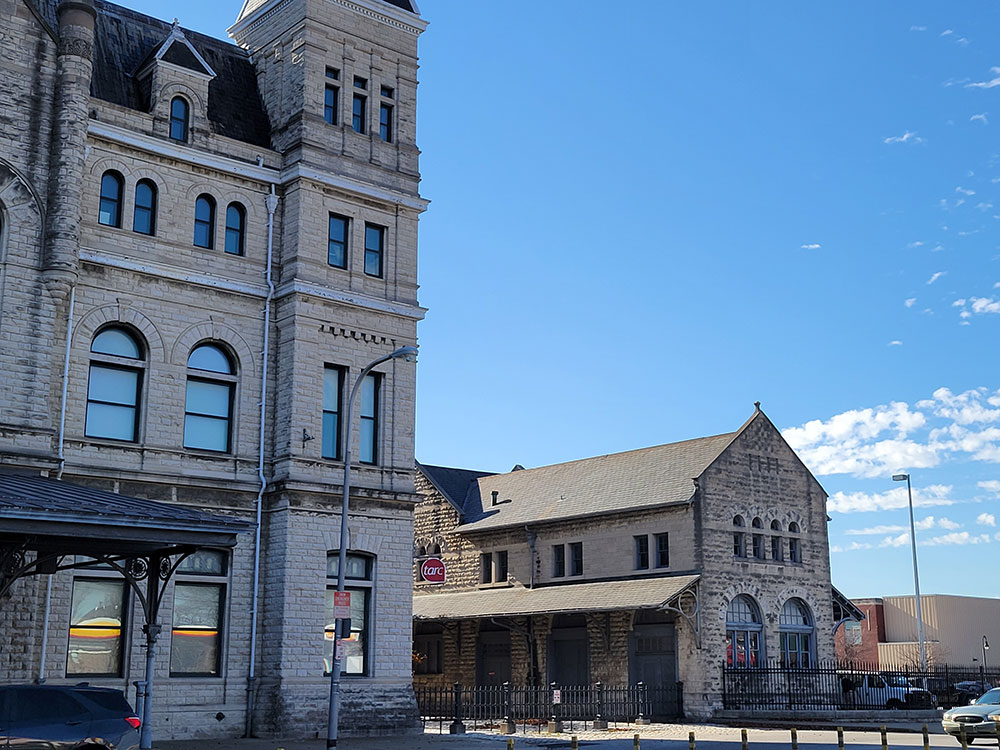
Historic railroad station reflecting Richardsonian Romanesque style of architecture.
General Information
- Hours:
- Not open to the public for regular tours; functions as the headquarters for the Transit Authority of River City (TARC)
- Fees:
- Not applicable; no public admission
- Pet Policy:
- No public access; pet policy not applicable
- Closest cities with hotels:
- Louisville, KY (0 mi)
- Seasons:
- Exterior viewable year-round; best in spring and fall for photography
- Location:
- 1000 W Broadway, Louisville, KY 40203
- Website:
- ridetarc.org
How to Get There
From Louisville, KY (0 mi): Head west on Broadway; Louisville Union Station is located at 1000 W Broadway and serves as the administrative offices for TARC.
Overview
The Union Station of Louisville is a historic railroad station that serves as offices for the Transit Authority of River City (TARC), as it has since mid-April 1980 after receiving a year-long restoration. It was one of at least five union stations in Kentucky, amongst others located in Lexington, Covington, Paducah and Owensboro. It was one of three stations serving Louisville, the others being Central Station and Southern Railway Station. It superseded previous, smaller, railroad depots located in Louisville, most notably one located at Tenth and Maple in 1868-1869, and another L&N station built in 1858. The station was formally opened on September 7, 1891 by the Louisville and Nashville Railroad.
Construction
Construction of the station began in 1880, but completion was delayed until 1889 due to rising costs. Local contractors constructed all but the clock tower. Architect Col Henry C. Wolters is credited with the design and supervision of the original structure. Architect F. W. Mowbray was specifically hired for the project, which was to reflect the Richardsonian Romanesque style of architecture. Its exterior was made of limestone ashlar, mostly from Bowling Green, Kentucky, although that from Bedford, Indiana was used for its trim. The roof was made of a slate covering protecting iron and heavy wood. Architectural features include a clock tower, smaller towers, turrets, a facade of considerable size, and barreled vaulting.
The interior was no less impressive. A wrought iron balcony overlooked the atrium. Soft lighting of the facility came from rose-colored windows on both sides of the atrium. The walls were made of marble from Georgia, as well as oak and southern pine. Ceramic tiles covered the floor.
History
Union Station opened in 1891 for the Louisville and Nashville Railroad and was one of the largest train stations in the South. Passenger service ended in 1976, and the Romanesque Revival building was restored as the headquarters of the Transit Authority of River City.
Things to Do
See the Stained Glass
The barrel-vaulted lobby has stained glass skylights.
Admire the Architecture
The stone station has towers and arched windows.
Take Photos
The building is a popular photo spot.
Explore Downtown
The station is near downtown attractions.
This article uses material from the Wikipedia article "Union Station (Louisville)" which is released under the Creative Commons Attribution-Share-Alike License 3.0