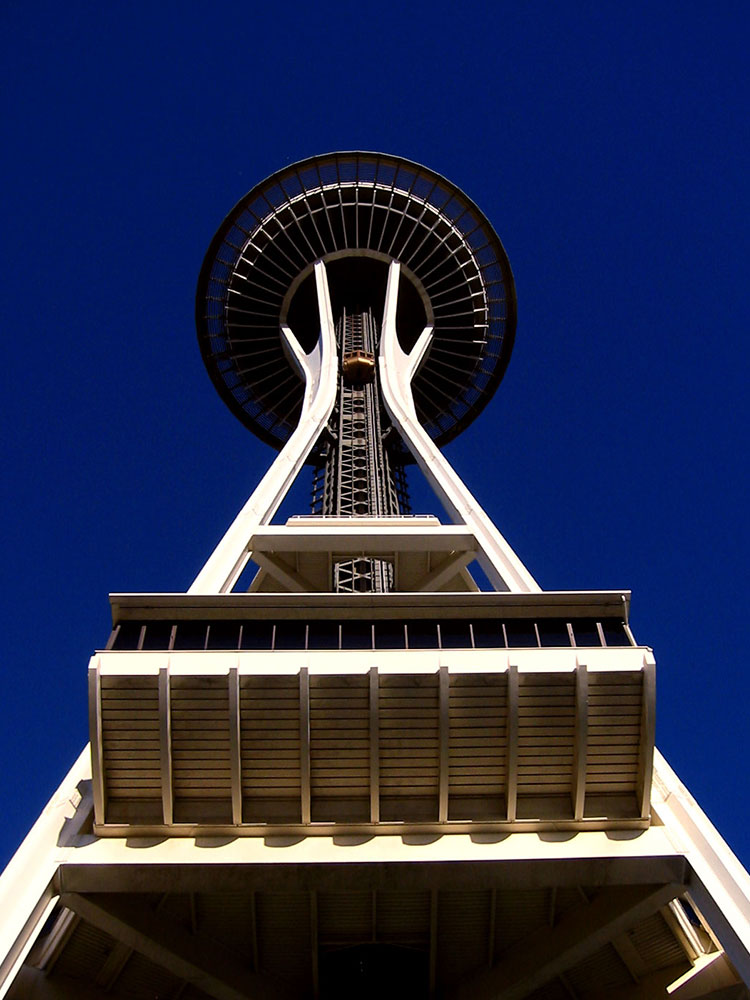
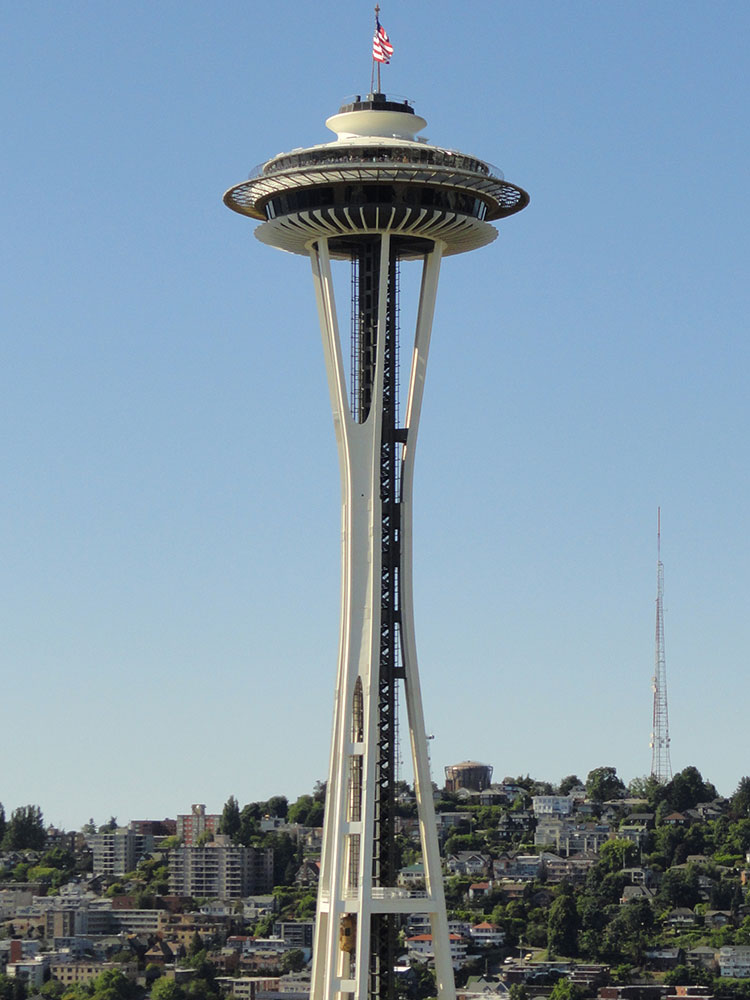
An icon of the city of Seattle and the Pacific Northwest, the 605 feet observation tower has been designated a Seattle landmark
General Information
Thursday: 9:00 AM to 10:00 PM
Friday: 8:30 AM to 11:00 PM
Saturday: 8:30 AM to 11:00 PM
Sunday: 8:30 AM to 10:30 PM
Monday: 9:00 AM to 10:00 PM
Tuesday: 9:00 AM to 10:00 PM
Youth (ages 5–12): Discounted admission available
Seniors (65+): Discounted admission available
How to Get There
From Seattle (2 mi): Head northwest through downtown Seattle toward Seattle Center, follow signs to Broad Street, then continue to 400 Broad St where the Space Needle is located within the Seattle Center campus.
The Space Needle, located in the Lower Queen Anne neighborhood, was built in the Seattle Center for the 1962 World's Fair. It was once the tallest structure west of the Mississippi River, standing at 605 ft (184 m). The tower is 138 ft (42 m) wide, weighs 9,550 short tons (8,660 metric tons), and is built to withstand winds of up to 200 mph (320 km/h) and earthquakes of up to 9.0 magnitude, as strong as the 1700 Cascadia earthquake. It also has 25 lightning rods.
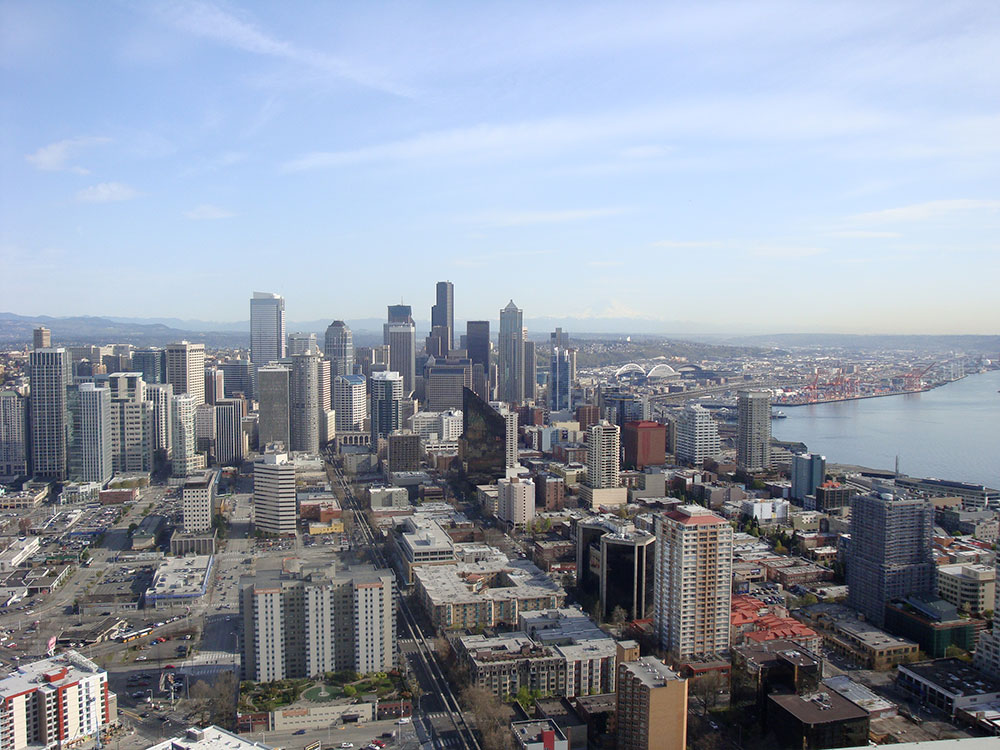
The Space Needle features an observation deck 520 ft (160 m) above ground, providing views of the downtown Seattle skyline, the Olympic and Cascade Mountains, Mount Rainier, Mount Baker, Elliott Bay, and various islands in Puget Sound. Visitors can reach the top of the Space Needle by elevators that travel at 10 mph (16 km/h), completing the ascent in 41 seconds (they are slowed to 5 mph (8.0 km/h) on windy days). On April 19, 1999, the city's Landmarks Preservation Board designated the tower a historic landmark.
The architecture of the Space Needle is the result of a compromise between the designs of two men, Edward E. Carlson and John Graham, Jr. The two leading ideas for the World Fair involved businessman Edward E. Carlson's sketch of a giant balloon tethered to the ground (the gently sloping base) and architect John Graham's concept of a flying saucer (the halo that houses the restaurant and observation deck). Victor Steinbrueck introduced the hourglass profile of the tower.
For decades, the hovering disk of the Space Needle was home to two restaurants 500 ft (150 m) above the ground: the Space Needle Restaurant, which was originally named Eye of the Needle, and Emerald Suite. These were closed in 2000 to make way for SkyCity, a larger restaurant that features Pacific Northwest cuisine. SkyCity rotates 360 degrees in exactly forty-seven minutes.
On December 31, 1999, the Legacy Light or Skybeam was unveiled for the first time. It is powered by lamps that total 85 million candela shining skyward from the top of the Space Needle to honor national holidays and special occasions in Seattle. The concept of this beam was derived from the official 1962 World's Fair poster, which depicted such a light source although none was incorporated into the original design. It is somewhat controversial because of the light pollution it creates. Originally planned to be turned on 75 nights per year, it has generally been used fewer than a dozen times per year. It did remain lit for eleven days in a row from September 11, 2001, to September 22, 2001, in response to the September 11, 2001 attacks.
A 1962 Seattle World's Fair poster showed a grand spiral entryway leading to the elevator that was ultimately omitted from final building plans. The stairway was eventually added as part of the Pavilion and Spacebase remodel in June 2000. The main stairwell has 848 steps from the basement to the top of the observation deck. At approximately 605 ft (184 m), the Space Needle was the tallest building west of the Mississippi River at the time it was built but is now dwarfed by other structures along the Seattle skyline, among them the Columbia Center, at 967 ft (295 m).
As a symbol of the Pacific Northwest, the Space Needle has made numerous appearances in films, TV shows, and other works of fiction. The Space Needle is often used to establish the setting is Seattle. Examples include the TV shows Frasier, Grey's Anatomy, Dark Angel, Bill Nye the Science Guy, and films It Happened at the World's Fair (1962) and The Parallax View (1974), Sleepless in Seattle (1993), and Chronicle (2012).
Guests visiting The Loupe Lounge are welcome to self-park in our turn-around loop at the base of the Space Needle, with limited self-parking available for other Guests. Valet parking at the Space Needle is temporarily closed. Guests must park their own vehicles, under the direction and guidance of Space Needle staff. Parking is available Thursday through Sunday from 1pm to 10pm $15.00 per hour For all other Guests, we recommend parking at the Seattle Center's 5th Avenue N. parking garage, located two blocks from the Space Needle The turn-around loop is also open for passenger loading and unloading.
This article uses material from the Wikipedia article "Space Needle", which is released under the Creative Commons Attribution-Share-Alike License 3.0