
National monument known for 13,944 acres (5,643 ha) of semi-desert shrublands, riparian zones, and colorful badlands and its well-preserved layers of fossil plants and mammals.
General Information
- Hours:
- Fees:
- Pet Policy:
- Closest cities with hotels:
- Seasons:
- Open all year though fully accessible for only four months during summer, owing to the very heavy winter snowfall
Overview
John Day Fossil Beds National Monument protects one of the most complete records of plant and animal life in the world, spanning about 50 million years of the Cenozoic Era in the high desert of central Oregon. The monument has three units, Sheep Rock, Painted Hills and Clarno, each with colorful hills, cliffs and fossil-rich rock. Fossils of ancient horses, saber-toothed cats, camels and rhinoceroses have been found here, and the Painted Hills are famous for their bands of red, gold and black. Established in 1974, the monument draws visitors who love geology, photography, paleontology and open, uncrowded landscapes.
Access
The three units are scattered across Wheeler and Grant counties in central and eastern Oregon, with the Painted Hills near Mitchell, the Sheep Rock Unit near Dayville and Kimberly, and the Clarno Unit near Fossil. The units are 30 to 70 miles apart, connected by US-26, OR-19 and OR-218. The closest cities are Bend and Prineville, about 2 hours away, and John Day, about 20 minutes from Sheep Rock. Most visitors travel by car, and services are sparse, so plan on gas, food and water.
Seasons
The monument is open year-round, with spring and fall offering the most pleasant temperatures. Summers are hot, dry and bright, and winter brings cold weather and occasional snow or ice that can affect roads. The Painted Hills are most vivid after rain or in the soft light of early morning and evening. The Thomas Condon Paleontology Center keeps daily hours in most seasons, but some trails and picnic areas close in bad weather. Spring wildflowers add color to the hills.
Things to Do
See the Painted Hills
The Painted Hills Unit is the monument's most famous, with rounded hills striped in red, orange, yellow and black. Short trails and overlooks make it easy to explore.
Visit the Thomas Condon Paleontology Center
This museum at the Sheep Rock Unit displays fossils, a working lab and exhibits explaining the monument's geology and ancient life. Visitors can watch scientists at work.
Hike Blue Basin
Blue Basin is a canyon of blue-green claystone, formed from ancient volcanic ash. A loop trail climbs into the bowl past fossil replicas.
Explore the Clarno Palisades
The Clarno Unit contains fossil plants from a subtropical forest that grew about 45 million years ago. Stone palisades and short trails offer views of the Clarno Formation.
Tour the Cant Ranch Historic District
The James Cant Ranch, near the visitor center, preserves ranch buildings from the early 1900s. A small museum describes pioneer ranching life.
Top Trails
Painted Hills Overlook Trail
Length: Approximately 0.5 miles round trip
Elevation Gain: Minimal
Difficulty: Easy
This short trail climbs to an overlook of the Painted Hills' colorful bands. It is easy and a good first stop.
Painted Cove Trail
Length: Approximately 0.25 miles loop
Elevation Gain: Minimal
Difficulty: Easy
A boardwalk and trail loop passes close to the red claystone hills. The walk shows the texture and color up close.
Blue Basin Overlook Trail
Length: Approximately 3.25 miles loop
Elevation Gain: Approximately 600 feet
Difficulty: Moderate
This longer loop climbs the rim of the blue-green canyon for views, then returns through the bowl. It is exposed, so start early in summer.
Island in Time Trail
Length: Approximately 1.3 miles round trip
Elevation Gain: Minimal
Difficulty: Easy
A trail through Blue Basin's canyon passes replica fossils set where they were found. It is an interesting walk for families.
Visitor Centers
The Thomas Condon Paleontology Center, at the Sheep Rock Unit, is the main visitor center and is typically open daily with seasonal variations. It has exhibits, a film, a research lab, a bookstore and rangers who provide maps and advice. The Painted Hills and Clarno units have restrooms and picnic areas but no staffed visitor centers. Check the National Park Service website for hours and conditions.
Camping and Lodging
There is no camping or lodging within the monument, but nearby campgrounds include Service Creek and Clarno on the river, and the Ochoco and Malheur national forests. Mitchell has a small hotel and campground near the Painted Hills, Dayville has cabins and small inns, and John Day, about 20 minutes from Sheep Rock, has chain hotels and motels. Prineville and Madras, about an hour and a half away, offer more lodging, and Bend, about 2 hours away, has a full range of hotels and resorts. Check each property's website for current availability.
This article uses material from the Wikipedia article and official pages for John Day Fossil Beds National Monument, National Park Service: John Day Fossil Beds National Monument, released under the Creative Commons Attribution-Share-Alike License 3.0.
Featured Locations
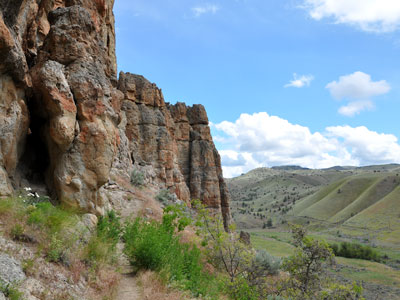
Finetooth, CC BY-SA 3.0, via Wikimedia Commons; Image Size Adjusted

Clarno
Unit featuring The Palisades, volcanic lahars, or mudflows, that formed 54-40 million years ago in a lush semi-tropical rainforest environment
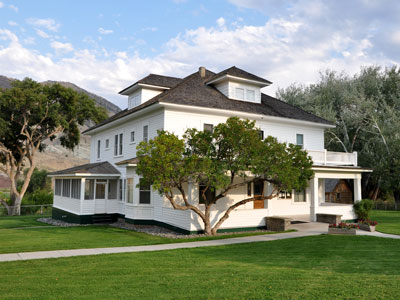
Finetooth, CC BY-SA 3.0, via Wikimedia Commons; Image Size Adjusted

James Cant Ranch Historic District
Pioneer ranch complex in eastern Oregon preserved as an interpretive site showing visitors an early 20th-century livestock ranch
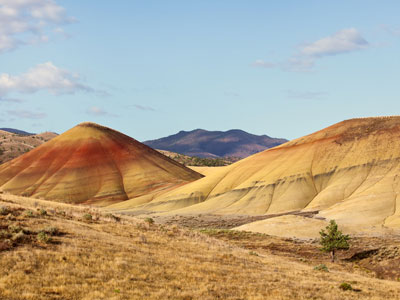
Photography by User: MrX, CC BY-SA 3.0, via Wikimedia Commons; Image Size Adjusted
Painted Hills
Geologic site named for the colorful layers of its hills corresponding to various geological eras, formed when the area was an ancient river floodplain
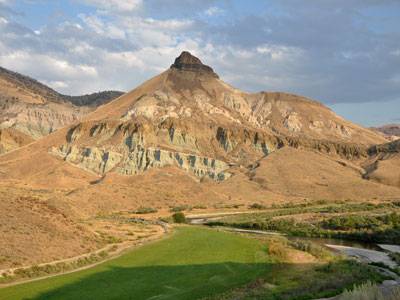
Finetooth, CC BY-SA 3.0, via Wikimedia Commons; Image Size Adjusted

Sheep Rock
Colorful geologic formation of layered volcanic ash and fossils rising above a scenic river valley, showcasing striking natural history and unique high desert landscapes.